


Through comparative trials, publications, field days, training programs, and seed conferences, the section conducts many extension and outreach activities that provide reliable advice about crop varieties that perform best in New York and the Northeast. Faculty members use experience, technology, and innovation to interact with industry and growers' groups in New York State, the nation, and the world.
- Faculty involved in breeding specific crops are found on the SIPS Research by Crop page
- Additional resources are listed on the Plant Breeding & Genetics Research page
Crop Variety Testing
Faculty in Plant Breeding & Genetics conduct variety trials for a wide variety of crops including grains, forages, fruit, vegetables,industrial hemp and more. See below for more information on our breeding programs.
Resources
Vegetables
Vegetable breeders in the the Plant Breeding & Genetics section breed new and commercially appealing vegetables, research the genetics of important traits and develop new lines appropriate for regional growing conditions.
More information:
- Mazourek Lab (cucurbits, peppers, peas)
- DeJong Lab (potatoes)
- Griffiths Lab (Horticulture Section: brassicas, beans, tomatoes)
- Greg Vogel (tomatoes, eggplant)
- Vegetable Breeding Institute
Fruit
Whether apples, grapes or berries, our researchers use the latest tools in genetics and selection to develop nutritious, appealing fruit varieties, adapted to local growing conditions and meeting the needs of the fresh and processing markets.
More information:
- Oravec Lab (grapes)
- Weber Lab (berries)
- Brown Lab (apples)
(These fruit breeders are based in the Horticulture Section.)
Grains
Our researchers use advanced genetics tools for complex trait analysis and development of new varieties of small grains with enhanced nutritional content and other traits of interest for product developers. (Corn grain and soybean breeding programs are currently inactive.)
More information:
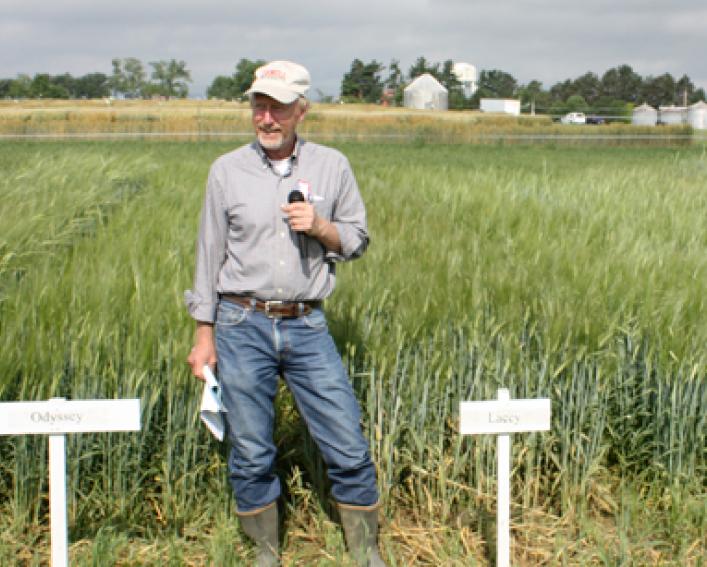
- Small grain trials (wheat, oats, barley, triticale)
- Corn Grain
- Soybeans
Industrial hemp, forage and bioenergy crops
Industrial hemp, forage crops, and plants used for biofuels represent important areas of research. They are the basis of emerging industries and in the case of forages, support New York state's dairy production.
- Cornell Hemp
- Willowpedia (willow bioenergy crops)
- Cornell Hops
- Forage trials
- Cover Crop Breeding Network
Ornamentals
Ornamental plant breeding introduces disease resistance, enhances winter hardiness and addresses consumer demand for new and interesting products. Much of Cornell's ornamental breeding is conducted at the Long Island Horticultural Research and Extension Center in Riverhead New York.
More information:
The Vegetable Breeding Institute (VBI) includes faculty at Cornell University and the University of Wisconsin-Madison who are conducting basic and applied vegetable breeding research, as well as domestic and international members in the vegetable seed industry who actively support VBI research. Learn more.
Cucurbits and Peppers
- New York is the nation's 4th largest squash producer and 7th largest cucumber producer.
- Annual crop value: squash - $37M; cucumber - $18.5M.
The cucurbit and pepper breeding program breeds new varieties and evaluates several winter and summer squash, cucumber, melon, and pepper lines for release or pre-release based on yield, quality, novelty, and disease resistance. All variety testing is conducted at a single field site in Freeville, NY.
For more information, contact: Michael Mazourek
Tomatoes and Eggplant
Focus on enhanced disease resistance, including Verticillium wilt resistance in eggplant, early blight and Septoria leaf spot resistance in tomato, and the characterization and introgression of "heirloom" quality traits into modern tomato varieties.
For more information, contact: Greg Vogel
Potatoes
- NYS ranks 11th in potato production in the country.
- Annual crop value: $61 million.
- NYS potatoes are grown for both the chipping industry and fresh market sales.
The potato breeding program breeds and evaluates adapted potato lines in six field locations for release or pre-release based on yield, quality, novelty, and golden nematode resistance.
For more information, contact: Walter De Jong
The New York Seed Improvement Project (NYSIP) operates within Cornell's Plant Breeding extension program and consists of two divisions:
- The Foundation Division amplifies and disseminates foundation seed stocks developed by Cornell breeders.
- The Certification Division validates the identity, health and consistency of seed to enable seed growers and companies to market, promote and sell seed that is genetically pure.
The Field Crops website is for corn, forage, small grain, and soybean producers. Provides comprehensive information on each crop along with recommendations, a newsletter and more.
See also: Cornell Field Crop Variety Trials
Our forage breeding efforts are lead by assistant professor Virginia Moore. Moore's program focuses on breeding for organic systems, for intercropping and polyculture systems, for pest resistance, and for ecosystem services. The program works on a range of species, including perennial forages, cover crops, dry beans, and hemp.
More information:
Edward S. Buckler's Maize Genetics and Diversity Lab
The Buckler lab utilizes functional genomic approaches to dissect complex traits in plants, specifically maize and Arabidopsis. Researchers exploit the natural diversity of these plant genomes to identify the individual nucleotides responsible for quantitative variation. Current research is focused on developing tools and resources for complex trait dissection, such as drought tolerance and nitrogen use.
USDA programs
Two genetics units are based on the Cornell AgriTech campus in Geneva, N.Y.:
- Plant Genetic Resources Unit (PGRU) - Collections of apples, apple rootstocks, grapes, tart cherries, vegetable seed crops (tomato, squash, onion, tomatillo, etc.), hemp and more.
- Grape Genetics Research Unit (GGRU)