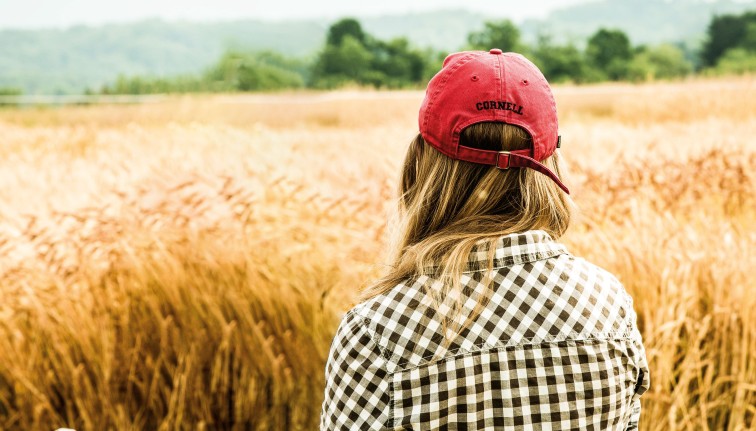
The School of Integrative Plant Science is the largest academic unit in Cornell's College of Agriculture and Life Sciences. It is composed of five sections with interrelated activities in the plant sciences: Horticulture, Plant Biology, Plant Breeding and Genetics, Plant Pathology and Plant-Microbe Biology, and Soil and Crop Sciences.

Degree programs

students at dilmun hill student farm
Undergraduate

The Cornell CALS plant sciences major prepares students for careers or further study in fundamental biology, plant breeding, pest and disease management and production of plants for food, fiber and ornamental uses.

students looking at rice plants
Graduate - M.S./Ph.D.

Graduate study in SIPS is organized into five graduate fields. Collectively these fields provide unparalleled opportunities to connect disciplines, creatively solve problems and integrate complex systems. Includes graduate fields of Horticulture, Plant Biology, Plant Breeding, Plant Pathology and Plant-Microbe Biology, and Soil and Crop Sciences.

people driving a hemp harvester in the field
Graduate - Integrative Plant Science MPS

The Master of Professional Studies (MPS) degree in Integrative Plant Science is a one-year, course-based master's degree, ideal for individuals who are interested in in-depth study of the issues and advancements in plant and soil sciences.

Continuing education

Our school is committed to lifelong learning, offering a wide range of programming and skill building for children and adults alike. See featured education programs to take advantage of these opportunities, including online courses and seminar, garden tours and more.

News from the School of Integrative Plant Science

Learn about the many ways we are addressing some of the world's most urgent challenges.

Senior graduates of the Class of 2024

News

  • Agriculture Sciences Major
  • School of Integrative Plant Science
  • Horticulture Section
Warren Hall and the Ag Quad.

News

The Graduate Diversity and Inclusion Awards recognized members of the graduate community for their accomplishments, leadership and commitments to advancing efforts around diversity, inclusion, outreach and student engagement.

  • Charles H. Dyson School of Applied Economics and Management
  • Ecology and Evolutionary Biology
  • Microbiology
Christine Smart works in a rhubarb research field

News

A little sour, a little sweet, a tiny bit vegetal: New rhubarb cultivars could be a significant boon to the state’s wines, beers, distilled spirits and hard ciders.

  • Cornell AgriTech
  • Cornell Craft Beverage Institute
  • Food Science
A group of students take a photo in front of the Ezra Cornell statue on the Arts Quad.

News

With the end of another academic year in sight, we’d like to recognize the CALS class of 2024.
  • Cornell AgriTech
  • Animal Science
  • Department of Communication

Land Acknowledgment

Cornell University is located on the traditional homelands of the Gayogo̱hó:nǫɁ (the Cayuga Nation). The Gayogo̱hó:nǫɁ are members of the Haudenosaunee Confederacy, an alliance of six sovereign Nations with a historic and contemporary presence on this land. The Confederacy precedes the establishment of Cornell University, New York state, and the United States of America. We acknowledge the painful history of Gayogo̱hó:nǫɁ dispossession, and honor the ongoing connection of Gayogo̱hó:nǫɁ people, past and present, to these lands and waters.

This land acknowledgment has been reviewed and approved by the traditional Gayogo̱hó:nǫɁ leadership. Learn more from the American Indian and Indigenous Studies Program website.