Agricultural Sciences Director's Report
“I am very fortunate to work in a field where every day there is a new challenge.”
Dear Agricultural Sciences Alumni, Students, Staff, and Faculty:
It is my great honor to serve as the 2nd Richard C. Call Director of the Agricultural Sciences major housed in the Nationally ranked School of Integrative Plant Science here in the College of Agriculture and Life Sciences on the campus of Cornell University in Ithaca, NY.
Having been passionately involved in advancing our changing urban landscape sustainably for decades through my work in turfgrass science, I was excited to assume the Director’s role upon the new administrative responsibilities of our founding Director Antonio DiTommaso. The major is a pillar of Cornell’s dedication to agriculture and the Land-Grant mission of securing a future for our food system. I believe Cornell’s legacy of groundbreaking contributions to agriculture is just the beginning, and I am eager to share our plans to enhance student experiences and further expand our impact on the agricultural sciences.
So many dedicated hands have nurtured this major into what it is today, and we remain in awe of all they accomplished and paved the way for. Antonio DiTommaso, the first Director for the major, fought for an agriculture major that integrated all major sciences with the breadth students needed, and it is because of him that we are able to celebrate the major’s top-ranked status. Kari Richards signed on to be the coordinator for the major, and became the heart of it for the students, faculty, and alumni. Their influence is felt in every step forward we take now.
This Director’s Report, our first, represents the beginning of a concerted effort to spread awareness of our major and further students’ interest in agriculture. As the #1 Agricultural Sciences major in the country, we look forward to doing more in the coming years to set an example and raise the bar in student experience and opportunity. We are excited to share with you, in this report and more to come, all that we have accomplished and celebrated recently, and all that we have planned for our growing future.
Yours for a growing world,
Frank S. Rossi, Ph.D.
The Richard C. Call Director of
The Agricultural Sciences Major
We are a community with an uncommon sense of a common goal: to leave the world better than we found it.
Cornell University’s College of Agriculture and Life Sciences has been exploring breakthrough solutions for people and the planet for over a century and will be doing so for a century more. Through purpose-driven science, we tackle the challenges of our time, advancing understanding and improving life.
Founded in agriculture and focused on life, we are pioneers who have shaped contemporary science, have eagerly embraced international opportunity, and are dedicated to enabling the next generation to continue this legacy through contemporary approaches to education and experiential learning. It’s no wonder The Wall Street Journal/Times Higher Education consistently ranks CALS #1 in agriculture, agriculture operations, and related sciences. The Agricultural Sciences major is a significant contributor to that ranking, with its own #1 ranking as the top Ag Sciences Major in the US.
We are a community driven by a unique sense of purpose, allowing us to drive change both in and out of the field. We drive progress through application, to better our world. With the aid of a vast and varied network, Cornell CALS tackles big challenges in an increasingly small and hyper-connected world, driving meaningful change and drawing in local to global communities to be a part of this mission.
The “solutions century” has begun, and how we embrace it will profoundly impact the future of our societies. Supporting the global food system and the management of plant and animal based systems, we influence production, processing, and distribution of our food and fiber, and have a profound impact on the world. Whether you’re involved in agriculture education, research, policy, or business, our community would not be what it is today without you.
Since the founding of Cornell University on April 27, 1865, it was one of the early adopters and significant contributors to the Land Grant system. Figuratively, Cornell was built on Ezra Cornell’s vision and literally on his donated farmland to fulfill the Land-Grant mission for NY State of advancing agricultural and mechanical arts, economic development, and public service.
As innovation in agriculture grew in the late 1800s, studies in agriculture were merged with the sciences—chemistry, botany, entomology, and veterinary medicine—to advance study in the field and form what eventually became the College of Agriculture and Life Sciences. The college has a long history of working hand-in-hand with producers, processors, distributors, and investors to make American agriculture the most productive in the world, greatly contributing to the nation’s rise as a developed economy. Over time, agricultural sciences evolved into distinct specialties, until the re-imagining of the Agricultural Sciences major in 2006.
Progress to establish the Agricultural Sciences major began in 2002, when the university realized that students with a general interest in agriculture application were not able to get the breadth of education needed from the numerous specialized majors offered. Agricultural Sciences came into being to provide this breadth and renew the university’s influence on innovation in food and agriculture, and has grown to impact countless lives and livelihoods thanks to its dedication to an interdisciplinary education with specialized concentrations and research opportunities, fully integrated into the modern food system.
Cornell has long had roots in agriculture, but it wasn’t until one Cornell donor took a serious interest that the newly reestablished Agricultural Sciences major truly took off. Richard C. Call, a member of one of New York’s most prominent farm families, contributed $1 million to establish the “Richard C. Call Directorship of Agricultural Sciences” in 2010. The gift was, and continues to be, used to improve and grow staffing, student internships, curriculum, and programs. The impact it has made has enabled the major to grow and flourish to provide students with the opportunities, support, and skills it does today.
Known as “Dick” to friends and colleagues, Mr. Call was one of more than 30 members of his extended family to graduate from Cornell. The Call family farm, My-T Acres, was established in 1922 and is one of the largest and most successful farms operating in New York still today. My-T Acres was named “Business of the Year” by the Ag Society in 2012. The farm was praised for its efforts to improve its land, implement technology, serve its customers, reward employees, and give back to the community. The farm traces its local roots back to 1854 when Robert Call arrived in Stafford from England with $10 in his pocket. The Call family continues to work that Stafford land to this day.
Mr. Call served many agricultural organizations in leadership roles. He has been a director and/or officer for Agway Cooperative, Telmark Leasing, H.P. Hood Milk Cooperative, Upstate Milk Cooperative, O-AT-KA Milk Products Cooperative, NYS Dairy Herd Improvement Association, Eastern A.I. Cooperative, Pro-Fac Cooperative and Western Farm Credit Association. In 2008, he received the Distinguished Service Citation, the highest honor bestowed by the New York State Agricultural Society. He served on the Cornell University Board of Trustees from 1993 to 2001 and was elected Trustee Emeritus in 2001. In 1985, he was recognized with the CALS Outstanding Alumni Award.
Mr. Call passed away in 2014, but his impact and influence continues to be felt at Cornell, in the Agricultural Sciences major and in the world through the effect of its students. We honor and remember him and the momentum his gift has made possible.
“Dick Call was a remarkable human being. His abiding commitment to fostering the well-being and prosperity of his friends, colleagues, employees, and neighbors earned him the respect and admiration of the state’s entire agriculture community. His love of Cornell, his commitment to service and his passion for supporting educational opportunities in CALS for the next generation of New York farmers will be deeply missed.”
Kathryn Boor
Former Ronald P. Lynch Dean of The Collage of Agriculture and Life Sciences
A Degree Apart
Cornell sets the standard for undergraduate education in agriculture. Our Agricultural Sciences major is a leader in the Northeast and across the nation, offering advanced coursework that prepares students to lead farms in New York and beyond, enter agriculture for the first time, or pursue a wide range of careers stemming from a Cornell education.
Cornell’s Agricultural Sciences community is close-knit and highly regarded. Students gain unparalleled access to world-class faculty, research opportunities, and global networks, engaging in meaningful work and leaving Ithaca with more than just a degree.
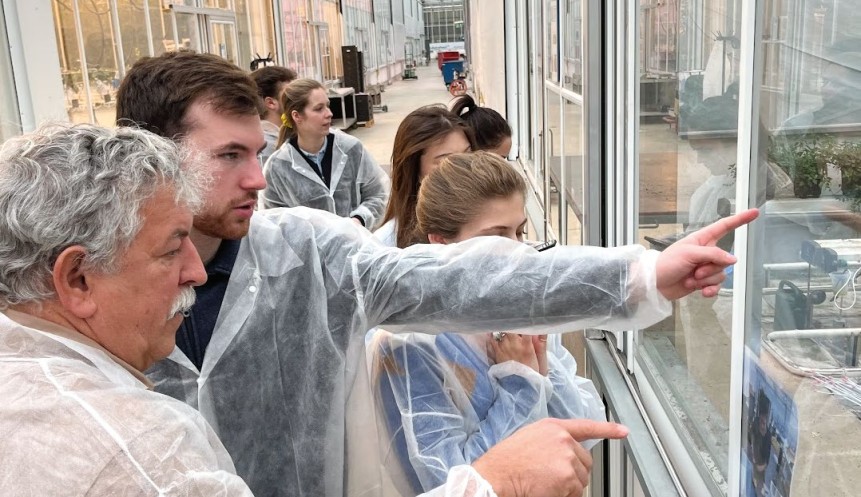
Jake Zajkowski ’26 explores greenhouse technology with Prof. Marvin Pritts in the Netherlands.
By the Numbers
#1 in National Ranking
Cornell University is consistently ranked in the top five universities for Agricultural Sciences in U.S. News & World Report, Times Higher Education, and The Wall Street Journal.
100 Students
Our student success is derived from our family-like culture, engaging students throughout their time here in various professional development opportunities.
20 Faculty
Accessible and engaged faculty advisors are the foundation of the major. These faculty instruct, advise, coach, encourage, and open their expertise and network up to our students.
50% New Yorkers
The Land-Grant mission is alive and well at Cornell, with more than 50% of students coming directly from our New York citizenry.
20 States
Cornell University attracts the best students in agriculture across the U.S., currently representing 20 states.
70 Countries
Cornell’s agricultural reach is evident in the many international students that have enrolled in the major from across 70 countries.
Alumni, A Growing Force
Agricultural Sciences alumni forge new paths, push the boundaries of tradition, and explore new ways to grow. Involved in business, farming, food, research, and more, our alumni have an expansive impact. It is thanks to them that innovation continues in our food systems today.

320 Alumni and Counting
Cornell Agricultural Sciences students come from all over the world but connect with one shared passion—the desire to improve agriculture to support a growing population. Supporting the food system is at the heart of what our alumni do, whether they are managing safe packaging, innovating farming practices, or teaching the next generation about agriculture.
Where Our Alumni Work
Many of our alumni have gone on to start their own business, lead the family farm into a new era, inform US agricultural policy, support farmers’ mental health, and more. It is this variety of perspective and opportunity that continues to enable our graduates to impact our food systems at every level.

Alumni Spotlight
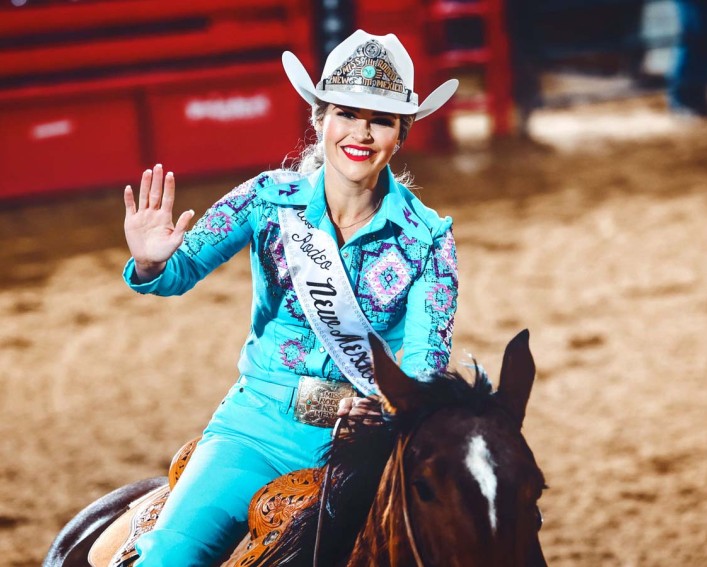
Recent Grad Saddles Up as 2024’s Miss Rodeo America
An avid horsewoman, Emma Cameron ’22, BS ’21, realized a lifelong dream by winning the coveted Western crown.