


Agricultural Sciences Director's Report: Our Impact
Global Impact: Making a Difference in Food
Our graduates are leading in areas such as crop production and chemical, seed, and fertilizer industries, as well as in business, government, and research organizations worldwide. It is clear that our graduates are reshaping how food is produced, distributed, and consumed, ensuring that future generations inherit a more resilient, equitable, and sustainable food system.
How Our Alumni are Transforming the Global Food System
65%
of alumni leaders are implementing climate smart, sustainable production systems.
71%
are involved in work that actively supports small farms.
65%
are actively improving food security locally, regionally, nationally, or internationally.
“Agricultural science impacts every citizen worldwide through contributing to available and safe food production. This major is very diverse, and former graduates have directly contributed to policy change, science, and research, food safety, food and beverage operations, and run both large- and small-scale operations.”
Sarah Gruntmeir ’19
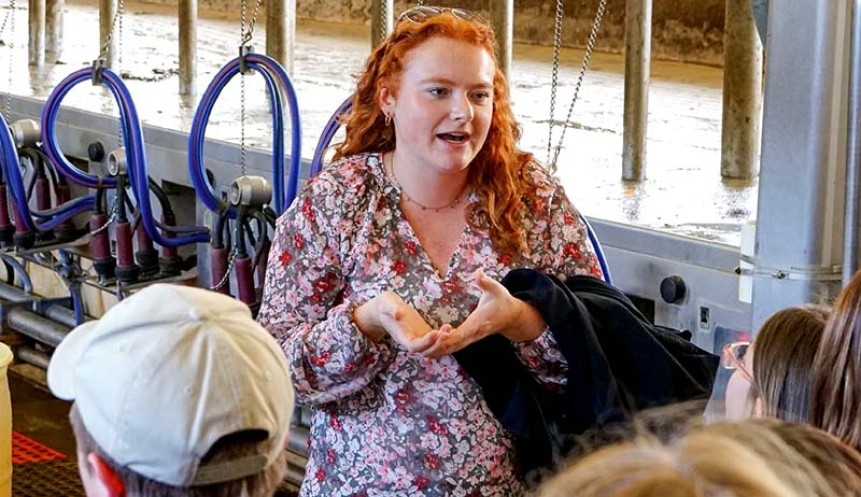
Jade Atheron '24 leads a tour of the Cornell dairy farm. After graduating with a minor in education, Jade now teaches high school agricultural education in Tully, NY.
“My role requires me to handle everything from people management to finance and marketing and have a foundation to be competent in front of my peers and farm customers. Ag Sci has allowed me to combine my personal strengths with a broad base of scientific foundation from various areas of the agricultural industry.”
Ryan Amberg '13
University Impact: Expanding Education
The Agricultural Sciences major at Cornell remains grounded in Science, Technology, Engineering, and Mathematics (STEM), ready to grow into new opportunities available in soil health and crop production, using digital tools that add precision and reduce environmental impact. Broadly, we are addressing emerging business and policy areas with a strong emphasis on the unique aspects of agricultural production.
Experiential learning continues to shine as a hallmark of the major. Field-based courses, internships, and local, regional, national, and international learning trips to agricultural operations immerse students in hands-on experiences, bridging classroom knowledge with industry practice. Undergraduates collaborate with faculty on impactful research, addressing precision agriculture, sustainable crops, animal business operations, and economic policy, attending guest lectures and workshops that inspire learning and leadership. The Agricultural Sciences major fully embraces an unwavering commitment to preparing students to drive meaningful change in agriculture and beyond.
“For more than 150 years, Cornell CALS has been focused on developing the next generation of leaders in agriculture. It’s exciting to celebrate the growth of agricultural sciences education throughout our state’s rural and urban communities, expanding knowledge and skills in young people who will translate this knowledge into future action for the benefit of all New Yorkers.”
Benjamin Z. Houlton
Cornell's College of Agriculture and Life Sciences Ronald P. Lynch Dean
Digital Agriculture Minor
This new minor at Cornell partners with the Cornell Institute for Digital Agriculture (CIDA) to provide students with new perspectives on the future of agriculture. Through a combination of education, field experience, and research, students gain skills in modern technologies, computer science, data ethics, and a food system of their choice.
Mentorship Program
To help students integrate with others in the major and provide a network for success after graduation, freshmen in Agricultural Sciences are paired with upperclassmen mentors. These mentors support class enrollment and college life adjustment and help connect students to opportunities on and off campus.
Food and Agriculture Business Minor
Together with the SC Johnson College of Business, this opportunity prepares students for the leadership and economic understanding and skills needed to run an agriculture business. Specializations further allow them to experience their area of interest, from food marketing to supply chain strategy to food justice.