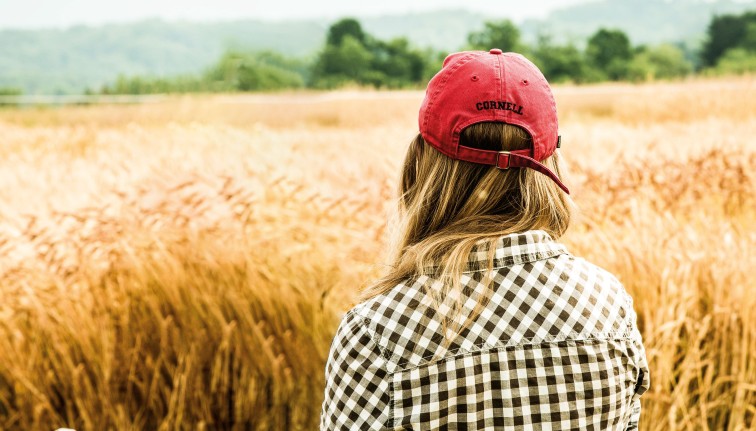
Continuing education

Our school is committed to lifelong learning, offering a wide range of programming and skill building for children and adults alike. See featured education programs to take advantage of these opportunities, including online courses and seminar, garden tours and more.

News from the School of Integrative Plant Science

Learn about the many ways we are addressing some of the world's most urgent challenges.

Microarthropod mites from three different taxonomic families. Photo by Hayden Bock.

News

The assortment of species of tiny soil animals – small enough to stand on the head of a pin – differ from one urban park to another, unlike plants and larger animals where a few species are often found across many parks.

  • Cornell AgriTech
  • Cornell Atkinson
  • Department of Entomology
Artificial satellite in space.

News

A novel method for estimating the rate of photosynthesis from land plants reveals that satellite observations underestimate this important metric.

  • School of Integrative Plant Science
  • Soil and Crop Sciences Section
  • Climate Change
Riesling grapes in mid-harvest along Keuka Lake in what looks to be an excellent year for New York state wineries.

News

In a wetter, hotter, more turbulent weather world, New York state wineries will endure new hardship, but they may be better off than most.

  • Cornell AgriTech
  • Department of Entomology
  • School of Integrative Plant Science
Researchers at a computer

News

  • Computational Biology
  • School of Integrative Plant Science
  • Plant Breeding and Genetics Section

Land Acknowledgment

Cornell University is located on the traditional homelands of the Gayogo̱hó:nǫɁ (the Cayuga Nation). The Gayogo̱hó:nǫɁ are members of the Haudenosaunee Confederacy, an alliance of six sovereign Nations with a historic and contemporary presence on this land. The Confederacy precedes the establishment of Cornell University, New York state, and the United States of America. We acknowledge the painful history of Gayogo̱hó:nǫɁ dispossession, and honor the ongoing connection of Gayogo̱hó:nǫɁ people, past and present, to these lands and waters.

This land acknowledgment has been reviewed and approved by the traditional Gayogo̱hó:nǫɁ leadership. Learn more from the American Indian and Indigenous Studies Program website.