Back

Discover CALS

See how our current work and research is bringing new thinking and new solutions to some of today's biggest challenges.

Search for News & Stories
Report

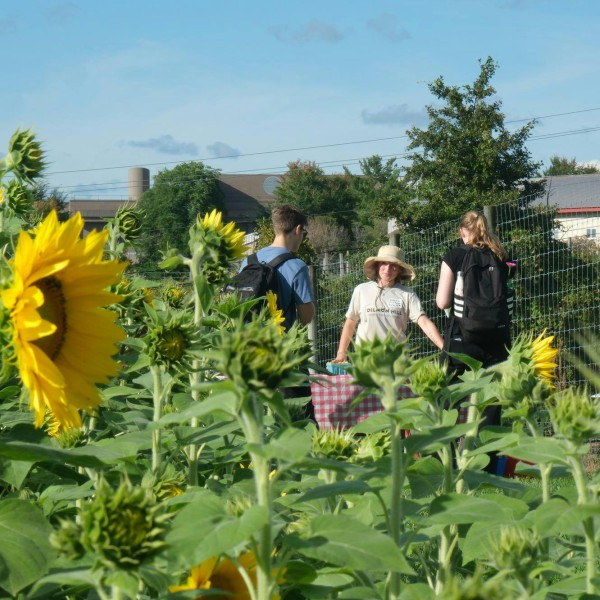
Relevance Urban agriculture plays an increasingly important role in New York State’s food system, particularly in New York City where growers operate on limited land and serve diverse markets. Producers must identify crop varieties that perform...

  • Cornell Cooperative Extension
Mark Sorrells in front of small grains field

Spotlight

For 12,000 years, wheat has been the bread of life; its discovery sparked the beginnings of agriculture, which enabled human flourishing across the globe. For farmers in New York’s humid climate, growing small grains like wheat, oats, barley and...
  • Campus Area Farms
  • Cornell University Agricultural Experiment Station
  • School of Integrative Plant Science
A large green tractor with a manure spreader stands in a green field, surrounded by rolling hills and a partly cloudy sky.

Report

Relevance Farmers across New York face rising input costs, labor shortages, and increasing environmental regulations that affect profitability. Small, dispersed fields and limited access to custom services can slow adoption of cost-saving...
  • Cornell Cooperative Extension
A team of Cornell students work on a prototype of their weed-killing robot

News

A team of Cornell students bested the competition with their invention: an autonomous robot that kills weeds with electricity.

  • Agriculture Sciences Major
  • Biological and Environmental Engineering
  • Agriculture
Dairy cow in a field

News

Heat stress on dairy cows not only decreases the amount of milk produced but also the fat and protein content, doubling the economic losses.

  • Charles H. Dyson School of Applied Economics and Management
  • Animals
  • Climate Change
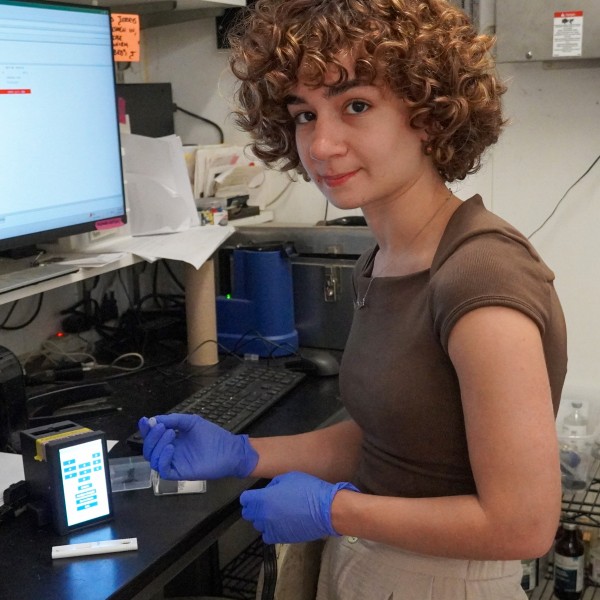
Two people work with scientific equipment on a desk.

News

On-farm research is a valuable tool for New York farmers. It happens in real-time on farm fields that are actively being cropped, producing practical results that can be applied in future growing seasons. It fosters two-way learning among...
  • Animal Science
  • Agriculture
  • Crops
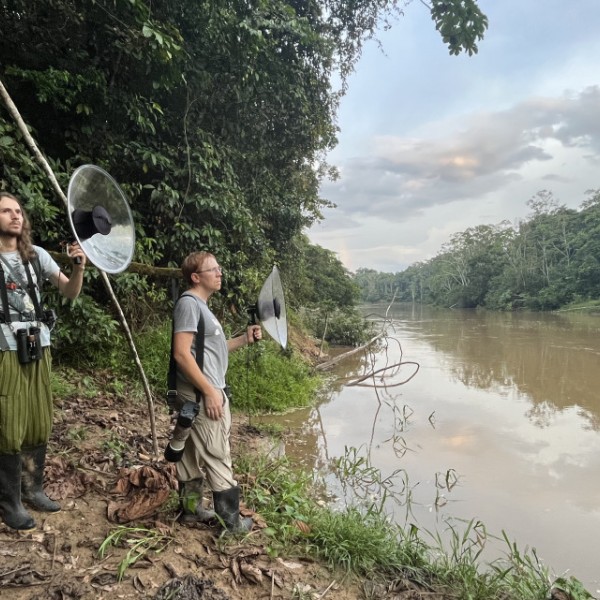
Cornell doctoral student Isabella Marie Errigo and Indigenous partners collect eDNA samples from a remote river in the Ecuadorian Amazon, helping communities assess aquatic biodiversity and ecosystem health across a range of environmental conditions.

News

A Cornell graduate student and indigenous Ecuadorian partners are sampling eDNA in Amazonian riverways to understand how gold mining and other human disturbances impact aquatic biodiversity and ecosystem health.

  • Cornell Atkinson
  • Ashley School of Global Development and the Environment
  • Biodiversity
Drone in apple orchard

News

Thirteen Cornell students will spend the summer advancing new technologies for agriculture after receiving 2026 Research Innovation Fund awards from the Cornell Institute for Digital Agriculture.

Students at the Center for Research on Programmable Plant Systems

News

Students from Buffalo's McKinley High School — home to one of the few high-school horticulture programs in New York state — visited Cornell May 19 to view the work of the Center for Research on Programmable Plant Systems (CROPPS).

  • Cornell University Agricultural Experiment Station
  • Plants
Lirong Xiang/Provided Cornell researchers stand with an autonomous biosecurity system in a tomato greenhouse. With support from a 2026 Academic Venture Fund, they will develop robotic and diagnostic technologies to improve early detection of plant diseases and strengthen climate-resilient greenhouse agriculture.

News

Cornell Atkinson has awarded $900k to support six new research projects that seek to protect coral reefs, improve greenhouse agriculture and understand whether wildfires affect disease spread.

  • Cornell Atkinson
  • Ashley School of Global Development and the Environment
  • Biological and Environmental Engineering

Field Note

Kaitlin is on a mission to make melon growing more sustainable. Growing a melon is not as simple as planting a seed and waiting for a sweet summer harvest. From tiny seedlings to the fruit on your picnic table, melons face nonstop pressure from...

  • Cornell AgriTech
  • School of Integrative Plant Science
The tops of corn in a field.

Field Note

In fall 2025, Matthew Haycook joined Cornell University’s Master of Professional Studies Program, with Quirine Ketterings of the Nutrient Management Spear Program (NMSP) as his main academic advisor. Growing up, Haycook was deeply integrated...
  • Animal Science
  • Agriculture
  • Field Crops
image of patrick webb

News

Patrick Webb, a globally influential scholar of nutrition, food and agriculture policy, and humanitarian assistance, will join Cornell July 1 as the inaugural executive director of the Ashley School of Global Development and the Environment in...
  • Ashley School of Global Development and the Environment
  • Global Development Section
  • Natural Resources and the Environment Section
Brian Aukema. with Alexa Maile and Vicki G at the 2025 NY State Fair

News

Raised on a small dairy farm near Binghamton, Brian Aukema’s path to Cornell was paved by 4-H and a seventh-grade spark that never dimmed. Today, as the New York State 4-H Livestock and Companion Animal Specialist, Aukema builds hands-on...
  • Cornell Cooperative Extension
  • Animal Science
Illustration of different people purchasing produce on a mobile phone

News

Grocery shopping online could help SNAP families access healthy foods, especially for those with young children or long commutes to grocery stores.

  • Communication
  • Food
  • Health + Nutrition
Yuqing Chen, a doctoral student and the study’s first author, searches for and counts baby oysters attached to shells in trays in Yonkers, New York.

News

A new study offers genetic evidence and proof that farmed eastern oysters are adding to and breeding with wild eastern oyster populations in the western and central Long Island Sound.

  • Ashley School of Global Development and the Environment
  • Natural Resources and the Environment Section
  • Biodiversity
A person stands before a group, infront of a raised garden bed, with green houses in the background.

Report

Relevance Many New York State residents want to grow their own food but face barriers, including limited gardening knowledge, a need for hands-on training, and disconnection from local resources and support. The Seed to Supper program is carried...
  • Cornell Cooperative Extension
Luke Stevens ’29

Spotlight

Major: Food science Hometown: Glens Falls, New York Why did you choose Cornell CALS? Growing up in upstate New York, I was constantly surrounded by a thriving dairy industry. While I initially planned to pursue a traditional engineering degree...
  • Food Science
  • Food
Tristin Secor ’29

Spotlight

Major: Food science Hometown: North Creek, New York Why did you choose Cornell CALS? Cornell CALS has a well-known and respected food science program and is a good distance from my hometown. Looking back over your freshman year at CALS, which...
  • Food Science
  • Food
Pilar Gamage

Spotlight

Major: Animal science Hometown: Saratoga, New York Why did you choose Cornell CALS? I chose Cornell CALS for the opportunities in animal science. CALS offers hands-on learning opportunities through research, courses and internships, all while...
  • Animal Science
  • Animals