Back

Discover CALS

See how our current work and research is bringing new thinking and new solutions to some of today's biggest challenges.

Share
  • Cornell Cooperative Extension
Impact: Environmental Stewardship

Forest regeneration across the Northeastern United States is increasingly threatened by over-browsing from high deer populations, which limits seedling survival and prevents the establishment of new forest growth. Poor regeneration undermines long-term forest health, biodiversity and the future supply of timber and ecosystem services. At the same time, forest managers, landowners and agencies need accurate, efficient and cost-effective tools to measure forest biomass and timber value to support sustainable management. Traditional inventory methods can be labor-intensive, costly and disruptive. Sustainable forest management approaches that combine practical regeneration strategies with advanced measurement technologies are essential to maintaining healthy forests, supporting rural economies and meeting conservation goals. 

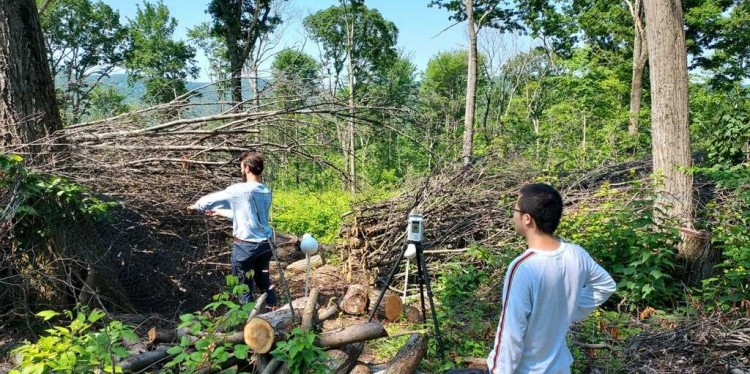
Cornell University researchers evaluated terrestrial LiDAR systems (TLS) as a non-destructive, high-resolution approach for measuring standing trees and woody material in managed forests. The research team assessed TLS performance for estimating both merchantable and non-merchantable wood volumes as well as materials needed to construct quality slash walls. In parallel, researchers tested slash walls—windrow-like barriers built from harvesting residues, known as “slash”—as a practical method to reduce deer impacts on forest regeneration. Project activities included collaboration with state agencies, private landowners, and forestry professionals. Researchers shared findings through dozens of presentations, field tours, and workshops, and developed standardized workflows that were disseminated through the Cornell Digital Forestry Initiative to support broader adoption of these tools and practices. 

Results

Research demonstrated that TLS can successfully estimate wood volume and biomass in forest and slash walls, providing foresters with reliable data to inform management planning and resource valuation. The importance of providing rigorous estimates for slash wall volume is demonstrated by the adoption of slash walls within at least 8 states and all possible ownerships. Without the TLS verification, these managers would have less confidence in designing, installing, and inspecting slash walls to exclude deer from forest regeneration. Forestry professionals reported a strong interest in using TLS to improve inventory efficiency, support management decisions. Cornell University also integrated slash wall practices into broader initiatives, demonstrating institutional leadership in applied forest sustainability. 

Public Value Statement

Through research and outreach on terrestrial LiDAR technology and slash wall practices, Cornell University provides landowners, foresters, and agencies with science-based tools to regenerate forests, protect biodiversity and increase biomass accumulation. These cost-effective innovations support sustainable forest management, strengthen rural and natural resource economies, and help address the growing challenges associated with environmental change and deer overpopulation. 

Keep Exploring

Difference between C3 and C4 plants graphic

Report

Climate change is altering weed dynamics on dairy and field crop farms across New York State. Shifts in temperature, precipitation, and seasonal patterns are reducing herbicide effectiveness, increasing the spread of invasive species, and...
  • Cornell Cooperative Extension
A bag in a field of buds

Report

Weed pressure remains one of the most persistent and costly challenges facing both organic and conventional farmers. Weeds compete directly with crops for water, nutrients and light, leading to reduced yields and profitability when not...
  • Cornell Cooperative Extension
