


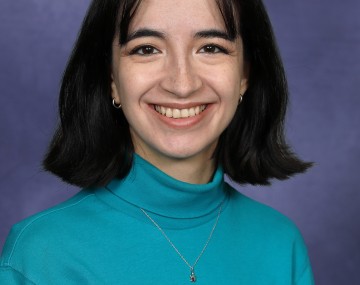
Celeste Groux, Ph.D. ‘28
Some people stumble into their field, but for Celeste Groux, it was a trail of mathematical breadcrumbs. In high school, she excelled in analytical subjects but wanted something that would have real-world impact. A university math project led her to stable matching algorithms told through Pride and Prejudice — a concept that earned Alvin Roth and Lloyd Shapley a Nobel Prize for applications like matching medical residents to hospitals and kidney donors to recipients. Intrigued, she attended seminars on market design, learning how mathematics could shape systems from food bank distribution to auction design. Operations research, she realized, was the perfect blend: rigorous math with tangible, real-world applications.
Today, her doctoral research focuses on optimizing shared, rechargeable resources — specifically, battery-swapping systems used by delivery workers who rely on e-bikes to complete their routes. The challenge lies in balancing charging speeds, battery lifespans, energy costs, and customer demand while planning for growth and multiple user types. “Using data-driven models, she tests strategies for allocation, swapping, and incentives to improve efficiency by abstracting to the most influential system dynamics.”
As a member of the Bigstone Cree Nation and former Canadian National Student Representative for the American Indian Science and Engineering Society (AISES), they’ve found community through Indigenous student networks at Cornell and view their presence in STEM as part of a broader effort to support future generations. Indigenous students remain underrepresented in mathematics and operations research, and Celeste sees the importance of visibility, asserting “We should be encouraged to pursue what we love just because we love it.”
Looking ahead, Groux doesn’t aim to be the most decorated in her field — she aims to do work that’s interesting, impactful, and valued. Whether in transportation, supply chains, or logistics, she wants her contributions to solve real problems while making space for more Indigenous mathematicians to follow.
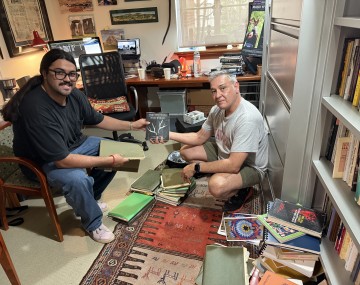
Zelazzie Zepeda, A&S ‘26
For Zelazzie Zepeda, language is more than words — it’s the lifeblood of a community. The passing of his grandmother, a Yaqui woman who grew up in the aftermath of heavy assimilation policies, was a turning point. “I dreamed in Yaqui,” he recalls. “I knew what I needed to do with my life.” That dream ignited a commitment to preserving and revitalizing Indigenous languages, especially those from less well-known communities.
Now an undergraduate completing a major in Linguistics and a minor in American Indian and Indigenous Studies, Zepeda works on multiple language projects. At Cornell, he has collaborated with Professor John Whitman (Linguistics) and Gayogohó꞉nǫʼ (Cayuga) Research Associate and Language Instructor Stephen Henhawk on documenting Gayogohó꞉nǫʼ plant names and researching Haudenosaunee and Gayogohó꞉nǫʼ place names, uncovering meanings often obscured by Latinized forms. With Professor Heidi Harley at the University of Arizona, he transcribed rare oral histories from Yaqui elders who survived the Yaqui Wars — accounts of displacement, survival, and resilience that echo his grandmother’s own experiences.
In Summer 2025, his work also extended to UCLA, where Zepeda collaborated with Professor David Shorter, editor of the NAIS journal and author of a trilingual Yaqui–English–Spanish dictionary, on work that blends linguistic documentation with deep cultural context. He has also contributed to modernizing Wikipedia entries in Yaqui, Wixárika, and Quechua, making them more accessible for everyday users.
It is widely said that it takes three to four generations to revitalize a language, but only one to lose it, which fuels Zelazzie’s commitment to keeping Indigenous languages alive in daily life. For Zepeda, revitalization is about more than academic research. It’s about languages being spoken in schools, governance, ceremonies, and casual conversation. “There’s nothing more decolonial than making sure a language survives,” he asserts.
Looking ahead, Zepeda hopes to earn a Ph.D., further research the Taracahitan language family, and help establish an immersion school where Indigenous languages can not only endure but thrive for generations to come.
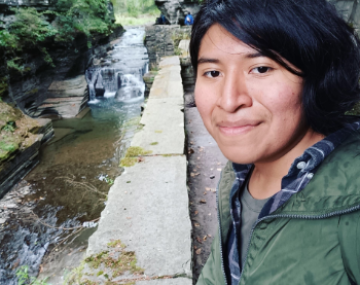
Jesse Hernandez, CALS ‘27
Hernandez grew up in Los Angeles, surrounded by the city’s palm trees and neighborhood greenery. Yet Jesse’s connection to plants stretches farther back into his Kakawira heritage from El Salvador, where family and community traditions emphasize the medicinal, culinary, and ceremonial uses of local flora. Bridging these worlds, he cultivates a practice that honors ancestral knowledge while exploring how plants thrive by bringing history, culture, and care to every seed, sprout, and garden he tends.
His interest in sustainable agriculture began during high school, while caring for a class rabbit over spring break. As suggested by his teacher, Jesse collected rabbit manure that would then be applied as a fertilizer. This early spark introduced him to alternative ways to nourish crops and work with underutilized organic resources.
Now in the Rebecca Nelson Lab at Cornell, this curiosity has evolved into research on nutrient systems and culturally significant crops, including skunk beans and heritage tobacco. Hernandez’s work also connects deeply to heritage crops from El Salvador, such as red silk beans, and to community-based seed preservation. “Working with natural, non-patented seeds has been eye-opening,” he says. “It’s strengthened my understanding of global and Indigenous seed systems.” Lab and field experiments, from disinfecting seeds to observing the striking blue pigments that appear during germination, highlight both the science and the beauty of these processes.
Hernandez credits his mentors in the lab with helping him design experiments and connect research to community impact; his work is shaped by an Indigenous worldview, emphasizing the importance of place, sustainability, and knowledge-sharing. Jesse is currently pursuing a major in Plant Sciences, with minors in Entomology and American Indian & Indigenous Studies. As part of the Bionutrient Circularity Lab, he hopes to pursue graduate studies in Honduras, support rural agricultural communities in Central America, and continue research that blends traditional knowledge, sustainability, and innovation—ensuring that the crops, seeds, and practices of his heritage continue to thrive for generations to come.