At Cornell, Indigenous students of all backgrounds are supported with a constellation of unique resources. Cornell University is a vibrant collaborative community. You belong here.

The American Indian and Indigenous Studies Program (AIISP) works with Cornell Admissions to open doors to promising futures for Haudenosaunee students, on whose homelands Cornell stands, and other North American Indian and global Indigenous students.

Please reach out to admissions [at] cornell.edu (admissions[at]cornell[dot]edu), or aiisp [at] cornell.edu (aiisp[at]cornell[dot]edu) to receive professional advice on the ins and outs of the application process. For questions regarding admissions or financial aid options, please contact the Office of Undergraduate Admissions at admissions [at] cornell.edu (admissions[at]cornell[dot]edu)

What academic level will you be joining us at?

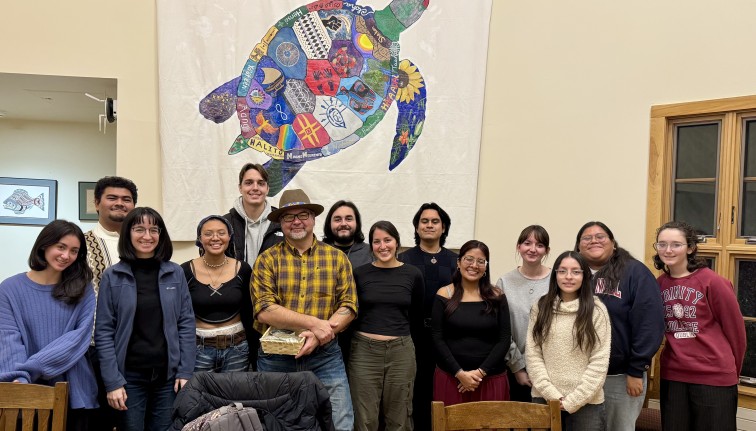
Students gather in the Akwe:kon Great Room.
Undergraduate Students

Discover what makes Cornell so special with an in-person or virtual visit. Nestled in the Finger Lakes region of Upstate New York, Cornell offers a world-class education in a vibrant college town surrounded by natural beauty. Find your community with our Indigenous-led undergraduate student organizations.

Four individuals stand together and smile at the camera.
Graduate Students

Graduate and professional students arrive from across the globe to pursue research and scholarship in more than 100 fields at Cornell. Connect with AIIS staff to learn about adding the American Indian and Indigenous Studies Graduate Minor to your Cornell experience. See the "Academics & Research" tab for more details.
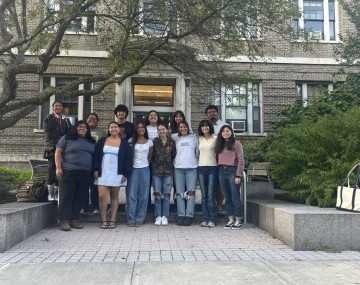
Student leaders stand smiling in front of Caldwell Hall.
Transfer Students

Undergraduate students transfer to Cornell for many reasons. Whether your academic interests have changed, or you are looking to continue your education after completing a two-year degree, make Cornell the next step on your journey. Students are considered transfer applicants if they have completed a high school degree (or equivalent), and earned at least 12 semester hours of college credit after completing high school.

Costs & Affordability: More Affordable Than You Might Think

The cost for college may be one of your family's greatest concerns about going to college. You may be surprised at just how affordable completing a Cornell degree can be. We are committed to making a Cornell education affordable to every student regardless of economic circumstances. We want you to graduate with little to no debt, ready to change your field. 

Cornell meets eligible undergraduate students' full demonstrated financial need (total estimated cost of attendance minus expected family contribution) with a package of aid that includes Cornell grants, Pell grants or NY State grants (when eligible), and annual work-study award, and zero or low student loans, depending on total family income. Families with a total 

  • A Cornell education is a worthy investment. 
  • Cornell practices need-blind admissions for U.S. citizens and eligible non-citizens, which means your ability to pay is not factored into the admissions process
  • Cornell guarantees that any family with a total income of up to $75,000 and typical assets of this income range (including primary home equity), will have a $0 expected family contribution and will receive aid offers that include only grant and work-study only - no parent contribution and no student loans

"Cornell actually ended up costing less than the state university closest to me, even if I lived at home to save money. Given the strength of Cornell academically, and the great financial aid, it was an easy choice." 

—Carl (Sault Ste. Marie Chippewa), Class of 2020, Mechanical Engineering Major

Learn more about costs & financial aid

  • Costs & Financial Aid - Please visit the Financial Aid website.
  • Scholarships & Fellowships - Please see our outside scholarship policy for how outside scholarships can affect your financial aid package.
  • Academic Funding through AIISP - The American Indian and Indigenous Studies Program offers funding to support undergraduate and graduate student success. Examples of how this funding can be used include academic research, professional development, skill enhancement, travel for conference presentations, research/coursework travel, service projects that address Indigenous needs, fieldwork, workshop participation, and data needs. Other research/academic expenses include things such as application fees, and support for high-impact unpaid or low-pay internships.

Contact us with any questions about admissions or financial aid options

For questions regarding admissions or financial aid options, please contact the Office of Undergraduate Admissions at admissions [at] cornell.edu (admissions[at]cornell[dot]edu). For admissions-related questions about transferring into Cornell, please contact transfer [at] cornell.edu (transfer[at]cornell[dot]edu).