

Search for News & Stories
News
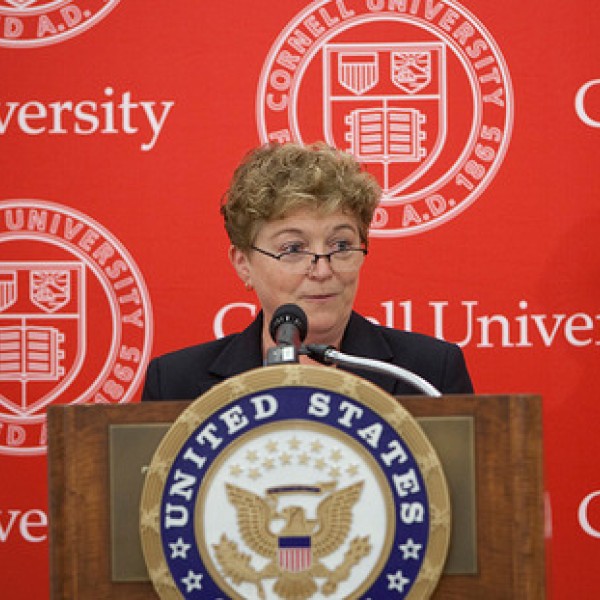
Richard C. Call ‘52, farmer, businessman, Cornell Trustee Emeritus and CALS alumnus, passed away this weekend after battling a long illness. He was 84 years old. Known as “Dick” to friends and colleagues, Call was one of more 30 members of his...
News
News
The Dyson School has been abuzz lately, with yet more high rankings and three exciting new hires. According to a new rankings system posted by the recently launched undergraduate news site and social network Poets and Quants, Dyson is the second...
News
Congratulations to Quirine Ketterings, professor of nutrient management in agricultural systems, who has been named a Fellow of the American Society of Agronomy, the scientific society’s highest honor. The annual awards are presented for...
News
News
Ever wonder what gives beer its refreshing blend of bitterness and aroma? Hops! This climbing vine produces hundreds of flowers commonly referred to as “cones” that contain Lupulin glands that produce both Iso-acid and oil extracts. Iso-acid is...
News
It’s a problem that officials in New York thought they had under control but now, for the first time in five years, a new infestation of Asian longhorned beetles (ALB) has emerged on Long Island. According to the ThinkProgress blog, 500 trees...
News
With the constant barrage of health and safety claims about foods and their ingredients online and in the media, one could be forgiven for developing certain food phobias that may not always be based on the best evidence available. A new study...
News
It started as a project to explore and strengthen food systems, but became so much more: a bridge between campus and community, a model for cooperative learning, and a catalyst for change. Christine Porter, Ph.D. ‘10, started the Food Dignity...
News
News
According to David Just, food marketing and economics expert and professor in the Dyson School, the recent decision by New York’s Court of Appeals to not reinstate laws limiting the size of sodas sold in New York City was not only the popular...
News
Jason Hopwood ‘14 did not initially pursue a career in the wine industry. Before coming to Cornell, Hopwood worked in hospitality, as a chef and eventually co-owner of a restaurant. His interest in wine grew through these experiences until he...
News
Yesterday, New York State Senator Mike Nozzolio announced that $3.4 million in new state funding would be allocated to the New York State Agricultural Experiment Station in Geneva, NY, to modernize the Fruit and Vegetable Processing Pilot Plant...
News
News
It was cheers for beers this week, at news from Albany that Governor Andrew M. Cuomo would be investing $350,000 for research into hops and malting barley, key beer-brewing ingredients, to help Cornell specialists understand the varieties and...
News
It grows 18 feet tall, bears a cone-shaped flower that begins to form after the summer solstice, has the potential to yield 400 different oils, and claims marijuana as its closest relative in the plant kingdom. What is it? The hop plant, once...
News
News
Cornell President David Skorton joined Dean Boor and a host of other dignitaries and Reunion attendees on the Ag Quad today to help launch the new School of Integrative Plant Science in CALS. The school brings together CALS’ former plant and...
News
Via the Cornell Horticulture blog: On a sunny Tuesday, associate professor of horticulture Justine Vanden Heuvel and research support specialist Michael Brown got a good start on planting a new cranberry bed, the first at Cornell Orchards. (The...
News
Via Cornell Horticulture Blog: Associate professor of horticulture Ken Mudge, program aid Steve Gabriel and research support specialist Jonathan Comstock appear in a new movie, The Resilient Ones: A Generation Takes On Climate Change from Bright...

We openly share valuable knowledge. Often through email.
Sign up for more insights, discoveries and solutions.