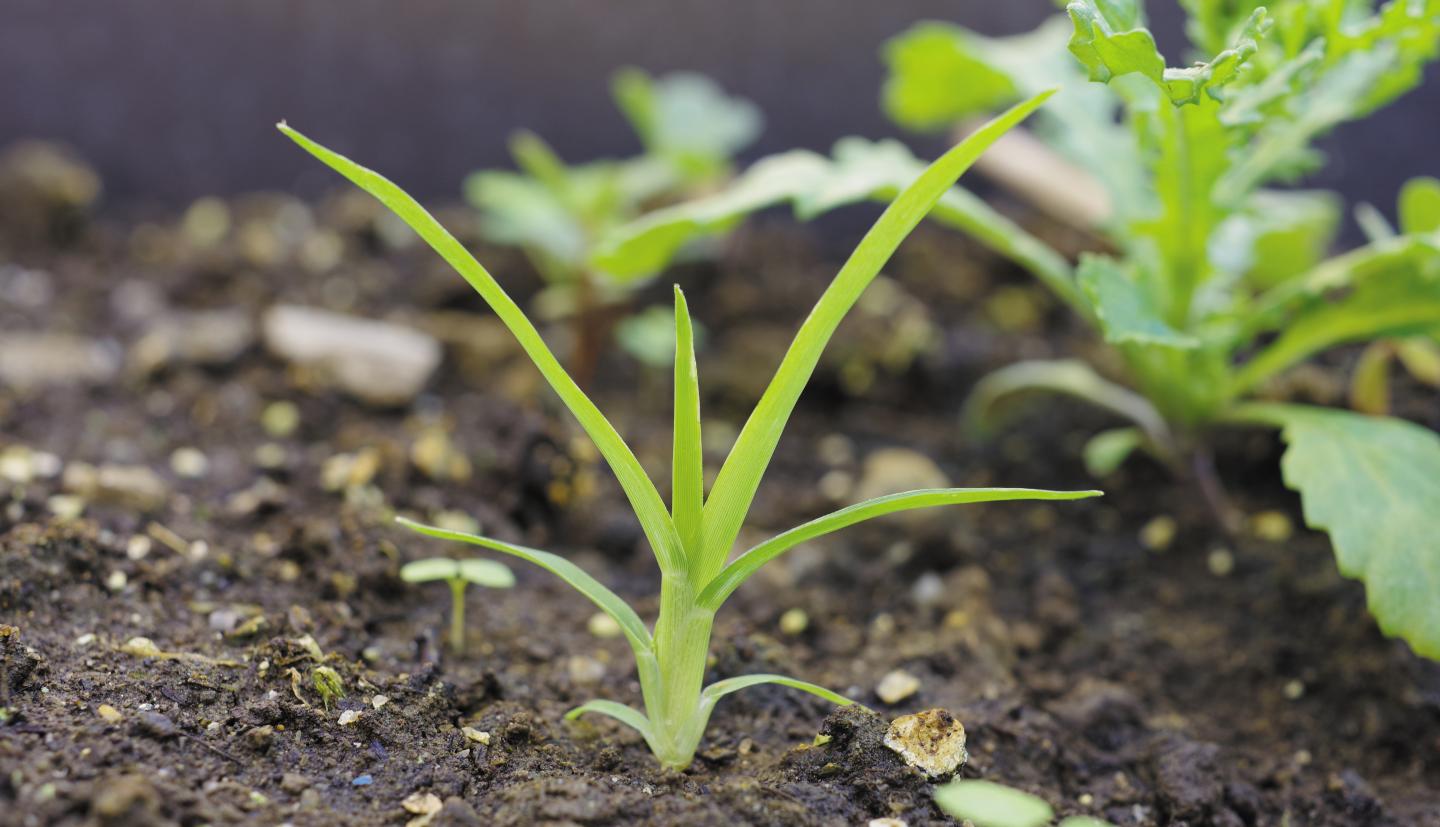
Annual bluegrass v4

Poa annua L.

Identification

Other common names:  low speargrass, six-weeks grass, annual meadowgrass, annual spear-grass, dwarf spear-grass, dwarf meadow grass, causeway grass, speargrass, poanna

Family:  grass family, Poaceae

Habit:  Short winter or summer annual bunchgrass, sometimes surviving through a second growing season.  Two major variants have been identified, P. annua var. annua, an annual with erect habit, and P. annua var. reptans, a short-lived perennial with prostrate growth habit (Hutchinson and Seymour 1982).  The perennial variants are more common in turfgrass than are the annual variants (Shem-Tov and Fennimore 2003).  Perennial variants survive by growing roots from stem nodes in contrast with Poa turfgrasses which are rhizomatous perennials (Mitich 1998).

Images below: Panicle (upper left). Seedling (upper right). Patch o' bluegrass (bottom).

Description:  The linear seedling leaf 0.2-0.35” (0.51-0.89 cm) long by 0.04-0.1” (0.10-0.25 cm) wide emerges perpendicular to the ground.  Young true leaves unfold from the bud into a V with a boat-prow shaped tip; they lack auricles and have 0.1-0.2” (0.25-0.51 cm) long, translucent, slightly pointed ligules.  Collar regions are green and hairless.  Light green blades are 0.75-2” (1.9-5.1 cm) long by less than 0.1” (0.25 cm) wide, crinkled or wavy on the surface, and smooth-edged.  Blades may be hairless or have scattered soft hairs.  Hairless, flattened sheaths open down the stem.  Mature plants grow into 1-12” (2.5-30.5 cm) tall, highly tillering, upright or prostrate clumps.  Stems are bright green to yellow-green.  Sheaths open nearly to the base, and easily pull away from the stem.  Sheaths are transparent and pale, hairless, V-shaped, and without auricles; mature leaves have a ligule similar to that of seedling leaves.  Blades are light green, linear, 0.5-5.5” (1.3-14 cm) long by 0.1” (0.25 cm) wide, nearly hairless, with the distinctive boat-prow shaped tip.  The root system is shallow, fibrous and matting.  Spontaneous rooting occurs at tiller bases.  Numerous 1-3” (2.5-7.6 cm) tall, pyramid-shaped inflorescences develop.  White-green immature seedheads are open or airy, with several small flower clusters (spikelets) loosely grouped at the ends of branches within the pyramid.  Individual spikelets are 0.2” (0.5 cm) long and contain 2-6 flowers.  As with other grasses, the apparent seed includes a thin tightly adhering layer of fruit tissue.  Yellow-gray seeds are 0.1” (0.25 cm) long, elliptical, with one blunt end.


Similar species:  Three other perennial bluegrass species resemble annual bluegrass.  Canada bluegrass (Poa compressa L.) is 1-2 ft (30-61 cm) tall, has flat, wiry stems, and narrow, blue-green blades.  Kentucky bluegrass (Poa pratensis L.) is 1-3.25 ft (30-99 cm) tall with dark green leaves 2-30” (5-76 cm) long, and is a coarser looking plant whose seedheads consistently have a whorl of 5 small spikes at the base.  Roughstalk bluegrass (Poa trivialis L.) is 1-3 ft (30-91 cm) tall, with yellow-green leaves 1-8” (2.5-20 cm) long.  Leaves are rough and folded in the bud, with a large tapering membranous ligule.  Italian ryegrass [Lolium perenne L. ssp. multiflorum (Lam.) Husnot] resembles annual bluegrass, but can be distinguished by its long, narrow auricles.


Similar species:  Three other perennial bluegrass species resemble annual bluegrass.  Canada bluegrass (Poa compressa L.) is 1-2 ft (30-61 cm) tall, has flat, wiry stems, and narrow, blue-green blades.  Kentucky bluegrass (Poa pratensis L.) is 1-3.25 ft (30-99 cm) tall with dark green leaves 2-30” (5-76 cm) long, and is a coarser looking plant whose seedheads consistently have a whorl of 5 small spikes at the base.  Roughstalk bluegrass (Poa trivialis L.) is 1-3 ft (30-91 cm) tall, with yellow-green leaves 1-8” (2.5-20 cm) long.  Leaves are rough and folded in the bud, with a large tapering membranous ligule.  Italian ryegrass [Lolium perenne L. ssp. multiflorum (Lam.) Husnot] resembles annual bluegrass, but can be distinguished by its long, narrow auricles.