The Region 9 AIS Program focuses on three primary areas to protect New York waters from the spread of AIS through early detection and rapid response, including invasive plant and animal monitoring, control, and native plant restoration. Projects within these focus areas are identified by the Region 9 AIS Coordinator and field staff, and initiated as applied research, demonstration projects, and community outreach, in addition to multiple collaborative projects spearheaded by agency partners. In 2024, the Region 9 AIS Program carried out 24 projects with 7 partners, centering on management of aquatic invasive species and protection of native ecosystems, leveraging regional expertise to identify priorities and continue make progress toward program goals and objectives.
Erie Canal Hydrilla Control Project
Hydrilla was first identified in the Erie Canal in 2012 by the U.S. Fish and Wildlife Service (USFWS), where it was discovered to occupy 359 acres, or 31%, of the westernmost 15 miles of the canal beginning at its confluence with the Niagara River. The U.S. Army Corps of Engineers’ (USACE) Aquatic Plant Control Research Program initiated the Tonawanda Creek/Erie Canal Hydrilla Demonstration Project in 2014, with the express purpose of demonstrating effective control techniques for hydrilla in a flowing system (EAS E&E 2022). To date, the project has utilized various control methods and strategies to monitor and improve upon treatment efficacy. Despite the overall success of these efforts to significantly reduce the hydrilla in the canal, trace to sparse patches of the plant have been able to persist within the original extent of the infestation and treatment area.
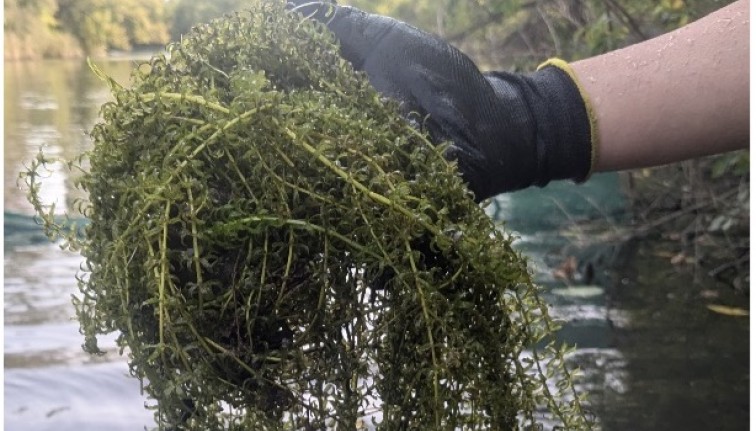
The Region 9 AIS Program began assisting with spot treatment of hydrilla in the Erie Canal and a tributary, Sawyer Creek, in 2023 before fully overseeing the treatment throughout much of the canal in 2024, for which a final report can be found below. Beginning in July of 2025, the first 14 miles of the canal will be treated with a low-dose metered injection of fluridone for 90 days, as well as a single application of florpyrauxifen benzyl in higher density areas, as was conducted in 2024. With a more consistent exposure throughout the growing season, successful control of the remaining trace amounts of hydrilla may be more feasible. Alternative efforts that were employed in 2024 include manual removal and the installation of benthic mats in areas not reached by the herbicide treatment.
In addition to herbicide control, the Region 9 Aquatic Plant Restoration Program has also been initiated to introduce native vegetation back into the canal and has shown promising results with extensive expansion planned for 2025.
Weekly Sampling Reports
Project Plan and Reporting
Additional Related Documents
Niagara River Submersed Aquatic Vegetation Mapping
Following the 2022 discovery of the expansion of invasive hydrilla around Tonawanda Island, it became a priority of the Region 9 AIS Program to conduct a full-scale submersed aquatic vegetation assessment of the Niagara River as an early detection-rapid response strategy for prevention of further spread downstream into Lake Ontario and introduction into Canada, which currently has no documented reports of hydrilla. SAV monitoring of the river was also identified as a priority of multiple DEC departments, state, and federal agency partners, as the Niagara River has never had a complete SAV assessment. Previous habitat mapping projects focused on identifying weed beds as opposed to species identification and abundance estimates. The Niagara River is a high monitoring priority due to its designation as an Area of Concern, home to one of only two self-sustaining muskellunge populations in New York, and its importance as the sole connection between Lake Erie and Lake Ontario.
The Niagara River was divided into three subsections to be sampled on a 3-year rotational basis, which began in 2023.
To date, nearly 5,000 acres of habitat have been assessed for both native and invasive plants, with ~8,400 observations of 24 species reported in the Upper Niagara River. Species presence, density, and biovolume were recorded, along with bottom hardness, water temperature, and depth. The data can be viewed publicly via ArcGIS Online here.
In 2025, the project will continue in the lower river beneath Niagara Falls.
Niagara River SAV Mapping Project Update 2024
Aquatic Plant Restoration in the Erie Canal
Native submersed aquatic vegetation (SAV) and emergent aquatic vegetation (EAV) provide a suite of necessary ecosystem services, including provision of critical habitat and food resources for native fish and wildlife, bank stabilization, and nutrient management. Treatment of AIS creates disturbed, open areas which may be recolonized by native species from the existing seed bank, but there is a high risk of colonization by AIS, especially in highly trafficked areas with vulnerability to new introductions.
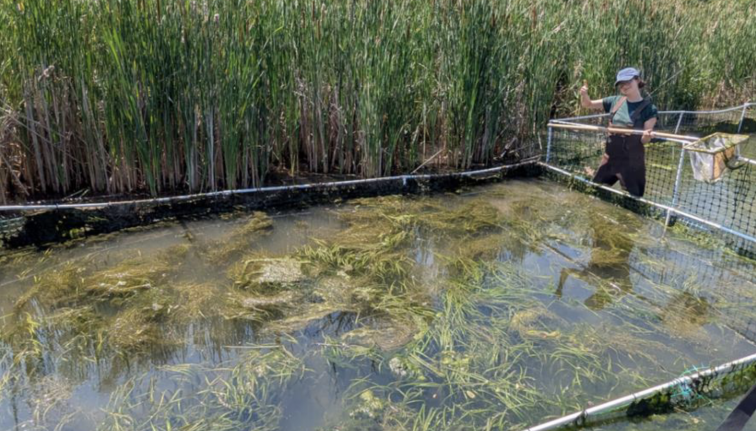
The Erie Canal has been treated with non-selective herbicides for a decade. While these treatments were successful in significantly reducing the target species (Hydrilla) in the canal, it has left native plant density extremely low and created many disturbed, open areas. With the creation of a local regional aquatic invasive species management program that is undertaking chemical AIS control projects, it is increasingly important to include active restoration as a part of our AIS management plans.
In 2024, we partnered with the North Tonawanda Botanical Garden to expand the cultivation program into a suitable greenhouse space, which would allow for long-term plant propagation and turion/seed harvest at a larger scale. We also planted ~160 plants in four test plots and saw successful growth from 200-500%.
Aquatic Plant Restoration in the Erie Canal Project Report
AIS Region 9 Reporting
Publications and Extension
Yoder, L. 2024. A Balancing Act Above the Falls: Assessing Two Aquatic Plant Survey Designs in the Niagara River. The Nor’easter: A Newsletter from the Northeast Aquatic Plant Management Society.
Yoder, L., A. Tucker, and G. Annis. 2024. Comparison of Systematic and Randomized Aquatic Plant Surveillance Methods in the Niagara River. Oral Presentation, Northeast Aquatic Plant Management Society Meeting.
Yoder, L., R. Quinn, and Z. Zygmunt. 2024. Use of ProcellaCOR EC in the Erie Canal. Poster, Northeast Aquatic Plant Management Society Meeting.
Yoder, L., A. Turner, and W. Pierrot. 2025. Shifting Gears After 10 Years: Initiating New Techniques for Hydrilla Control in the Erie Canal. Oral Presentation, Northeast Aquatic Plant Management Society Meeting.
Turner, A., L. Yoder, and W. Pierrot. 2025. Restoring Submerged Aquatic Vegetation on the Erie Canal. Poster, Northeast Aquatic Plant Management Society Meeting.