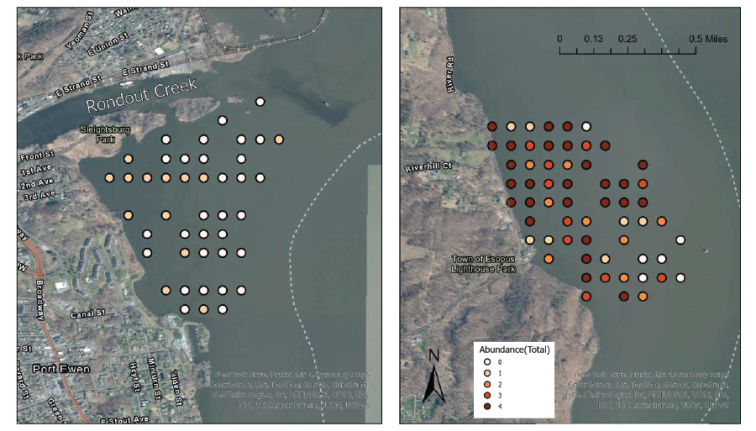
NYSDEC Region 3 is made up of the seven counties that make up the lower Hudson valley (Dutchess, Orange, Putnam, Rockland, Sullivan, Ulster, and Westchester).  The region boasts a diversity of aquatic resources and recreational opportunities centering on the Hudson River and its’ system of tributaries. The introduction and continued expansion of aquatic invasive species in this region imperils the native species and decreases the use of recreational areas.

Hudson River Water Chestnut Management

The prohibited (6 NYCRR Part 575) aquatic invasive plant water chestnut (Trapa natans) was first introduced to New York State in the late 1800’s. It is now found throughout New York. Once water chestnut becomes established and expands it is challenging and expensive to remove. It alters native habitats, impacts fisheries, prohibits recreation, affects water use safety, emergency access locations, and local economies.

To our knowledge only manual and mechanical removal have been used for water chestnut management in the Hudson River and its tributaries. Both methods are not feasible for large-scale infestations. We propose to use chemical treatment which involves the foliar application of imazamox, an herbicide that has been successfully employed at other locations in New York State. Unlike most foliar applications which are conducted via backpack sprayers and spraying from boats we will be piloting the use of an unmanned aerial vehicle (UAV or drone) to apply the herbicide to increase efficacy and reduce cost. As with all water chestnut projects the goal is to reduce the population to a few plants/small patches that can be monitored, and hand pulled on a yearly basis. In addition, we are supporting and, in some cases, embarking on research regarding ecological impacts of water chestnut to help inform management decisions and predict their outcomes at the native animal and plant community levels. 

NYSDEC Invasive Species Coordination Section endeavors to conserve aquatic habitats to create resilient systems for native biodiversity preservation and improvement recreational use. Management of water chestnut in the Hudson is proposed with the following justification. 

  • ​Improved access for boating and fishing recreation
  • ​Increase knowledge and experience in large scale treatment of water chestnut in a flowing tidal system.
  • ​Decrease invasive species pressure to allow for potential native species recovery.