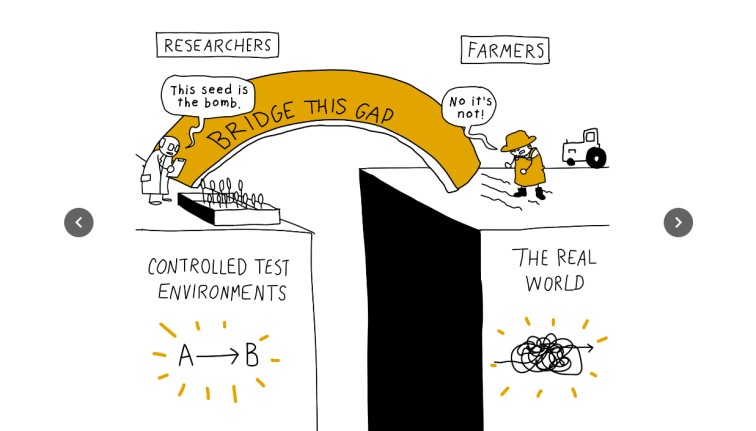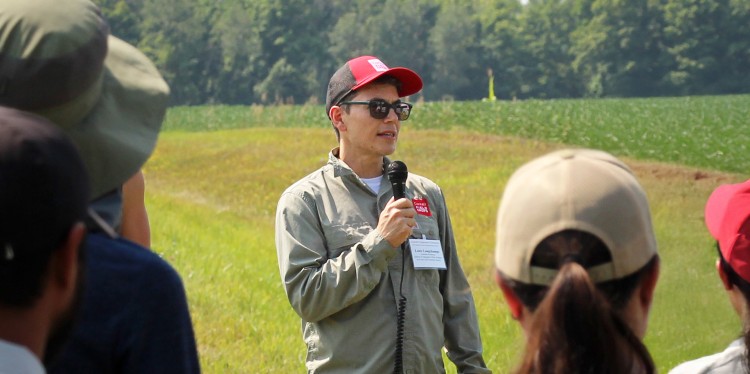
Growers routinely conduct their own on-farm experiments, testing different seeds and management strategies to improve yields and long-term sustainability. But most growers don’t have the time, resources or expertise that scientists have to fully evaluate their trials, or to put their findings in a format that can benefit other growers . Louis Longchamps, assistant professor of digital agronomy in the School of Integrative Plant Science, and his Farmers DataLab seek to empower farmers by conducting research that is farmer-led and scientist-supported. Here, Longchamps and Katie Rohrbaugh, a graduate student in his lab, explain how they hope that flipping the script on traditional agricultural research could improve public trust in research findings, support responsible agricultural innovation and ultimately benefit food security, environmental quality and rural communities.
Where did the idea for this kind of farmer-led research come from?
Longchamps: As a graduate student, I observed that weed problems in many farm fields were patchy but farmers were spraying everywhere. I thought perhaps there was an opportunity to save herbicides by spraying only where they were needed – saving money for growers and reducing environmental harms. I did agronomic engineering, developed optical sensors, created ways to map your weeds and strategies to do spot spraying of weeds. But when I presented my findings to growers, I found that weeds were not their top priority at that time, and my project was quite disconnected from the reality of their most-pressing problems. It was a big realization, and I decided I wanted to flip it all around. Now, I put all this technology, all the analytics and expertise, to the service of farmers when they are experimenting with something. Because if they are experimenting on a topic, that means it is important for them to progress toward their vision and objectives. I didn’t pioneer this concept, but I’ve been part of conversations with many colleagues across Europe, Australia, South America, and the U.S. about expanding this research model.
Rohrbaugh: I think what differentiates on-farm experimentation from more-normative kinds of research is the perspective you bring to the table, and the acknowledgement that there are multiple kinds of knowledge. Farmers know their land better than a scientist ever could, while they may have specific questions that scientists are better able to answer. It’s a skill-share.
Logistically, how do you support growers’ experiments?
Longchamps: A lot of farmers will do an experiment, but then they lose the capacity to keep an eye on it, or they may end up not collecting any data for a more thorough interpretation of their results. We help by adapting research to their own experimental design, taking on the task of looking at the data, and thinking about how to interpret the results to inform how to farm next year. We also seek out colleagues across campus who have different expertise than we have in our lab, if that’s what an experiment requires. For example, we have collaborated with experts on soil microbiology or cover crops to help us design sampling and interpret data. Another way we support farmers’ experiments is by providing anonymous benchmarking data from the other farms participating in the experiments. If you are one of 15 farms working on an experiment, you can see the data from your colleagues and see when others planted, how much magnesium or copper was in others’ soil versus yours, and so forth. Farmers have appreciated being able to learn from each others’ expertise, not just ours.
What challenges have you encountered with this research model?
Longchamps: Science generally moves slowly, and farming moves quickly. We know that farmers need answers almost instantaneously, but scientific testing and analysis takes time. Our first report took two years, which was much too long. The last one took us one year. We have been working hard at improving data processing and management techniques so that we can move faster and provide answers in-season, when they are most beneficial to growers.