A Cornell research team led by Michael Scanlon, professor of plant biology in the College of Agriculture and Life Sciences’ School of Integrative Plant Science, recently reported new insights into the patterns of gene expression in maize stem cells — revealing details about their role in guiding shoot developmental processes.
The study, “Plant stem-cell organization and differentiation at single-cell resolution,” published in the Proceedings of the National Academy of Science on Dec. 29.
Plants continually grow new vegetative structures. During the early stages of development, cells are given a specific function, and they grow in a highly organized manner. All the cells, organs and tissues in the above-ground portions of adult plants exist thanks to a pool of stem cells that live in a structure called the shoot apical meristem (SAM).
The SAM generates cells that undergo specific patterns of gene expression as they develop, giving rise to the more complex cells and tissues found in mature plants. It also helps maintain the balance between the cells dedicated to organ building and those that produce more stem cells.
To accomplish this, complex networks of genes are turned on and off in a precise series, and as the plants continue to develop, they experience a natural variation in gene expression. This ultimately influences the traits that appear in adult plants, such as leaf size, leaf shape and plant height.
Scanlon’s recent paper describes gene expression patterns observed in individual SAM cells and reports the functions of the expressed genes. Using these data, graduate student James Satterlee and postdoctoral researcher Josh Strable pinpointed the subset of cells in the SAM that function like stem cells and identified potential genetic strategies by which maize plants protect stem cell DNA from mutation.
“Unlike in most animals where stem cells are protected by sequestration in special tissues, plant stem cells are embedded in vegetative shoot apex and potentially vulnerable to mutation,” Scanlon said.
Understanding the genetic variation of individual stem cells is critical to learning more about the development process, as well as the mature tissues and organs that they help form.
In spring 2020, Scanlon was awarded a five-year, $1.8 million continuing grant from the NSF’s Plant Genome Research Program to research fundamental mechanisms of maize development. This builds on research Scanlon and his lab have been conducting since the early 2000s, much of which has also been supported by NSF.
Magdalen Lindeberg is the assistant director of the School of Integrative Plant Science.
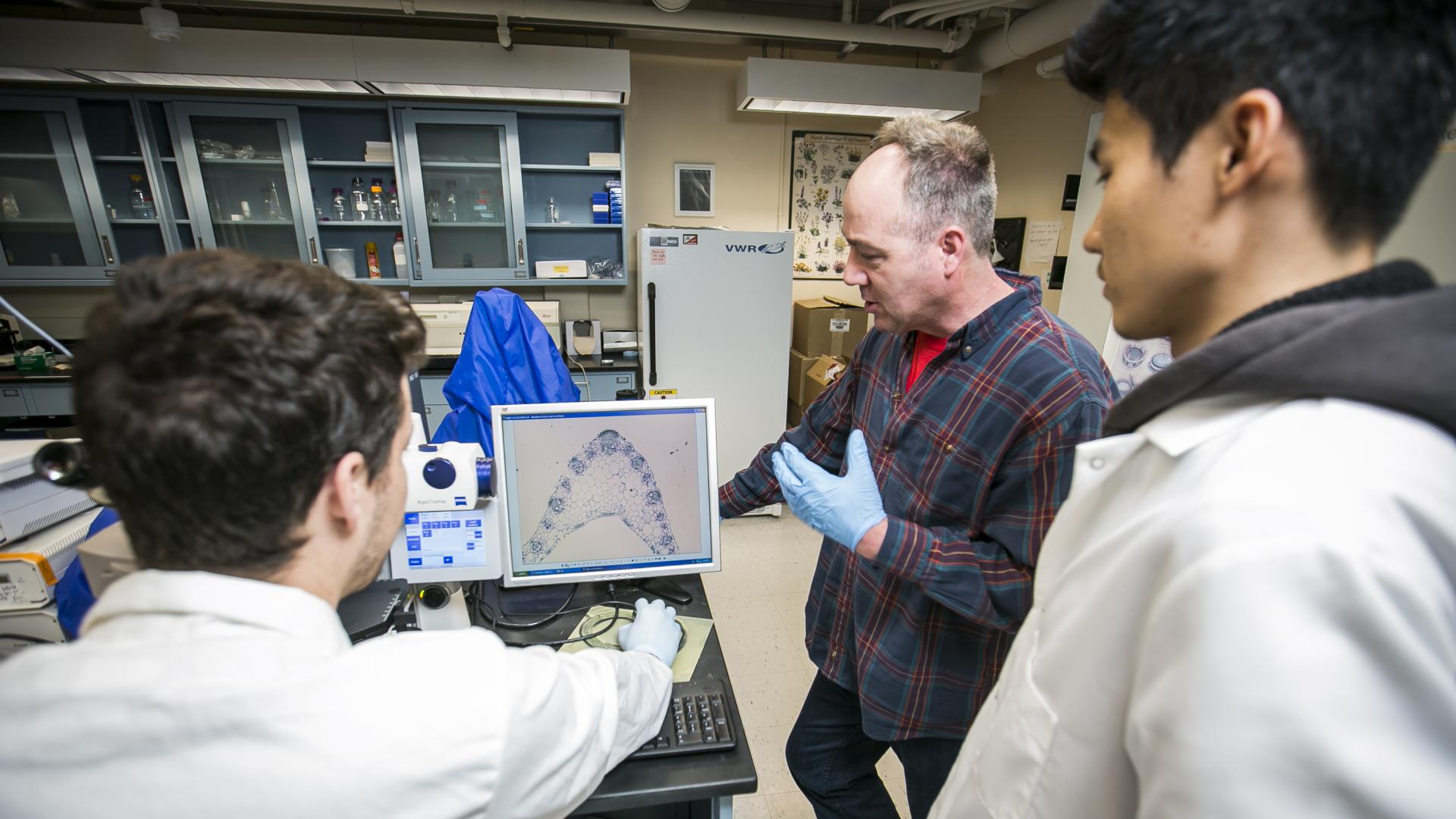
Header image: Michael Scanlon, professor of plant biology, examines developing plants to see how changes in gene expression influence the traits of adult plants. Photo by Jesse Winter/Cornell University.