The safety and well-being of our community is our highest priority. We know the recent news and allegations are deeply concerning, and we are committed to a safe environment for all. Learn how Cornell is addressing sexual violence.

Alert Close
Back

Discover CALS

See how our current work and research is bringing new thinking and new solutions to some of today's biggest challenges.

Share
  • Animal Science
  • Digital Agriculture
  • Ruminant Center
  • PRO-DAIRY

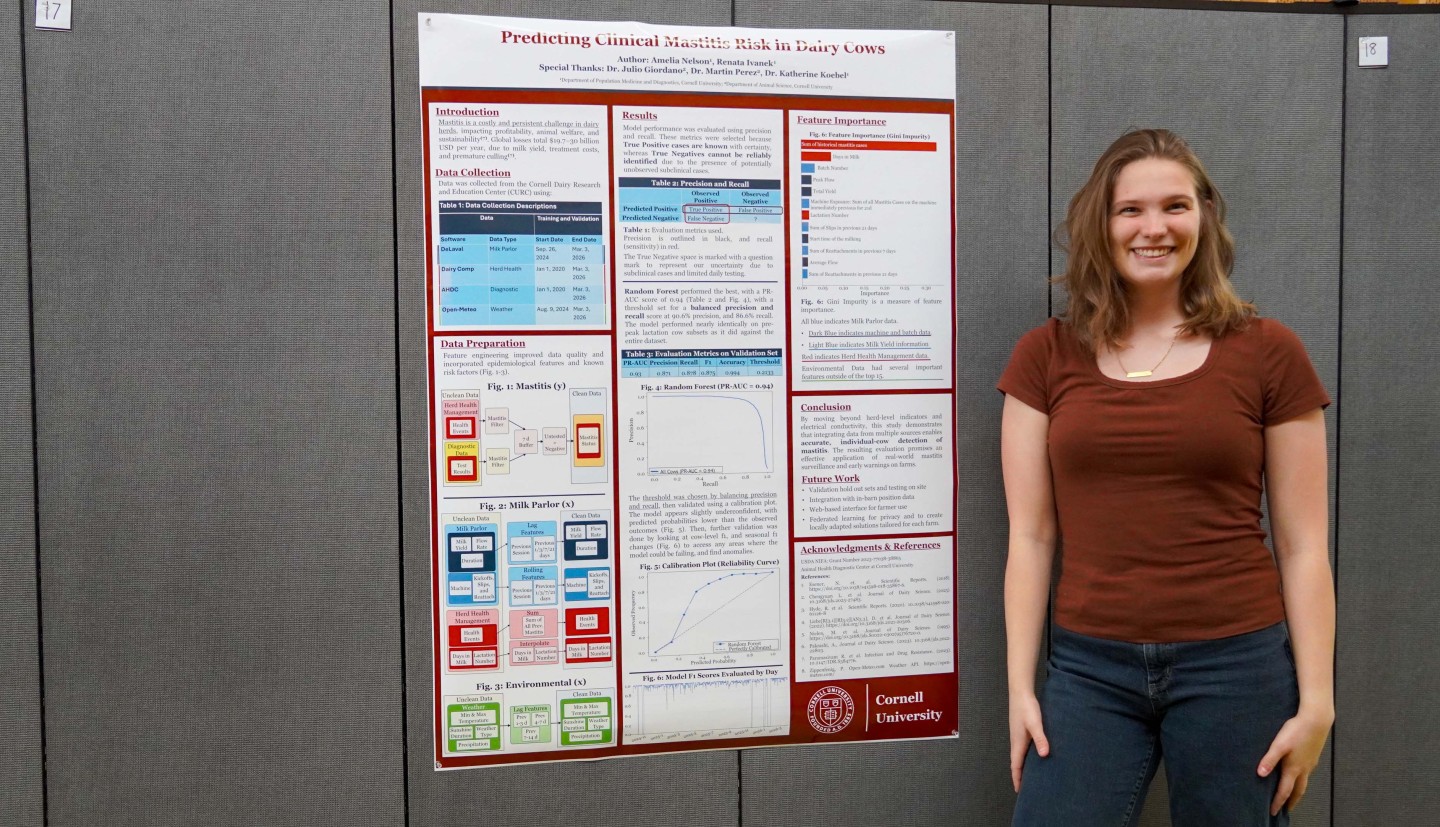
Amelia Nelson PhD’29 is a graduate student in the College of Veterinary Medicine working in the lab of Professor Renata Ivanek. Collaborating with the Cornell Agricultural Systems Testbed and Demonstration Site (CAST) for the Farm of the Future, Nelson is creating a predictive model for mastitis, a common inflammation of the cow udder that is a constant struggle in dairies.

We spoke to her about her work.

What is mastitis, and why do we need a better way to predict it? 

Mastitis is an inflammation of the udder that can be caused by a range of pathogens or injuries. It’s painful for the cow and also a persistent, costly and widespread challenge for dairy farmers. It impacts farm profitability, animal welfare and sustainable production. 

Although there are in-machine predictors and a lot of papers on mastitis prediction, they often focus on herd-level statistics. They emphasize electrical conductivity of the milk as a main predictive feature since mastitis causes vascular permeability that lets sodium ions and chloride leak from the blood into the milk, which raises conductivity. That is problematic because that type of reading can be finicky to maintain. Another way to predict subclinical cases is somatic cell count testing, which can be expensive for the farmer.

How will your predictive model get around these limitations?

Our implementation takes a combination of milk parlor data (such as the flow of milk over time or the amount of milk produced in total), weather data (such as the maximum temperature per day or the maximum humidity), diagnostic and herd health data (such as the frequency of a cow’s mastitis infections in the past or what pathogen caused previous mastitis episodes), and geospatial data that identifies the cow’s location within the barn at a given point in time.  

All this information feeds into our model to help us make meaningful predictions and then take that data and make powerful insights.
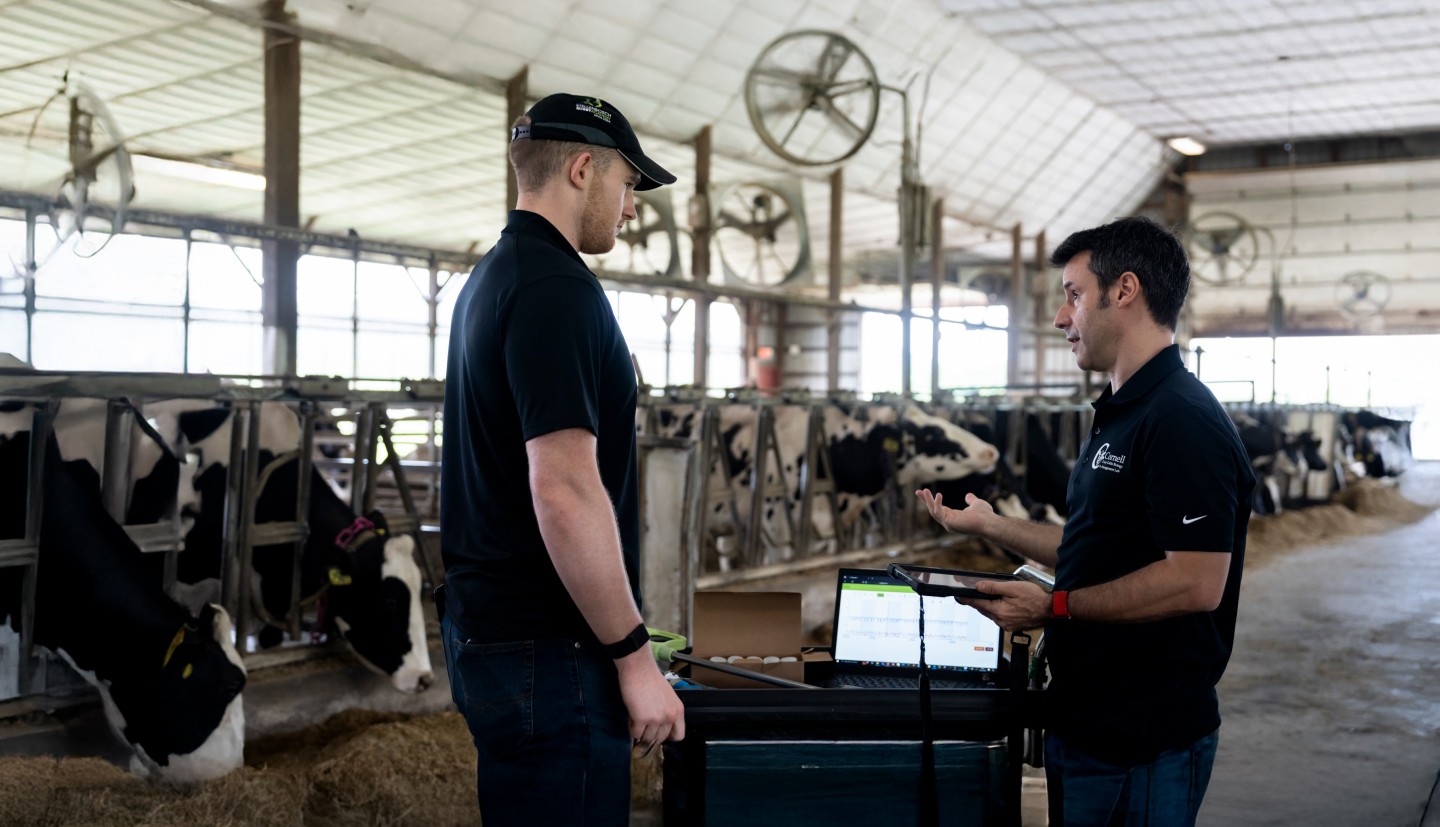
Your data comes from CAST, which is creating an ecosystem of networked technologies and techniques for modern farms. What kind of data did they give you?

We're using data gathered by CAST from their main farm, the Cornell Dairy Research and Education Center (CDREC). There’s a lot of different kinds. We have herd health data from Dairy Comp, a dairy herd management software. We also have diagnostic data from the Cornell Animal Health Diagnostic Center for CDREC. Then, we have milk parlor data from Delpro, which is a dairy and milking management platform. Delpro gives us all kinds of measurements of milk output and composition. And we have geospatial ear-tag data, which shows the location of each cow within the barn at a millisecond level.

CDREC is our first farm, and we're excited to get a testable prototype through the data CAST is providing.

Can you describe your research and your process for creating the prediction model?

We’re starting with prediction of mastitis episodes. So, we’re looking at when a cow gets mastitis and the factors that show us she still has it, such as reduced milk yield or a larger percentage of low milk flow. Then, we use these models as a baseline to indicate the top contributing factors. 

We then compare the outputs from the model, and what the model considers important, such as traditional biological factors like the sum of historical mastitis cases for a particular cow. Whenever the model has stronger signals than we expect, or when the model is giving us unexpected signals, we can combine that with the biological signals to give us insights. 

For example, we might infer that lining slips are causing an increased risk of mastitis on a farm. This happens  when the milking machine loses its tight seal, allowing a cow’s teats to be exposed to air during the milking process. We can recommend updating automated milking machine settings, such as the vacuum power, to prevent this. 

Or, if we can identify areas of the barn where cows are at a higher risk, we can walk through the barn and try to associate that increased risk with an influential factor and a fix. For example, we might notice that there’s water pooling in a specific area of the barn and that it’s developing a persistent pathogen or algae that is increasing the risk of mastitis. 

Overall, we want to develop a locally adapted, flexible system where we can tailor a model to any farm and use whatever data they have available to give them predictive power and actionable insights.

It seems like the model you’re creating should increase herd productivity and profitability if farmers use it to deal with mastitis in a more timely manner. 

Yes, that’s what we are aiming for. We want to provide actionable insights from the data the farmer has and help them find things like malfunctioning machines or identify if a specific section of the barn needs new bedding, for example. If our model can give them insights on ways to increase the efficacy of targeted interventions or treatments based on the cow’s mastitis risk, that should help raise productivity and profitability—and increase cow welfare. The models are limited to the data the farmer can provide, but the goal is to take whatever data the farm has and make it work for them. 

Looking forward, what are the next steps?

We have two big next steps! Right now, we are working on two papers. One is about mastitis prediction from parlor, weather, herd health and diagnostic data. The other is about mastitis prediction based on geospatial data.  

Jackie Swift is the communications specialist for the Cornell CALS Department of Animal Science and the communications manager for CAST.

Keep Exploring

A field of soybeans planted in rows.

Field Note

Headlands are the areas bordering a field. Compared to the rest of the field, headlands are more exposed to wildlife, pests, disease, nutrient loss to weeds, and the elements. They are also at a higher risk for compaction because equipment...
  • Animal Science
  • Agriculture
  • Digital Agriculture
A man works on three computers. He is wearing a red shirt, sitting at a desk and smiling.

Field Note

With hundreds of thousands of acres of corn in New York, it's crucial to support farmers’ efforts to optimize crop production. Yield varies in crop fields for many reasons, including soil fertility and topography. In a recent study, Cornell CALS...
  • Animal Science
  • Soil
  • Agriculture