


Compost Use and Quality
Organic Circularity: From Crop Waste to Compost
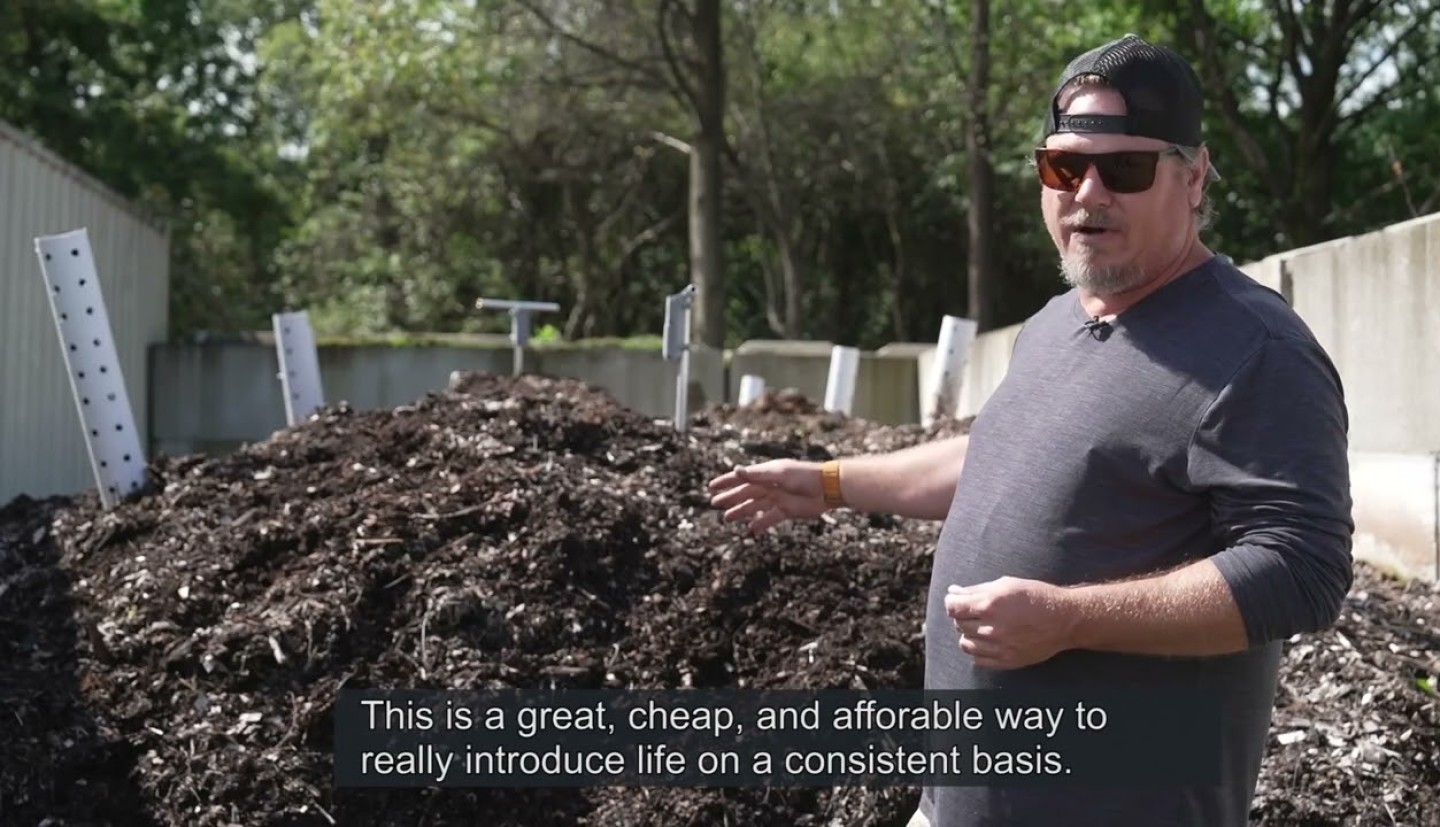
Crop waste can be used to create compost to grow more crops, hence improving soil and contributing to a circular economy.
Compost Use Estimator
This formula may be used to calculate the approximate amount of compost needed for a specified area. To use this calculation, substitute your own values for area and depth.
Volume Required (cubic yards) = area (sq. ft.) x depth (inches) x 0.0031
C/N Ratio
Of the many elements required for microbial decomposition, carbon and nitrogen are the most important. Carbon provides both an energy source and the basic building block making up about 50 percent of the mass of microbial cells. Nitrogen is a crucial component of the proteins, nucleic acids, amino acids, enzymes, and co-enzymes necessary for cell growth and function.
To provide optimal amounts of these two crucial elements, you can use the carbon-to nitrogen (C/N) ratio for each of your compost ingredients. The ideal C/N ratio for composting is generally considered to be around 30:1, or 30 parts carbon for each part nitrogen by weight. Why 30:1? At lower ratios, nitrogen will be supplied in excess and will be lost as ammonia gas, causing undesirable odors. Higher ratios mean that there is not sufficient nitrogen for optimal growth of the microbial populations, so the compost will remain relatively cool, and degradation will proceed at a slow rate. In general, materials that are green and moist tend to be high in nitrogen, and those that are brown and dry are high in carbon. High nitrogen materials include grass clippings, plant cuttings, and fruit and vegetable scraps. Brown or woody materials such as autumn leaves, wood chips, sawdust, and shredded paper are high in carbon. You can calculate the C/N ratio of your compost mixture, or you can estimate optimal conditions simply by using a combination of materials that are high in carbon and others that are high in nitrogen.
As composting proceeds, the C/N ratio gradually decreases from 30:1 to 10-15:1 for the finished product. This occurs because each time that organic compounds are consumed by microorganisms, two-thirds of the carbon is given off as carbon dioxide. The remaining third is incorporated along with nitrogen into microbial cells, then later released for further use once those cells die.
Although attaining a C/N ratio of roughly 30:1 is a useful goal in planning composting operations, this ratio may need to be adjusted according to the bioavailability of the materials in question. Most of the nitrogen in compostable materials is readily available. Some of the carbon, however, may be bound up in compounds that are highly resistant to biological degradation. Newspaper, for example, is slower than other types of paper to break down because it is made up of cellulose fibers sheathed in lignin, a highly resistant compound found in wood. Corn stalks and straw are similarly slow to break down because they are made up of a resistant form of cellulose. Although all of these materials can still be composted, their relatively slow rates of decomposition mean that not all of their carbon will be readily available to microorganisms, so a higher initial C/N ratio can be planned. Particle size also is a relevant consideration; although the same amount of carbon is contained in comparable masses of wood chips and sawdust, the larger surface area in the sawdust makes its carbon more readily available for microbial use.
Additional resources
- Characteristics of a Sampling of New York State Composts Summary and database of compost characteristics from a sampling of NYS composts, 2017.
- Compost Use Guidelines and Specifications. Links to guidelines and specifications, 2003.
- Compost Sampling for Nutrient and Quality Parameters: Variability of Sampler, Timing and Pile Depth. Article published in Compost Science and Utilization, Vol 20 (3):141-149. 2012.
- Compost Use for Improved Soil Poster Series. (2017)
- Compost Use for Improved Soil - Agricultural Applications
- Compost Use for Improved Soil - General Highway Use
- Compost Use for Improved Soil - General Use
- Compost Use for Improved Soil - Reclamation and Remediation
- Compost Use for Improved Soil - Roadsides, Street Trees and Medians
- Compost Use for Improved Soil - Slope Stabilization, Erosion Control and Storm Water Management
- Compost Use for Improved Soil - Make it, Use it: Urban Applications
- Highly Compacted Soils Improved by Compost Use. 2p article summarizing project results. Published in BioCycle 48(7):55-56, 2007.
- Develop Manufactured Topsoil Mixes to Support the Growth of Pollinator-Friendly Vegetation in Roadside Settings. Powerpoint presentation describing the NYSDOT/UTRC Research Consortium funded project on developing topsoil mixes using composts to encourage native wildflower growth resulting in pollinator-friendly vegetation. 2019.
- Surveys Guide Development of Quality Compost Seal. Article published in BioCycle 41(11):72-78, 2000.
- Using Organic Matter in the Garden. Pages 16-26. Chapter on use of various soil amendments including manure, sewage sludge and compost, 2001.
- Using Manure-Based Composts. Links to results of a 3-year research study, 2007.
- What's Behind a Compost Label or Seal? 3p article published in BioCycle 44(9):28-30, 2003.