The safety and well-being of our community is our highest priority. We know the recent news and allegations are deeply concerning, and we are committed to a safe environment for all. Learn how Cornell is addressing sexual violence.

Alert Close
Back

Discover CALS

See how our current work and research is bringing new thinking and new solutions to some of today's biggest challenges.

Share
  • Dairy
  • Animal Science
  • Animals
  • PRO-DAIRY

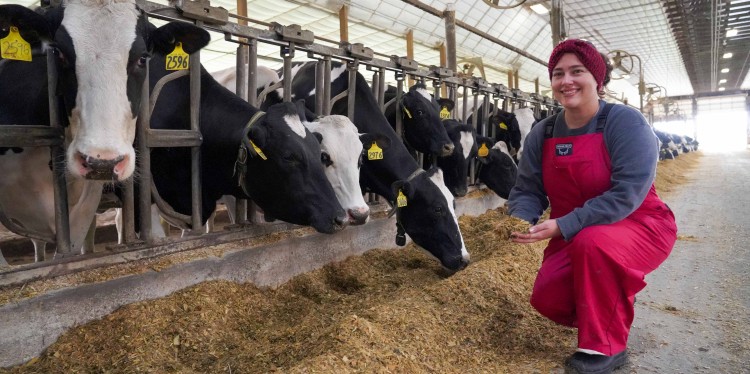
Ananda Portela Fontoura PhD’22 is a postdoctoral associate working in the lab of Michael Van Amburgh, professor of dairy nutrition. Ananda’s research focuses on maintaining or enhancing dairy cow performance through optimizing nutrient use efficiency while minimizing urinary nitrogen excretion.

We spoke to her about her work.

Cows are producing more milk than ever, so why do we need to worry about how efficiently they use nutrients? Aren’t they already efficient enough?

Modern dairy cows have a lot of productive potential and are able to produce large quantities of milk and components, such as protein and fat. In a recent experiment we conducted, for example, we observed cows producing more than 150 pounds of energy-corrected milk (ECM) per day; with some cows reaching up to 205 pounds per day at their highest observed productivity. 

These cows demonstrate that there may be more productive potential in today's animals than is captured by some of the assumptions we currently use to formulate diets. Our research seeks to better match the nutrients we feed them with what they need to produce milk and milk components. 

So, are we aiming for a world where every cow produces 205 pounds of milk? That’s an extraordinarily high number!

Not necessarily 205 pounds for all cows, because higher milk production is not automatically better. It’s more important how efficiently the cow converts the nutrients she consumes into milk and components like milk fat and protein. If a cow can produce more valuable milk from the same amount of feed, we’re getting more out of resources already being used.

Nitrogen is a good example. When a cow receives more nitrogen than she needs, the excess leaves her, primarily through urine. That represents nutrients the farmer has purchased but that the cow did not use for production, and it can contribute to environmental losses. If we can help cows direct more of the nutrients they consume toward milk production and less toward waste, we can improve both economic and environmental efficiency. 
Your research explores ways to supply nutrients to high-producing cows without compromising milk production or milk components. Tell us about that.

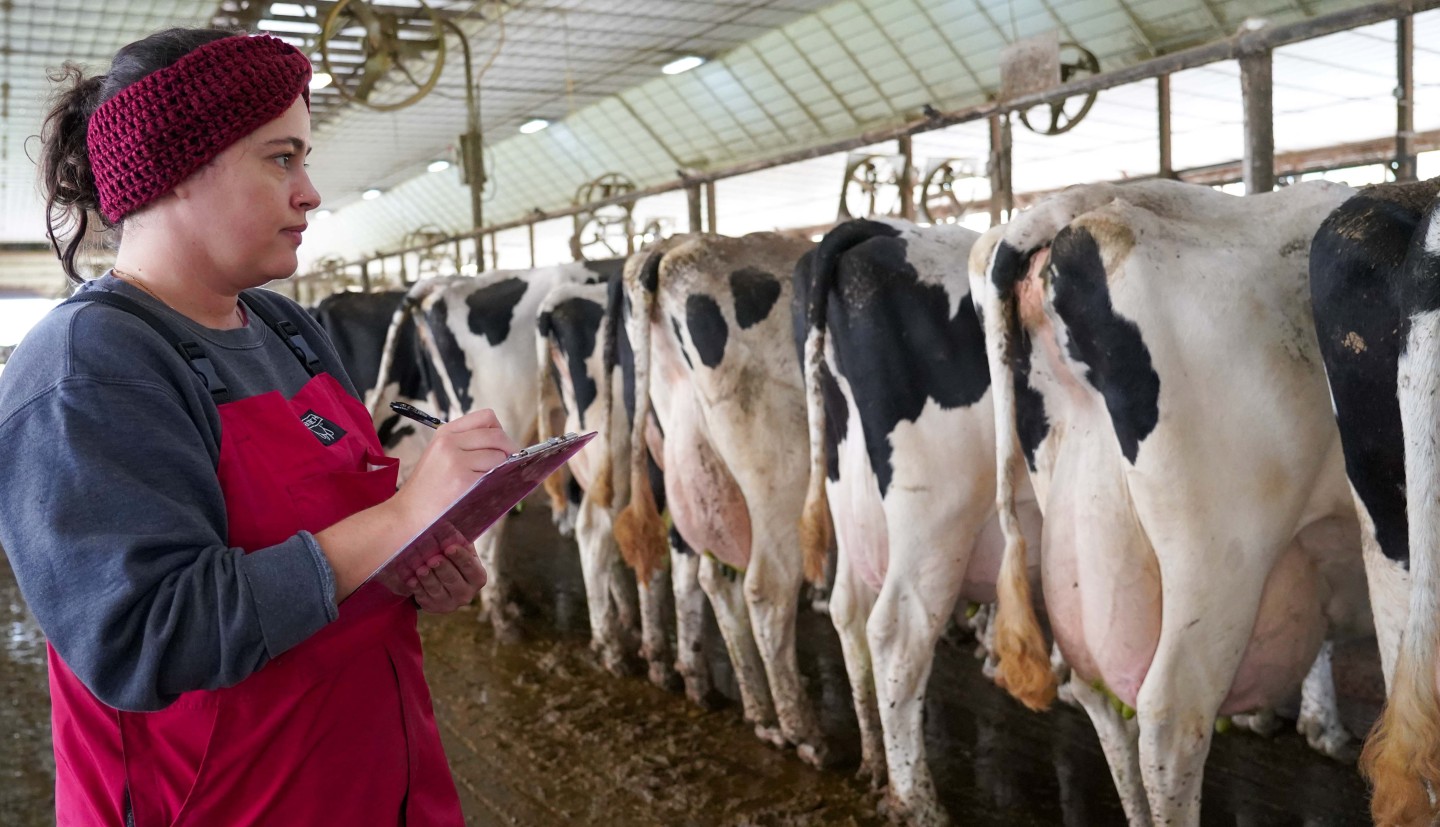
That’s right. We want to understand what these highly productive cows are capable of and how we can feed them more precisely. At the same time, we also want to reduce unnecessary nutrient losses. Part of this work looks at nitrogen. We’re testing how far we can reduce nitrogen supply while still providing enough for the cow and the microbes that live in her rumen, the part of her stomach that breaks down and ferments her food.

For example, in one recent study, we hoped to make better use of the nitrogen available in the diet. We compared three different diets fed to 144 lactating Holstein cows. All diets were relatively low in nitrogen, but two included isoacids, which are compounds that support rumen microbial growth, along with either conventional or slow-release urea. 

We found milk volume was similar among treatments, but cows receiving isoacid diets produced more ECM and more milk protein and lactose. So the amount of milk components produced increased without increasing the amount of milk.

You’re also doing some on-farm testing of lower-nitrogen diets, aren’t you?

Yes, with dairy producers and nutritionists, we’re testing how lower nitrogen diets can be implemented under commercial conditions while monitoring production, economics and nitrogen losses. These data will help us improve the Cornell Net Carbohydrate and Protein System (CNCPS), which nutritionists use to formulate dairy cattle diets.

What does a lower-nitrogen diet mean for dairy farmers and the environment?

For farmers, the goal is straightforward: to use feed they are already purchasing more effectively. If we can reduce unnecessary nitrogen in the diet while maintaining or improving milk and milk components production, farmers may be able to reduce feed costs and improve income over feed costs. In our recent study, preliminary economic analysis indicated an advantage of approximately $0.22 per cow per day for the isoacid diets compared with the control diet.

There is also an environmental benefit. A significant portion of nitrogen that is not captured in milk is excreted in urine. Reducing unnecessary nitrogen intake can therefore reduce the amount of nitrogen entering the manure pit, since urine mixes with manure in the barn. Less nitrogen in the manure pit potentially reduces nitrogen losses to the environment.

For greenhouse gases, our preliminary modeling showed similar estimated methane and carbon dioxide-equivalent emissions across diets despite greater ECM production with isoacid treatments. So improving productivity without proportionally increasing emissions could potentially reduce the environmental footprint per unit of milk produced. These emissions values are model estimates, so we’re continuing to refine them as research progresses.

Looking forward, what are the next steps?

We presented findings from completed and ongoing studies to the dairy industry at the American Dairy Science Association Annual Meeting and the Cornell Nutrition Conference. We’re also continuing on-farm work, collecting diet, production, economic and nitrogen-use data from commercial dairy farms. That will help us determine whether strategies that work under controlled research conditions can provide similar benefits on farms.

Our goal is to incorporate the improved understanding of nutrient requirements and nutrient use into tools such as the CNCPS, so that nutritionists can use the information when formulating diets for dairy herds in New York State and across the United States. 

Jackie Swift is the communications specialist for the Cornell CALS Department of Animal Science.

Keep Exploring

Red-faced Cormorant

News

Birds play an outsized, underappreciated role in shaping Earth’s chemistry, distributing nutrients across oceans, forests and coral reefs and sustaining life far beyond the nest, according to a new scientific review.

  • Animals
  • Natural Resources and the Environment Section
  • Ashley School of Global Development and the Environment
Coral on the seafloor off the coast of Curaçao

News

A doctoral student and a team of Cornell researchers and colleagues created WildFin, a data set composed of nine hours of video that they labeled frame-by-frame with fish behaviors.

  • Computational Biology
  • Animals
  • Fish