Academic focus: Evolution of animal signals, morphology and behavior
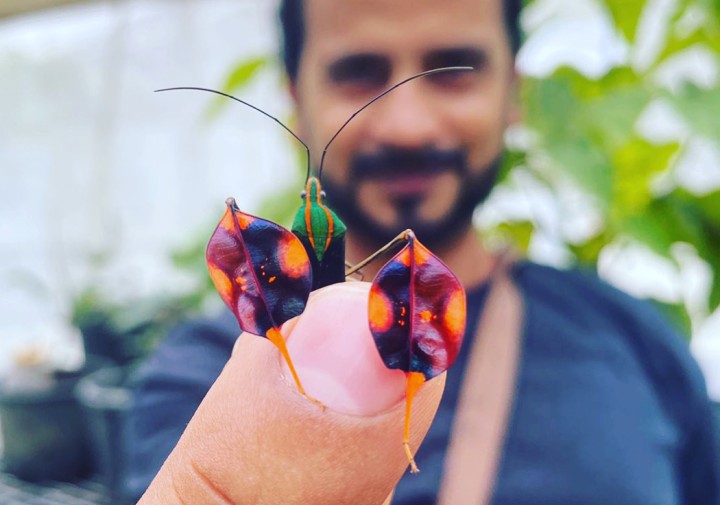
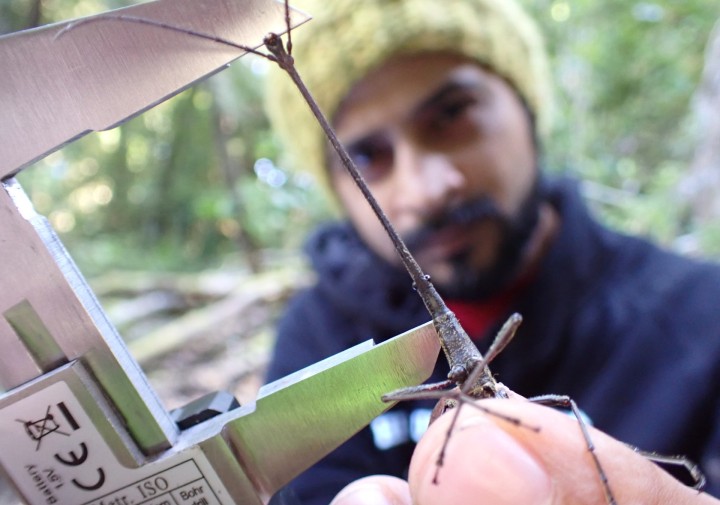
Research summary: My research explores how social competition shapes animal morphology, physiology and behavior. I am especially interested in the evolution of elaborate traits, such as beetle horns, the elongated heads of giraffe weevils and the enlarged legs of leaf-footed bugs. Such elaborate traits often diversify rapidly and can function as weapons, signals, ornaments or even as antipredator defenses. By combining field experiments, natural history observations and comparative approaches, I investigate how these traits arise, diversify and evolve.
What do you like to do when you’re not working?
I find myself gravitating toward activities that get me outdoors. I love rock climbing and hiking, and I have recently started fishing. I also enjoy amateur origami, and I love cooking dishes from different regions.
What brought you to Cornell CALS?
Cornell CALS has an exciting community of people studying insects, along with a broader group of faculty working across animal behavior and evolutionary biology. I’m constantly just a stone’s throw away from colleagues whose expertise connects with my own, who can help me think about questions in new ways, and whose research inspires me. I am also excited to connect with highly motivated students in entomology. In addition to the great research community, it is wonderful to be somewhere with such easy access to nature, from the forests and lakes to the many opportunities for outdoor activities.
What is an interesting fact about your field of study that you think everyone should know?
You may have heard of giraffe weevils, but have you heard of tusked weevils? These are tiny, peppercorn-sized weevils with little tusk-like horns that they use to participate in highly ritualized contests.
Why did you feel inspired to pursue a career in this field?
I have always been deeply passionate about animal behavior. As an undergraduate, I took every opportunity I could to study animals in the field, from mammals to birds to snakes. I was a little disheartened, however, to realize that many of the species I encountered were already very well studied. But when I began working with insects, however, I discovered an entirely different world – one filled with thousands, perhaps millions, of species and behaviors that remain unknown or poorly understood. I realized that, when it comes to insect behavior, we are still living in an age of discovery.