Back

Discover CALS

See how our current work and research is bringing new thinking and new solutions to some of today's biggest challenges.

Share
  • Cornell AgriTech
  • School of Integrative Plant Science

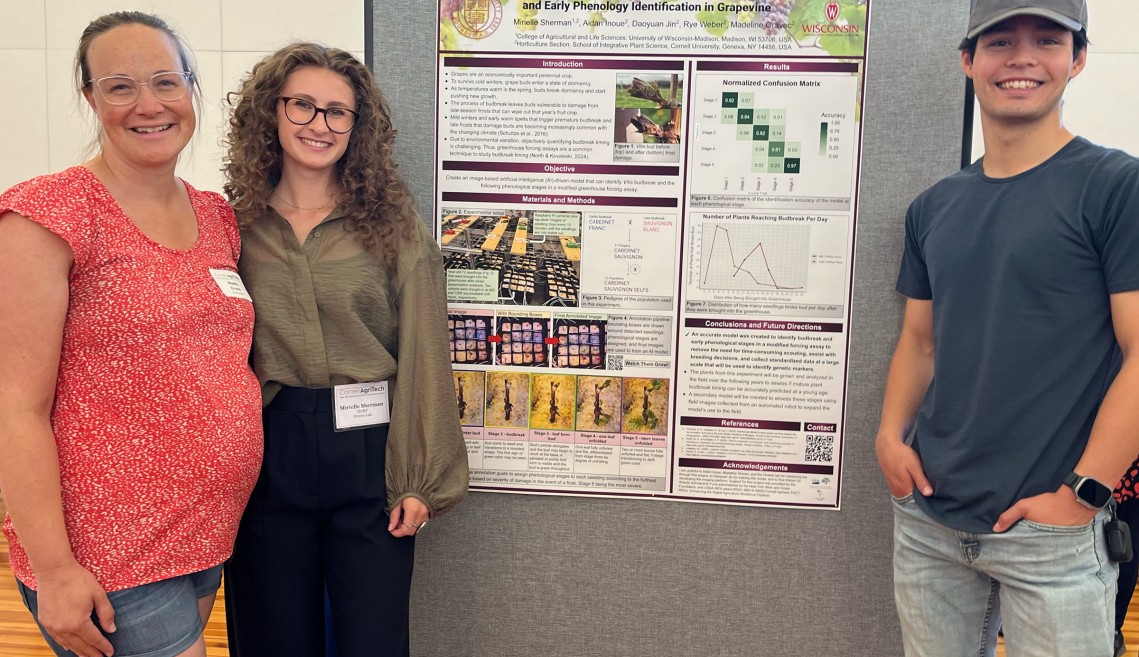
Mirielle Sherman leaned over her scientific poster, making a few final adjustments before presenting her work at Cornell AgriTech’s Summer Research Scholars symposium in July.

Photographs of grapevines covered the poster. Some showed cameras mounted inside a greenhouse; others captured grapevine buds at different stages of development. For Sherman, each image represented hours of careful analysis and a small piece of a much larger plant breeding puzzle.

“One of my big jobs was annotating all of these images according to a scale that we developed,” Sherman said.

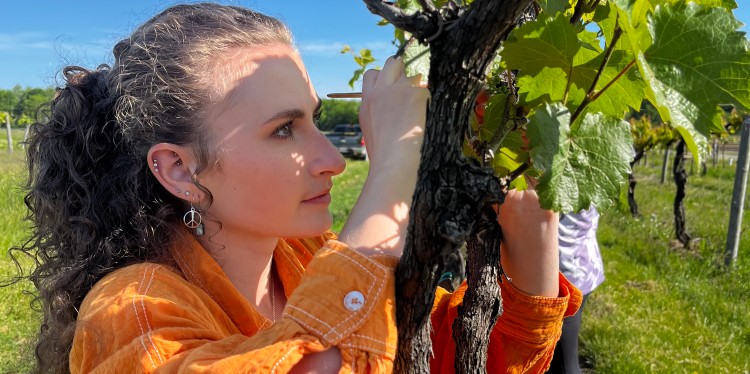
The University of Wisconsin-Madison undergraduate had spent the summer in assistant professor Maddy Oravec’s grape breeding and genetics lab, where she worked under the mentorship of plant breeding Ph.D. student Aidan Inoue. Her project focused on tracking grapevine bud development and understanding how vulnerable buds are to late spring frosts.

The stakes are high for grape growers. As buds develop, they become increasingly susceptible to frost damage, which can reduce yields and affect vineyard productivity.

“The goal is to eventually use the data from from the research to help match budbreak timing and make breeding selections based on plants that have later budbreak,” Sherman said. “This scale is based on how much damage would occur to the bud if there was a late frost.”
Sherman was one of 29 students who participated in the 2026 Cornell AgriTech Summer Research Scholars Program. From May through July, students representing 23 colleges across 15 states lived and worked in Geneva, New York, contributing to research projects spanning food science, entomology, plant pathology, horticulture and plant breeding.

For Sherman, the experience represented both a continuation of her research journey and an opportunity to explore a new field. At the University of Wisconsin-Madison, she had already developed a passion for fruit crop research through projects involving cranberries and blueberries. For her work at Cornell AgriTech, applied grape breeding was new territory.

Beyond image analysis, Sherman joined members of the Oravec lab in the painstaking work of making hand crosses, carefully pollinating tiny grape flowers to combine traits from selected parent vines. The work provided a glimpse into the breeding process that aims to develop future varieties that may prove more resilient to environmental challenges.

Long hours among the trellised vines did little to discourage her. Instead, by the end of the summer, Sherman saw plant breeding as more than a research opportunity; she saw it as a future career.

“The summer has really made me decide that I want a Ph.D. in breeding,” Sherman said. “I think all of the field work is so fun.”

The experience showed her how breeding combines scientific discovery with practical solutions that can help growers adapt to challenges such as frost damage and changing environmental conditions.

As scholars prepared to return to their home institutions, many reflected on the research skills they had gained and the professional paths they hoped to pursue. For Sherman, however, the scientific experience was only part of what made the summer memorable.

What stood out most were the people.

“All of the members of this lab are super, super great,” Sherman said. “My roommates have been awesome. Those will be friends that I’ll have for the rest of my life.”

For a student who arrived in Geneva hoping to learn more about grapes and plant breeding, her summer experience delivered far more than research analyzing grapevines and making breeding crosses: It helped clarify her future plans.

Keep Exploring

Ph.D. student Nick Gunner shows a group of growers the results of digital ag and ai work.

Field Note

What sparked your interest in robotics, and how did your journey lead you to this field? I’m not actually a roboticist, which may seem unusual given that I study in a robotics lab. Our work extends far beyond building robots: We draw on software...
headshot of jeremy allan

Field Note

If there’s someone that every animal science student knows, it would be Jeremy Allen, senior lecturer and director of undergraduate studies. And that’s for the better — from teaching to advising, Allen values helping students above all else. “My...
  • Animal Science