April 29, 2026
Awards
Undergraduate student Rafaela Dandolfo Bustamante has been named the inaugural Marshall Engaged Scholar. As part of the program, Rafaela will spend summer 2026 working in public media at KNPR in Las Vegas. When she returns to Cornell in the fall, she will continue her investigative research and writing on campus. Engaged learning opportunities such as this program are what make Cornell CALS Communication unique. The program was made possible by the gracious support of Terry ’76 and Ann ’76 Marshall.
Undergraduate student and student administrative assistant Caroline Michailoff received the Cornell Tradition Senior Recognition Award, a competitive honor presented annually by Cornell Tradition to a select group of fellows. The award is based on students’ community and campus service, leadership, work ethic, and overall contribution to the quality of campus life. Tradition fellows are nominated by their professors, advisors, or administrators, or may be self-nominated. As part of the award, each recipient designates a one-year, $4,000 Tradition Fellowship for a continuing Tradition Fellow; Caroline designated her fellowship to support a female undergraduate studying Communication. In addition, a $500 donation is made to a nonprofit organization of the recipient’s choice.
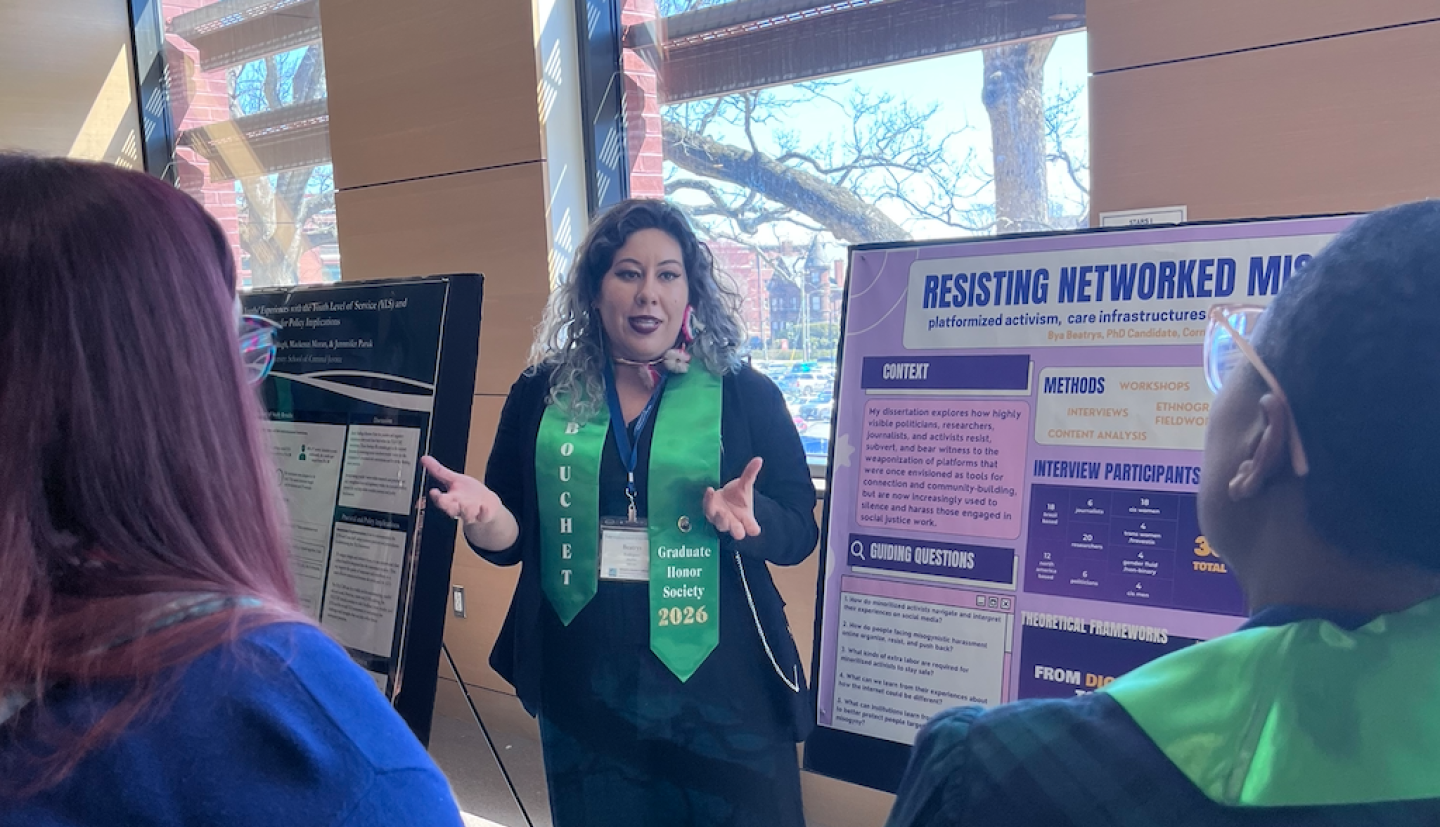
Graduate student Beatrys Rodrigues was selected as a 2026 inductee into the Edward A. Bouchet Graduate Honor Society by the Cornell University chapter, an honor that recognizes outstanding scholarly achievement and a strong commitment to academic and personal excellence. The Bouchet Society seeks to cultivate a network of preeminent scholars who exemplify leadership, advocacy, service, and mentorship, and its inductees are distinguished by their contributions to research, dedication to fostering inclusive academic communities, and engagement both within and beyond the university.
Events
Graduate student Ria Gualano is organizing an interactive exhibition, “Cripping Time across Realities: Disability and Neurodiversity Arts Exhibition,” featuring artwork by students and staff from across the Cornell community. The opening event will take place on Thursday, April 30, 2026, 4:30–6:30 p.m., in the Department of Communication, located on the fourth floor of Mann Library. The event will feature opening remarks by Diversity & Inclusion Research Librarian D. Krahmer and include opportunities to engage creatively with virtual reality and augmented reality technologies in connection with the exhibition’s theme. Light refreshments will be provided. The exhibition will remain on view for asynchronous visits during Department of Communication hours from Friday, May 1, at 9:00 a.m. through Friday, May 8, at 3:30 p.m. For accessibility needs, please contact rjg322 [at] cornell.edu (Ria Gualano) in advance. The exhibition is supported by the Mellon/ACLS Dissertation Innovation Fellowship.
Lectures
On April 28, Professor Natalie Bazarova was an invited participant at the Translating Well-Being Evidence into Impact roundtable. The event was sponsored by the Harvard T.H. Chan School of Public Health’s Lee Kum Sheung Center for Health and Happiness. This roundtable brought together a small group of leaders across research, practice, policy, and industry to assess the current state of evidence in positive health and well-being and explore how it could be more effectively translated into real-world practice and policy. In a moment of rising mental health concerns, loneliness, and inequalities, they aim to move beyond deficit-focused models toward practical, asset-based strategies that strengthen our shared social fabric.
Publications
J.I. Segal, M.L. Turman, M. Emrich, Lab Manager in the Virtual Embodiment Lab Isabelle McLeod Daphnis, S. Rodriguez, J. Difede & Associate Professor Andrea Stevenson Won, April 2026, “Practitioner-Centered Design: A Case Study of a Human–Computer Interaction–Clinician Collaboration on the Development of Prototype Virtual Reality Environments for the Treatment of Posttraumatic Stress Disorder and Moral Injury in Health Care Workers,” Journal of Medical Extended Reality.
This article explores a collaboration between technical and clinical professionals developing immersive environments for treating posttraumatic stress disorder and moral injury in health care workers. The authors detail the processes of establishing communication, identifying and overcoming differences in work expectations and knowledge, and they specify how the team addressed critical issues during this process.