To seek solutions, the National Science Foundation’s Division of Ocean Sciences and Environmental Biology awarded a four-year, $2.5 million grant to Drew Harvell, professor emeritus in ecology and evolutionary biology in the College of Agriculture and Life Sciences, to examine the transmission pathways of seagrass wasting disease in coastal meadows.
The funding was one of eight Ecology and Evolution of an Infectious Disease grants the agency awarded, and one of only two such marine awards given in 2021.
“In previous research, we showed how seagrass meadows have superpowers for filtering pathogens – particularly bacteria – from the ocean,” said Harvell, a faculty fellow in the Cornell Atkinson Center for Sustainability, who will serve as the principal investigator.
“To lose these coastal meadows is a big setback for both the marine ecosystem and for human health. We are not only rapidly losing seagrass meadows that are habitat for marine biodiversity, but we are losing a breathing ecosystem that puts oxygen into water, filters out pathogens and absorbs carbon dioxide.”
Joining Harvell on the grant will be co-principal investigators Maya Groner, who will soon be a senior research scientist at the Bigelow Laboratory for Ocean Sciences, Boothbay, Maine; Eileen Hofmann, professor of ocean and earth sciences, Old Dominion University, Norfolk, Virginia; and Colleen Burge, research scientist at the California Department of Fish and Wildlife, and research associate at the Bodega Marine Laboratory, University of California, Davis. Burge is a former Cornell postdoctoral researcher in Harvell’s lab.
Underwater transmission of all marine pathogens is poorly understood. The pathogen Labyrinthula zosterae infects seagrass blades in meadows along the Pacific Ocean shores from Alaska to California, as well as in Europe, creating devasting outbreaks. It also presents an unusual opportunity, since it is tractable for transmission studies because it can be cultured and detected in the water and on other marine organisms.
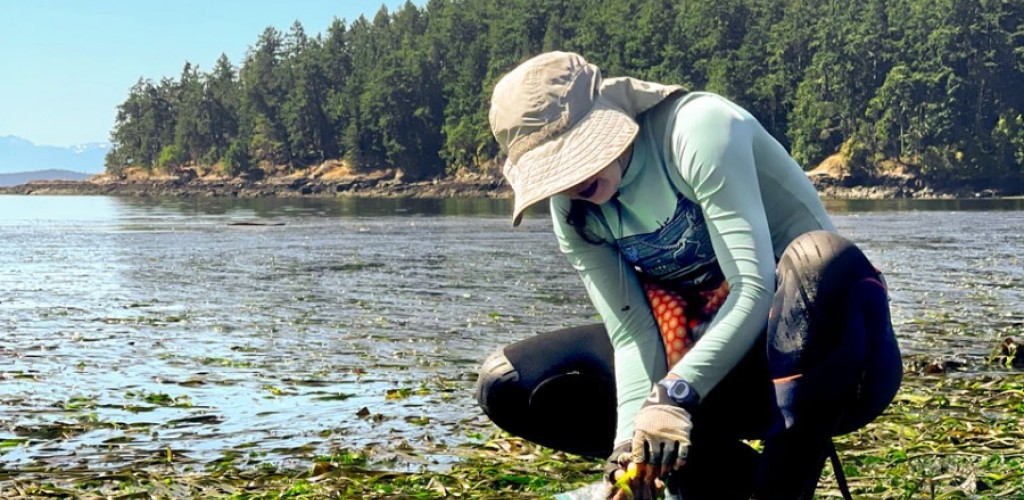
The team began the research at Friday Harbor Laboratories, on the San Juan Islands in Washington, in 2012, as part of an Ecology of Infectious Marine Disease class. There, the team will track transmission paths and examine factors including climate warming and pathogen strain in starting new infections. The group also will investigate how the seagrass microbiomes and the biota – such as snails and oysters – may affect the infection rate.
The experimental work will integrate with mathematical modeling, led by Hofmann, that tests scenarios of changing environmental conditions – resulting from climate warming – on disease transmission. This will inform mitigation strategies to reduce disease impact.
“Labyrinthula zosterae is a real killer,” Harvell said. Over the last decade, the disease levels have increased in the warming waters in the San Juan Islands. In about 90% of the seagrass meadows, scientists are finding disease, which manifests in black lesions on the seagrass blades that go on to spread, she said.
“We’ve seen well over 60% decline in density of these meadows,” Harvell said. “At some of our sites we’ve lost the upper 20 to 30 feet.”
In addition to the research, this grant also will contribute to training graduate students through scholarships in a marine disease course taught at Friday Harbor Laboratories in 2022 and 2024.