For farmers, weeds are a relentless problem, and the ones that sprout right next to the crop are the hardest to manage. New research from Cornell AgriTech shows that farmers may be able to gain better control of those stubborn in-row weeds by stacking multiple cultivation tools in a single pass without sacrificing their crop.
Mechanical cultivation is one of agriculture's oldest weed-management practices. Metal implements are pulled through the soil behind a tractor to uproot, cut and bury weeds.
"It's relatively easy to control the weeds between the crop rows," said Bryan Brown, lead researcher on the study and an Integrated Weed Management specialist with Cornell Integrated Pest Management. "But it gets challenging when you're trying to work closer to the crop because you obviously don't want to damage the crop."
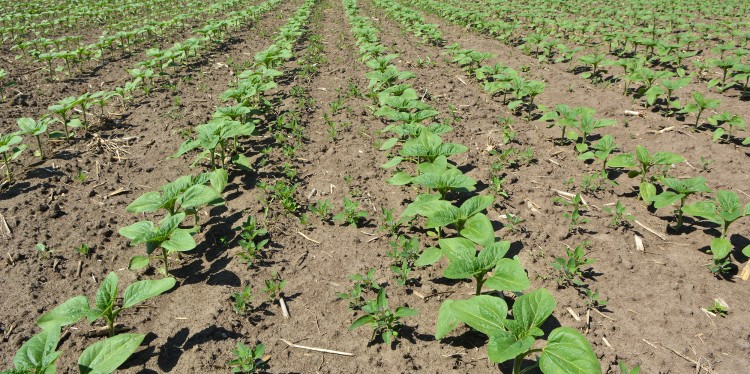
In New York state, many vegetables are planted in 30-inch rows, wide enough for a tractor tire to pass between them. The most difficult area to manage is the narrow band around the plants, roughly 4 inches wide, extending about 2 inches on either side of the crop row.
Building on a promising idea
The concept of stacking tools emerged from Brown's earlier research, which found that different cultivation implements affect weeds in different ways. Some undercut weeds by slicing just beneath the soil surface and severing roots. Others uproot weeds entirely, while still others bury them under a layer of soil. When those approaches were combined, weed control improved dramatically.
There was just one problem.
"We also decimated the crop," Brown said. "This was a follow-up study to determine whether we could maintain that level of weed control while reducing crop damage."
Small changes, big differences
To better protect crops, the research team made several adjustments. They added GPS guidance to both planting and cultivation operations, allowing crops to grow in straighter rows and reducing the likelihood that plants would stray into the path of cultivation tools. They also replaced one implement with gentler alternatives and moved the tools a few inches farther from the crop row.
"As a result of all those changes, we had less contact with the crop," Brown said. "Even though the tools were positioned a few inches farther away, they were still able to dislodge weeds while reducing the risk of crop injury."
The three-tool combinations provided stronger weed control without significantly reducing survival of well-established crops.
Size matters
One of the study's clearest findings was that crop size relative to weed size plays a major role in cultivation success. The larger the crop's head start over emerging weeds, the more aggressively growers can cultivate.
"It's going to be as effective as possible on the tiny weeds," Brown said, "whereas the more robust, well-rooted crop plants are more likely to survive."
Researchers set a target of achieving 80% weed control with no more than 5% crop loss. To meet that goal, a single cultivation tool required the crop to be about 6.2 times taller than the weeds. Using two tools reduced the requirement to 5.6 times taller, while three stacked tools lowered it to 3.6 times taller.
In other words, stacking tools gives growers more flexibility. Because the implements attack weeds in complementary ways, the system can succeed even when crops have a smaller competitive advantage.
To test the approach under challenging conditions, the team selected snap beans and beets, both direct-seeded crops. Snap beans can compete with weeds to some extent, but beets generally cannot.
Even in beets, the stacked systems improved weed control without significantly affecting survival of well-established plants.
Within reach for most farmers
While GPS-guided cultivation may make the most sense for larger operations, Brown said the concept of stacking cultivation tools is accessible to many growers.
"A lot of these tools can just be attached onto the back of existing cultivators," he said. "Cultivation is shallow, so it does not require much horsepower. Adding more tools to make each pass as effective as possible makes a lot of sense."
Brown added that stacked hand tools are also becoming available, opening the possibility that smaller-scale farms could benefit from the approach.
He emphasized that stacked cultivation should be viewed as one component of an integrated weed management strategy.
"I like to see a broad array of weed management tactics being employed, whether that's chemical, thermal or physical," Brown said. "It diversifies the selection pressure and reduces the burden on any one tactic."
With agricultural equipment manufacturers beginning to offer their own stacked cultivation products, Brown sees opportunities to continue refining how different tool types work together in the years ahead.
CHRISTINA SZALINSKI is a freelance writer for Cornell University's College of Agriculture and Life Sciences.