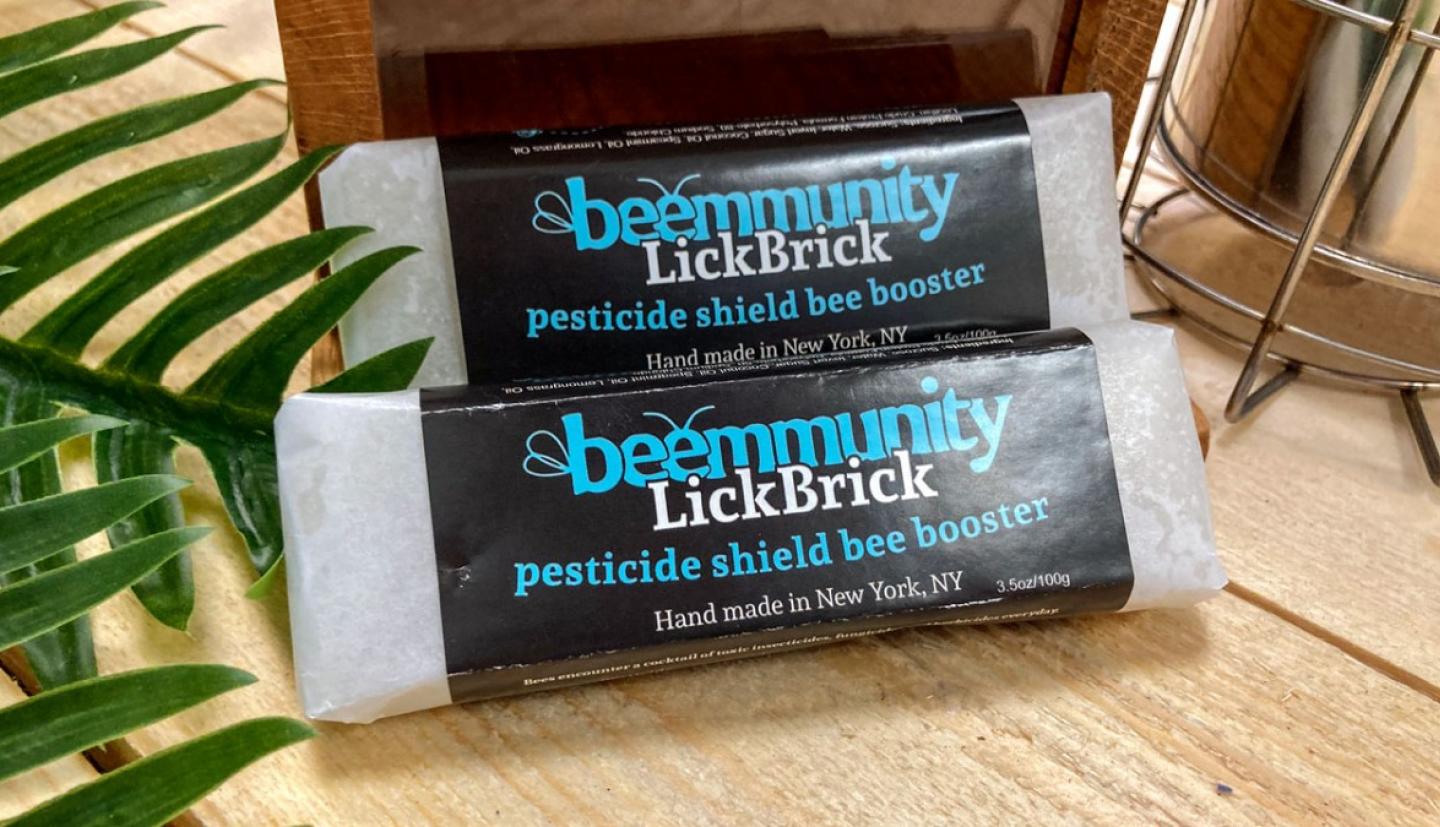
An early version of the technology – which detoxified a widely-used group of insecticides called organophosphates – is described in a new study, “Pollen-Inspired Enzymatic Microparticles to Reduce Organophosphate Toxicity in Managed Pollinators,” published May 20 in Nature Food. The antidote delivery method has now been adapted to effectively protect bees from all insecticides, and has inspired a new company, Beemmunity, based in New York state.
Studies show that wax and pollen in 98% of hives in the U.S. are contaminated with an average of six pesticides, which also lower a bee’s immunity to devastating varroa mites and pathogens. At the same time, pollinators provide vital services by helping to fertilize crops that lead to production of a third of the food we consume, according to the paper.
“We have a solution whereby beekeepers can feed their bees our microparticle products in pollen patties or in a sugar syrup, and it allows them to detoxify the hive of any pesticides that they might find,” said James Webb, M.S. ‘20, a co-author of the paper and CEO of Beemmunity.
First author Jing Chen is a postdoctoral researcher in the lab of senior author Minglin Ma, associate professor in the Department of Biological and Environmental Engineering in the College of Agriculture and Life Sciences (CALS). Scott McArt, assistant professor of entomology in CALS, is also a co-author.
The paper focuses on organophosphate-based insecticides, which account for about a third of the insecticides on the market. A recent worldwide meta-analysis of in-hive pesticide residue studies found that, under current use patterns, five insecticides posed substantial risks to bees, two of which were organophosphates, McArt said.