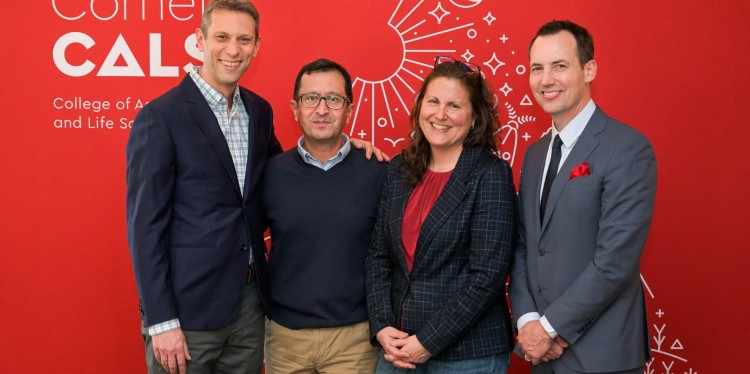
Given during the annual CALS Faculty and Staff Awards ceremony, the award recognized McArt and Calixto for conducting, synthesizing and communicating science on neonicotinoid insecticides, which led to the passage of the New York State Birds and Bees Protection Act, designed to preserve pollinator and bird health and protect New Yorkers from harmful toxins by prohibiting the use of neonicotinoid treated seeds in corn, soybean, wheat seeds and in ornamental plants and turfs for non-agricultural production.
CALS Dean of Translational Research Julie Suarez, who played an essential role in bridging the divide between research and public awareness, lauded McArt’s and Calixto commitment to ensuring understanding and opportunities among policymakers and growers.
“Integrating science into public policy can be extremely complex; requiring the ability to credibly, authentically and without bias communicate what is and is not known in the scientific community on highly controversial issues like neonicotinoid seed treatments. “The team award presented to Dr. Calixto and Dr. McArt for excellence in science in public policy is so well-deserved. The recognition reflects the incredible hard work, willingness to travel anywhere in New York State to talk to farmers, agri-businesses, environmentalists and public policy officials, and a desire to ensure that farmers can have confidence in the science as a result of the largest set of on-farm field trials in the history of the Cornell IPM Program is simply exemplary.”
Work on the project began in 2018 when McArt’s team was commissioned by the New York State Legislature to conduct a formal risk-benefit analysis on neonicotinoid insecticides. The result was a 432-page report that leveraged research and expertise from Cornell IPM and CALS faculty, staff and researchers.
Published in 2020, the report led to countless meetings for McArt, Calixto and Suarez to communicate its findings to approximately 200 state policymakers. Ultimately leading to the 2023 adoption of the Birds and Bees Protection Act. McArt and Calixto have now shifted their efforts to communicate about current research and alternatives to neonicotinoids to ensure that New York growers have the tools they need to combat seedcorn maggots and other pests of large-seeded crops.
“While Scott and I are humbled and grateful to receive this recognition, the award is truly a testament to the work of dozens of people in our respective programs, Dean Suarez, Cornell Cooperative Extension Regional Teams, Entomology faculty and throughout CALS who have worked tirelessly to communicate the importance of pollinator health, research and grower resources across New York State and nationwide,” Calixto said.