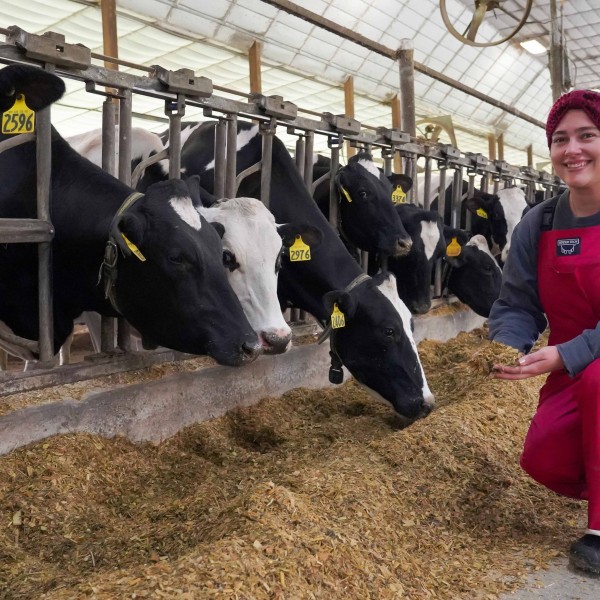
New York Governor Andrew M. Cuomo today unveiled his budget plans during the 2019 State of the State and Budget Address in Albany. His proposals include $5 million in funding to agricultural programs in the state of New York.
Kathryn J. Boor, the Ronald P. Lynch Dean of CALS, said:
"Strong, vibrant leadership is essential to protecting the health of our communities, our farms and the lives of every person in New York State. Governor Cuomo recognizes the role science plays in tackling the challenges facing our great state. His call for fully realizing the potential of New York State farms to be a productive part of a comprehensive climate change adaptation and mitigation strategy is critically important, and backed by a considerable amount of Cornell CALS faculty climate science research.
"From addressing soil health and investing in emerging crops such as industrial hemp and malting barley, to funding improvements at our Arnot Teaching and Research Forest to supporting New York’s maple industry, this budget proposal provides vital resources we need to push the boundaries of knowledge at a time when there is much to be done. I am particularly grateful for the governor’s continuation of resources for many of Cornell CALS’ flagship statewide extension and research programs including our 30-year-old PRO-DAIRY program and the NYS Integrated Pest Management program, which assist our farms in meeting economic and environmental goals.
"We share the governor’s vision to make New York the preeminent leader in food and farming innovation, and we are committed to solving the toughest problems while serving the public good."
Contact the Cornell CALS Office of Marketing and Communications:
Contact us by email: Samara.Sit [at] Cornell.edu (Samara[dot]Sit[at]Cornell[dot]edu)
Contact us by phone: (607) 255-2204