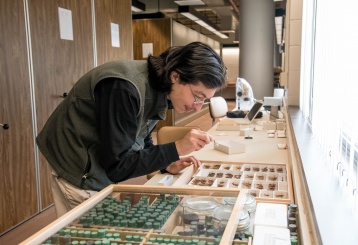
Brandon Woo
When entomology major Brandon Woo '19 was eight years old, his mother took him to a park in Maryland to witness a brood of 17-year cicadas emerge. Ever since that day he knew he wanted to study insects.
Wide-eyed, Woo explains, "They're really striking animals — black with red eyes and bright orange wings. The nymphs, or babies, live underground sucking sap from tree roots for 17 years, and then on some unknown cue, they emerge en masse. They sing, they lay eggs for about six weeks, and then they're gone for another 17 years."
As a boy, when Woo saw the cicadas emerge, shedding their skins, flying around, singing their staccato chorus, he thought it was the coolest thing ever. Now he's thrilled to be studying entomology at Cornell, where a big highlight is his job at the Cornell University Insect Collection (CUIC), a world-class research and training collection that includes over 7 million insect specimens representing about 200,000 species, or roughly 20 percent of the world's described insect fauna.

Rocky Mountain Locust
It was while working at CUIC that Woo made an exciting discovery. In a collection of unidentified material, Woo identified three specimens of the extinct species Melanoplus spretus, or the Rocky Mountain locust. The specimens had been unidentified in the Cornell collection since around 1893.
When asked about his plans for the future, Woo says with certainty, "Taxonomy. Insects greatly outnumber almost every other organism on the planet. There are so many new species being described every day, and once you have a name for something, you can look at its behavior or its ecology. I like looking at the diversity of life — the different species all do so many awesome and important things."