

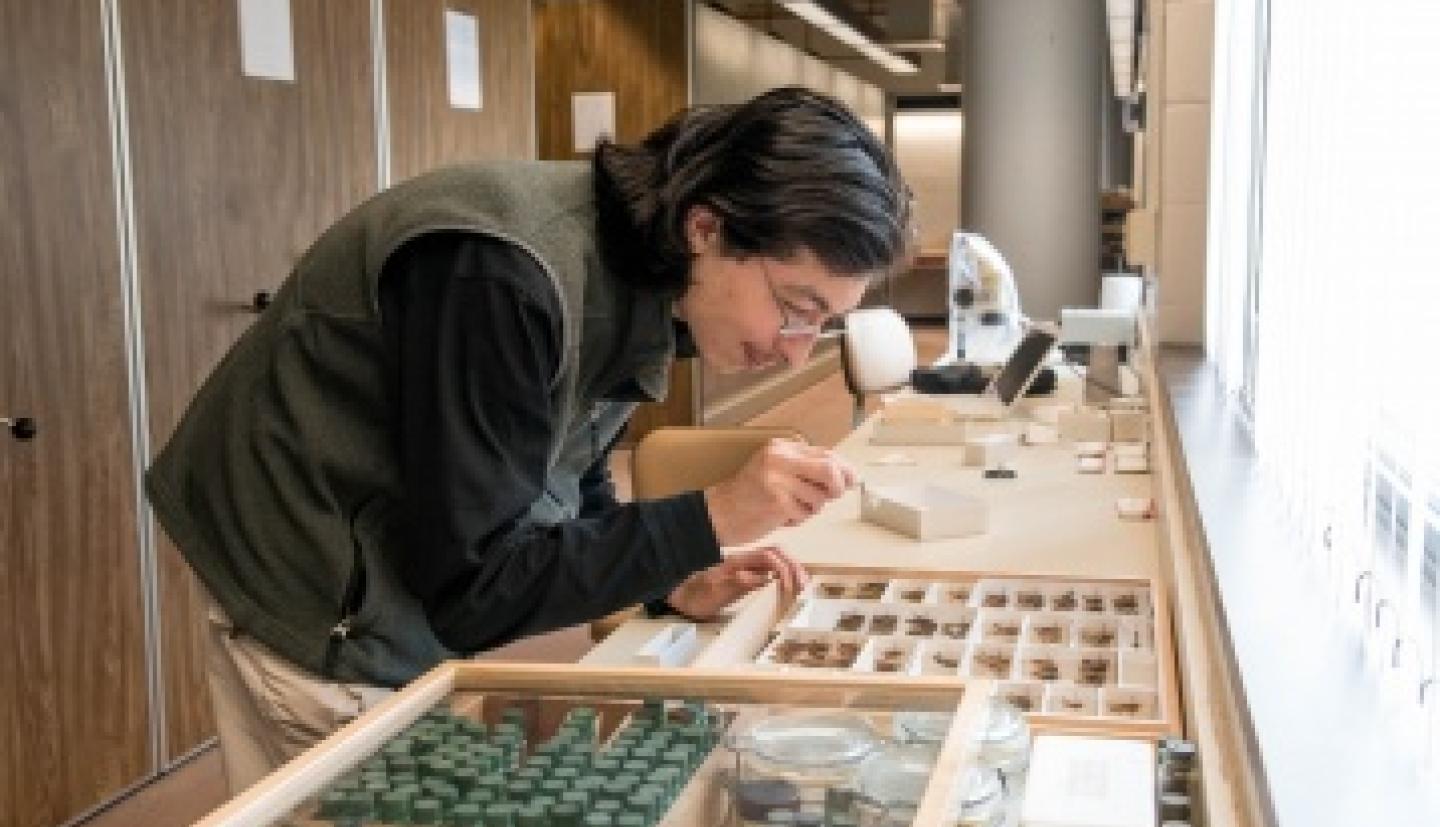
While organizing drawers of unidentified grasshopper specimens at the Cornell University Insect Collection (CUIC), something caught the eye of Brandon Woo ’19.
Three oddly shaped dull brown specimens with extra-long wings stood out to the Cornell entomology student whose area of focus is a group of insects called orthopterans, which includes grasshoppers, locusts, crickets and katydids. Comparing the specimens’ lot number to a CUIC log book, Woo learned he had uncovered Melanoplus spretus, the Rocky Mountain locust, an extinct pest that wreaked agricultural havoc 150 years ago.
“Every continent in the world has one or two species of plague locust,” said Woo. “North America doesn’t have one anymore, but it used to. And it was this one.”
Near the end of the 19th century, as settlers moved west over the Great Plains, the Rocky Mountain locust swarmed across prairies, devouring everything in its path and putting people’s survival at risk. It has been credited for creating the largest recorded swarm of locusts in history. A swarm in Nebraska in 1874 covered an approximate 198,000 square miles, nearly twice the size of the state of Colorado.
Eventually, entomologists learned that these pests routinely retreated to strongholds in the Rocky Mountains, where females laid eggs in the soil. Farmers tilled the land where females laid eggs, destroying their egg pods, and over time this took a toll on the species. This is significant, said Woo, because it’s the only instance of a major pest insect being eradicated.

The five specimens of Rocky Mountain Locusts now in the Cornell University Insect Collection. (Matt Hayes / College of Agriculture and Life Sciences)
“Usually they occur in such numbers and wide locations, they’re impossible to get rid of. Humans exploited the fact that this locust had small localities to retreat to in order to breed,” he said.
When the Rocky Mountain locust was swarming there were so many that people didn’t bother to collect them. Now that they’re extinct, it’s rare to encounter specimens, or even to be able to identify them. The specimens Woo identified were purchased along with others from professor Lawrence Brunner of the University of Lincoln, Nebraska, around 1893. The three specimens now join the collection’s two previously identified locusts.
Access to insect specimens like the Rocky Mountain locust is of immense scientific value to entomological researchers, said Jason Dombroskie, CUIC collection manager and coordinator of the Insect Diagnostic Lab. Specimens – especially extinct ones – provide entomologists with the knowledge base to refine the classification of insects and provide insights into the morphology of these creatures.
The CUIC, housed in Comstock Hall, includes more than 7 million insect specimens representing about 200,000 species, or roughly 20 percent of the world’s described insect fauna.


