Rosy Apple Aphid (Dysaphis plantaginea)
Fruit Fact Sheet
Rosy apple aphid (RAA) is found in apple-growing regions of North America. It feeds on apple leaves and fruits in spring, then moves to other plants in summer. RAA attacks all apple varieties, with Cortland, Monroe, and others being most susceptible.
In this fact sheet
- Biology of rosy apple aphid
- Damage of rosy apple aphid
- Monitoring rosy apple aphid
- Managing rosy apple aphid
- Guide to stages
Rosy apple aphid (RAA) can be found throughout the apple growing regions of North America. In the spring, the aphids feed on apple leaves and fruits, and in the summer move to alternate hosts, such as narrow-leaved plantain. RAA will attack all apple varieties, but varieties such as Cortland, Monroe, Rhode Island Greening, Ida Red, and Golden Delicious are particularly susceptible.
Biology of rosy apple aphid
Adults
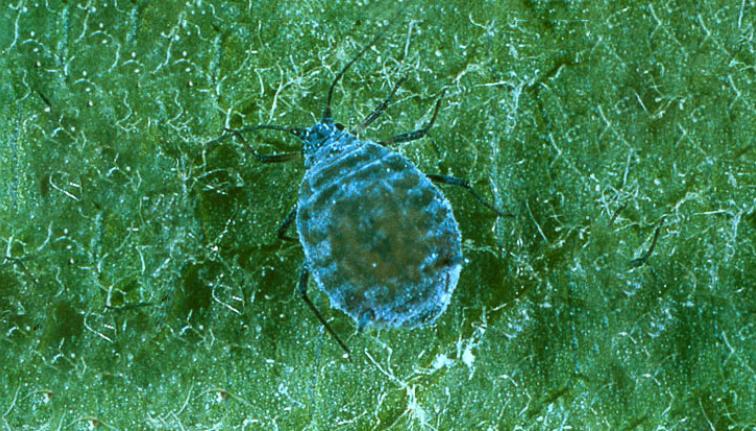
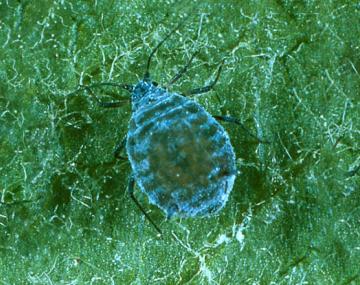
Overwintering eggs give rise to only female aphids known as stem mothers (Fig. 3) which give birth to living young. A few winged adults are produced in the second generation and proportionately more are produced in the third and fourth generations. These winged adults, produced between May and mid-July, leave the apple trees and move to weed host plants to spend the summer. The winged migrant adults are colored brownish-green and black and are 2.0-2.5 mm in length. Narrow-leaved plantain and dock are two of the more important summer hosts for the RAA. They feed and produce wingless asexual forms until late summer or early fall when winged adults are again produced and the RAA migrates back to the apple trees. These adults produce offspring that in turn produce both male and female offspring. This is the only time male RAA are produced. When these males and females become adults, they mate and the females lay eggs to carry the species through the winter.
Eggs
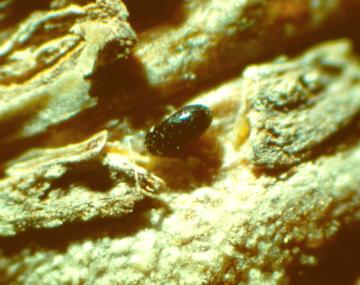
RAA produces eggs only in the fall and continues to do so until heavy frosts kill all the females. The aphid overwinters in the egg stage. The ovate eggs, which measure .4 mm in length, are laid in the fall on twigs, bud axils, or in crevices in the bark. The eggs are a pale green color when first laid and then turn shiny black (Fig. 1 ), and are impossible to differentiate from apple grain aphid and green apple aphid eggs. The eggs hatch between silver tip and half-inch green.
Nymphs
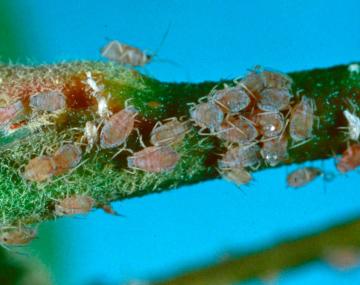
RAA passes through 5 nymphal instars, increasing in size from .4 to 2.0 mm (Fig. 2). As the aphids grow, their color changes from dark green to rosy brown or purple and they acquire a powdery white covering. In early spring, RAAs move to the developing fruit clusters and become reproductive adults during bloom. It takes 2 to 3 weeks for a RAA to mature.
Damage of rosy apple aphid
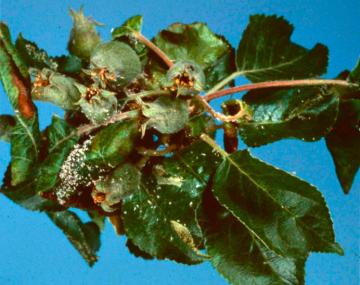
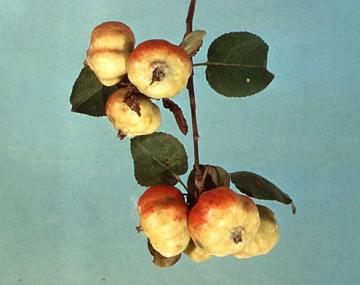
RAA feeding causes apple leaves to curl (Fig. 4) and often turn a bright crimson. Leaf curling normally does not become obvious until about petal fall. Feeding on the leaves of fruit clusters often results in bunching, stunting, and malformation of the fruit (Fig. 5), which becomes noticeable as the fruit develops and renders it unmarketable. Honeydew produced by the aphids provides a media for the growth of a sooty mold fungus which can affect the fruit finish.
Monitoring rosy apple aphid
Monitoring for RAA is possible at pink after egg hatch begins since the eggs of apple grain aphid and apple aphid are identical to rosy apple aphid eggs. Starting at early pink, select 5 to 10 trees per block. Sensitive varieties such as ‘Cortland', 'Ida Red', and 'Golden Delicious' should be selected if present. For 3 minutes, on each tree, count the number of fruit spurs showing curled leaves. The presence of more than one aphid-infested cluster per tree justifies an insecticide treatment to prevent fruit injury. Samples should be taken from the upper parts of the canopy on the inside of the tree where rosy apple aphid colonies are most common.
Rosy apple aphid management
The green apple aphid, apple-grain aphid, and rosy apple aphid overwinter as eggs on twigs and bark crevices of apple trees. A delayed dormant oil application between green-tip and half-inch green controls newly hatched aphids. Other options include one spray of Esteem at half inch green, or one spray of Beleaf from green tip to pink bud. Exirel and Minecto Pro should be applied green tip to early pink, and should include an effective adjuvant. Other options before pink include: Sivanto Prime, Versys Inscalis, and Besiege.
Treatment is best done no later than pink, as this is when most damage will occur. You can consider a pink spray (non-pyrethroid options include Actara, Assail, Beleaf, Esteem, Lannate, Lorsban, or Vydate) if you have the luxury of a suitable application window. Be sure to consider potential impacts on non-target species such as beneficials, and be aware of your bee supplier's concerns about effects on pollinating bees. After petal fall, because the curled leaves protect the aphids, the best control will be achieved with a systemic insecticide. Some insecticide options include Admire Pro and Movento (active ingredient: spirotetramat*, at a rate of 6 to 9 fl. Oz).
*Spirotetramat is an insecticide derived from tetramic acid, a systemic material, for the control of sucking insects in their juvenile, immature stages, including aphids, scale insects, and whitefly. It produces growth inhibition of younger insects, reduces the ability of insects to reproduce, resulting in mortality. Spirotetramat is harmless to slightly harmful to beneficials such as hoverfly larvae, spiders, predatory bugs, wasp parasites, lady beetles and lacewings.
Guide to rosy apple aphid stages
- Adults (wingless)
Timing: Pink to mid-July and again in the fall.
Where to look: Cluster or terminal leaves. - Adults (winged)
Timing: Petal-fall through mid-July and again in late summer through frost.
Where to look: Leaves and twigs. - Eggs
Timing: Fall to bud burst.
Where to look: Twigs, bud axils, bark crevices. - Nymphs
Timing: Silver tip through June, often found on apples several weeks after bloom.
Where to look: Cluster or terminal leaves.
Authors
- Monique Rivera
Department of Entomology, Cornell University - Michael Basedow
Eastern New York Commercial Horticulture Program, Cornell Cooperative Extension - Janet van Zoeren
Lake Ontario Fruit Program, Cornell Cooperative Extension
Last updated: 2022
Modified from an article written by R. Weires and J. Leeper: Weires, R., Leeper, J. (1980). Rosy Apple Aphid. New York State Agricultural Experiment Station.
- Figure 1. Rosy apple aphid egg. Photo: NYSAES, Cornell University
- Figure 2. Rosy apple aphid nymphs. Photo: NYSAES, Cornell University
- Figure 3. Rosy apple aphid adult. Photo: NYSAES, Cornell University
- Figure 4. Apple injury caused by the rosy apple aphid. Photo: NYSAES, Cornell University
- Figure 5. Apple fruit injury caused by rosy apple aphid. Photo: NYSAES, Cornell University
- Figure 6. Guide to stages of the rosy apple aphid.Credit: NYSAES, Cornell University
- aew232 [at] cornell.edu
- monique.rivera [at] cornell.edu
- (518) 410-6823
- mrb254 [at] cornell.edu
- (585) 797-8368
- jev67 [at] cornell.edu