Sheep Bot Fly (Oestrus ovis)

Livestock IPM Fact Sheet

The sheep bot fly (Oestrus ovis) is a worldwide parasite of sheep and goats. Its larvae invade nasal passages, causing sneezing, stress, weight loss, and lower wool or milk production. Severe infestations may require ivermectin treatment.

The sheep bot fly (Oestrus ovis) is a parasitic fly whose larvae infest the nasal passages of sheep and occasionally goats. This obligate parasite is found worldwide. While often undetected and not always fatal, infestations can sometimes lead to malnutrition and death. In North America, Oestrus ovis is generally not considered an economic issue but can cause occasional problems.

Identification of sheep bot fly

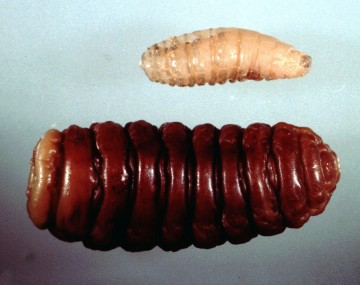
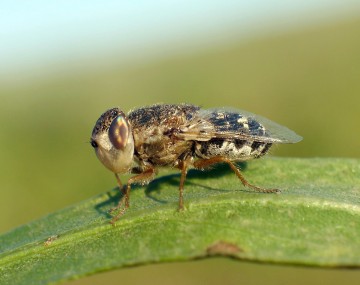
The adult fly measures approximately 0.79 inches (10 millimeters) in length and is characterized by a light yellowish head and a gray body. Like many flies, its wings are transparent. The larvae undergo significant changes during development. In the first instar, they measure about 0.04 inches (1 millimeter) in length and grow to approximately 1.18 inches (30 millimeters) by the third instar. Initially, the larvae are white, but they gradually turn tan as they mature into the third instar. The pupae are brown.

A close-up of two sheep bot fly larvae at different stages of maturity resting on a plain, light-colored background. The immature larva positioned on top is small, pale yellowish-white, and lightly segmented. Below it, the mature larva is significantly larger and thicker, featuring a glossy, dark reddish-brown exterior with deeply ridged, pronounced segments along its body.

Figure 2. Sheep bot fly larva—immature at top; mature at bottom
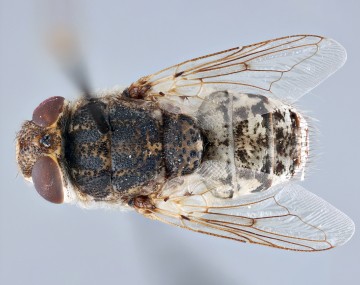
Adult sheep bot fly viewed from above against a light gray background. The fly has large reddish-brown compound eyes, a dark mottled thorax, pale abdomen with dark banding, and two clear veined wings extending along the body.

Figure 3. Adult sheep bot fly

A close-up, side-profile view of an adult sheep bot fly resting on a green leaf. The stout fly has a fuzzy, brownish-grey mottled thorax and a black-and-white patterned abdomen. Its translucent wings are folded flat over its back. The fly has a pale, somewhat bulbous face and large eyes with a slight iridescent reddish-purple sheen.

Figure 4. Adult sheep bot fly in pasture

Life cycle of sheep bot fly 

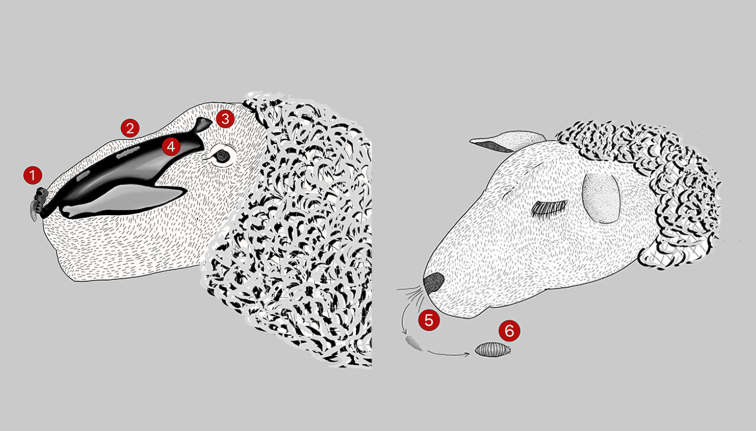
The female fly does not lay eggs directly. Instead, the eggs hatch within her body, and she gives birth to live larvae, a process known as larviposit. These larvae are deposited in a droplet near the nostrils of the host. Once deposited, the larvae enter the host's nasal passages, where they develop and mature.

The female fly lives up to three weeks. They deposit 2 to 20 larvae on the host's nose and can produce up to 500 deposited larvae over the adult lifespan. The adult female fly does not feed. Depending on the climate, the larvae can survive within the nasal area for 2 to 9 months. The three larval instars develop inside the nasal canals. In New York State, this typically happens between July and August. Upon reaching the third instar, the larvae exit the nasal passages, drop to the ground, and pupate in the soil.

Damage of sheep bot fly

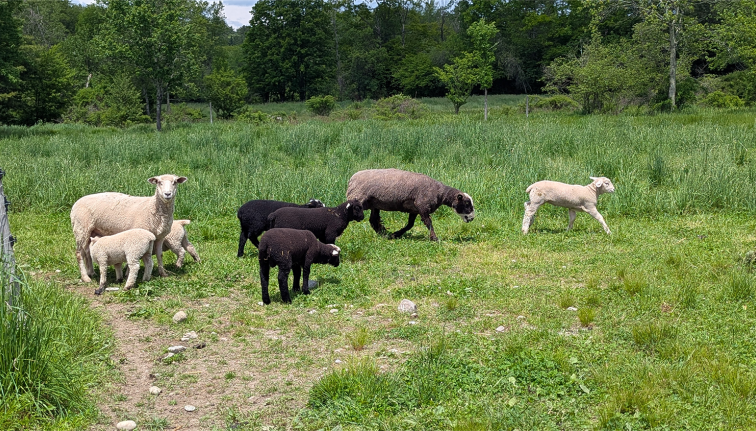
When flies are present, sheep exhibit defensive behaviors, such as huddling together and protecting their noses. They often push their noses into the wool of other sheep or down into the grass to shield themselves from infestations, which interrupts their feeding time. Other common behaviors include stomping and running.

Signs of bot infestation in sheep include excessive head movement, nasal discharge, sneezing, and visible discomfort. In severe cases, larvae may become lodged in the nasal cavity or sinuses, potentially leading to death. While bot flies generally do not cause significant economic losses in sheep, they can occasionally infect the eye, leading to irritation. In such cases, a veterinarian may need to extract the larvae from the eye.

High populations of larvae within the nose can result in weight loss, reduced wool yields, and decreased milk production. In warmer climates, sheep bot flies can cause more substantial damage and economic losses. However, in colder climates, their impact is generally minimal.

Treatment for sheep bot fly

Controlling the adult flies is not recommended as site specific timing of the flies on animals is rather random. There are no traps and repellents that are effective. External insecticides are not effective against the adult flies. 

Most sheep infected with sheep bot fly larvae (Oestrus ovis) do not require treatment. If mildly infected, animals show few or no obvious clinical signs.

However, if an animal shows signs of a problem caused by sheep bot larvae, treatment may be necessary. Effective treatments include the use of ivermectin, abamectin, or moxidectin.

Any time you use a pesticide, you must read and follow the label directions and comply with all applicable laws and regulations related to pesticide use. Also be sure that any pesticide used is approved for use in your country and state/province.

Authors

  • Ken Wise
    Associate Director, Agricultural IPM, Dairy/Livestock IPM Coordinator, Cornell Integrated Pest Management
  • Hannah Tolz
    Extension Support Specialist, Cornell Integrated Pest Management
  • Sean O’Hehir 
    Field Research Technician, Cornell Hudson Valley Lab

Last updated: July 1, 2026

Funding for this material was provided by a USDA EIP Grant (2024-70006-43573).

portrait of Ken Wise
Ken Wise

Associate Director, Agricultural IPM, Dairy/Livestock IPM Coordinator

Cornell Integrated Pest Management

Ken Wise
  • klw24 [at] cornell.edu
A headshot photo of Hannah Tolz
Hannah Tolz

Extension Support Specialist

Cornell Integrated Pest Management

Hudson Valley Research Laboratory

Hannah Tolz