Cattle Lice
Livestock IPM Fact Sheet
Lice are a skinborne pest of livestock which can irritate cattle, harming the animals’ health and reducing growth or milk production. Infestations can rapidly spread through a herd, so regular inspections and proactive treatment are important.
In this fact sheet
- Identifying cattle lice species
- Symptoms of cattle lice
- Life cycle of cattle lice
- Managing cattle lice
Featured image
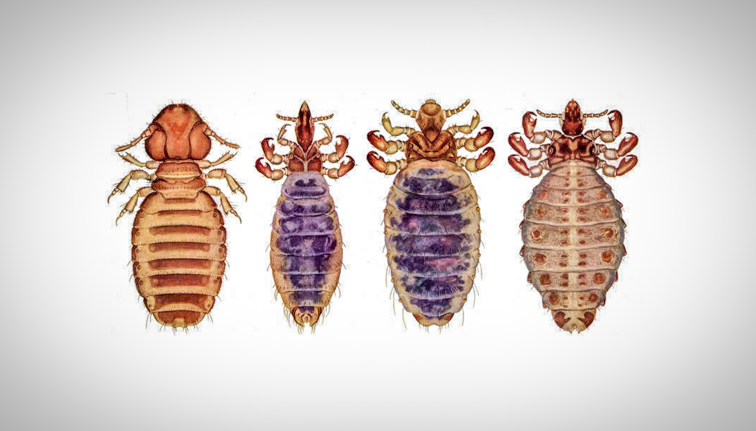
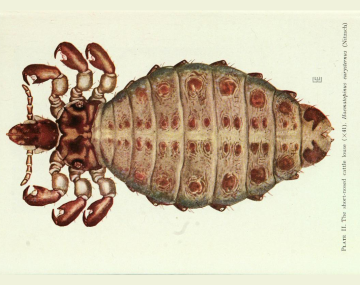
Figure 1. Four species of cattle lice present in New York State. From left to right: Little Red Cattle louse, Long Nosed Cattle louse, Little Blue Cattle louse, and Short-Nosed Cattle louse.
Lice are among the most important insect pests of cattle, especially in New York where long, cold winters keep cattle huddled together for many months of the year. Lice cannot survive off a host animal for an extended period of time, but low levels of infestation within a herd can quickly grow to levels that damage the health and productivity of cattle. Management requires direct inspection of cattle’s skin and prompt treatment when populations reach above threshold. Calves are particularly sensitive to lice damage. It is also important to inspect and quarantine new additions to the herd, to make sure they are not introducing parasites or other diseases. While many treatment options exist, the efficacy of application depends on the species of lice being treated.
In New York State, four species of lice are considered economically important pests of cattle: the short-nosed sucking louse (Haematopinus eurysternus), the long-nosed sucking louse (Linognathus vituli), the little blue sucking louse (Solenopotes capillatus), and the red cattle chewing (biting) louse (Bovicola bovis).
Identifying cattle lice species
- Short-nosed sucking louse: Large (about 1/8 to 1/5 inch or 3.2-5.1 mm), brown-gray, broad head; found on top of neck, on the ears, and on the brisket
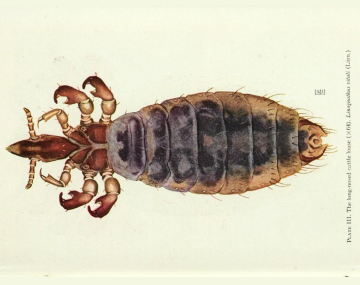
- Long-nosed sucking louse: Small (1/10 inch or 2.5 mm long), long thin head (twice as long as broad), slender body, typically bluish-black to almost black; found on neck, dewlap, and shoulders
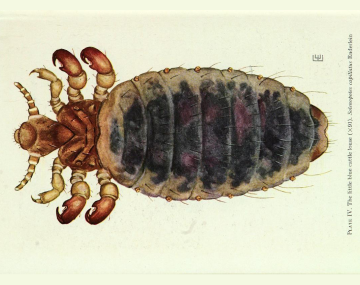
- Little blue sucking louse: Very small (1/16 inch or 1.2-1.7 mm), blue-gray; often found around the eyes and muzzle
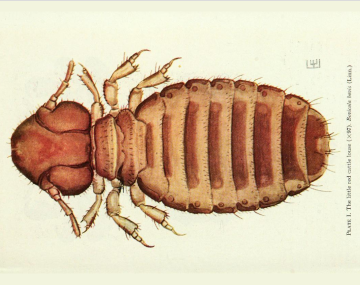
- Red cattle chewing louse: Small (1/16 inch or 1.7-2 mm), reddish-brown; fast moving; found along the topline and flanks. Populations are almost completely female, and reproduction takes place without mating.
Lice are very host specific. Cattle lice cannot survive off a host animal, nor can they affect people or other species of livestock. Sucking lice tend to cluster together and stay in one place when disturbed. While sucking lice are perceived as causing more harm by feeding on blood compared to chewing lice, which feed on dead skin, chewing lice have proven far more common in New York State historically. Because they do not feed on blood, systemic insecticide treatments do not work on them. Chewing lice, Bovicola bovis, can be distinguished most clearly by their red color, by their tendency to move when disturbed, and by their preference to stay separate from other lice.
Symptoms of cattle lice
Lice infestations can lead to hair loss, raw spots, and cold damage from exposed skin on cattle. In severe infestations, lice can cause weight loss, anemia, decreased milk production, and general unthriftiness. Cattle experiencing heavy infestations will rub against fences to relieve irritation, which can cause open lesions which are then susceptible to microbial infection. Rubbing also causes damage to infrastructure, and irritated cattle can be a danger to the people handling them. Calves are even more affected, and lice infestations can impair their development and lifetime performance. The estimated economic losses due to lice damage in the livestock industry were around $125 million per year in 1992, equivalent to almost $300 million in 2026 adjusted for inflation.
Figure 2. Little Red Chewing/Biting Lice have a broader head suitable for chewing on skin debris, lack the crab-like claws of the other cattle lice, and show prominent crossbars on the abdomen.
Life cycle of cattle lice
Cattle lice cannot survive off a host animal for much more than a day, so the entire lifecycle occurs on the cattle itself. The eggs, known as nits, are attached to hairs and hatch in about two weeks. The development from hatch to adult takes about two to three weeks, with nymphs resembling adults in all but size. Females will lay an egg every 1-2 days during their adult lifespan, which can last up to 40 days. A full cycle egg to egg can occur in 29 days.
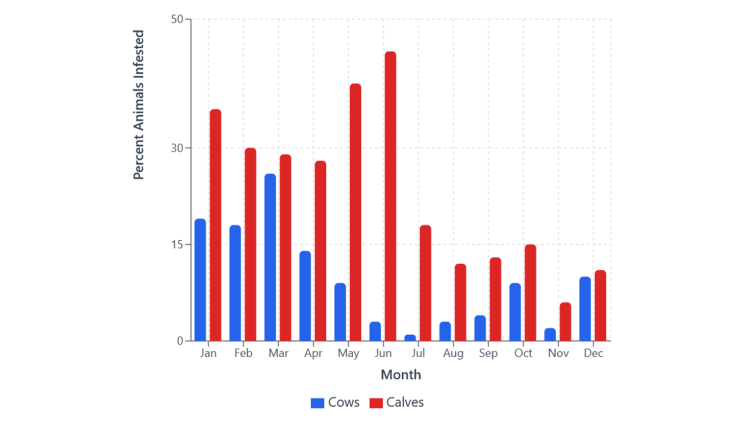
Lice populations are naturally low during summer when cattle are on pasture. Sunlight and airflow help keep numbers down below treatment thresholds. On a warm day in direct sunlight, a cow’s skin is hot enough to kill lice, around 120° F. Problems develop in winter when cattle grow thick coats and stay close together, which create conditions more conducive to lice reproduction and development. Lice populations peak in late winter and can remain high until June, when warm temperatures slow their growth.
Seasonal populations chart
Figure 6. Lice infestations on cows begin to increase in December and reach peaks in March, falling as temperatures rise. Data from Bishop et. al 1990.
Management of cattle lice
Monitoring
Begin routine inspections in September. Monitoring is conducted with a "two handed hair part," inspecting the skin around the cheeks, eyes and muzzle for sucking lice, and in several locations along the poll, withers, and topline for chewing lice. At least 10 animals in every group should be inspected. Populations below 5 per square inch can be considered tolerable, while populations of 10 or more per square inch call for treatment.
In high infestations cattle lice can be easy to identify as they gather in large clusters visible from several feet away. Chewing lice can be more difficult to assess, because they tend not to concentrate in groups. As mentioned above the individual chewing lice may jump when disturbed
Prevention
Biosecurity measures should be taken to prevent introducing carriers of lice to an uninfested herd. Inspecting new cattle brought onto the farm is crucial, and new animals should be isolated and observed for at least three weeks. Individual outdoor calf hutches can help minimize lice spread when appropriately maintained. Cattle farms with good sanitation practices show low populations of lice overall.
A recent study has shown that essential oils of lavender, thyme and clove, which are often included in fly sprays, can significantly reduce the rate of lice infestation. The essential oils were mixed into mineral oil, the formulation was applied as a pour-on along the topline, and then rubbed into the coat. There was also a reduction in existing lice populations following this treatment.
Treatment
Various insecticides are effective against lice, and treatments should be applied twice, with applications spaced 10 to 14 days apart to account for egg hatching. Systemic insecticide injections are only effective against sucking lice, while other application methods are used for biting/chewing lice.
Insecticides can be applied via pour on formulations, sprays, or dusts. While the best application method depends on the setting and other management practices, dusts have historically been supported as most effective. Dust bags or scratcher-groomers can be set up to allow for self-application. It is important to rotate active ingredients to reduce risk of developing resistance.
Please check VetPestX for products to use. Make sure the insecticides are registered for use in New York State. Approval may be different for milking cows than other cattle.
Any time you use a pesticide, you must read and follow the label directions and comply with all applicable laws and regulations related to pesticide use. Also be sure that any pesticide used is approved for use in your country and state/province.
Author
Jacob Leeser
Extension Support Specialist, Cornell Integrated Pest Management
Last updated: January 2026
Modified from Geden, C., D. Steinkraus, and D. Rutz. 1989. Cattle Lice. Cornell Cooperative Extension / New York State IPM.
Cornell University Agricultural Experiment Station. (1946). Bulletin No. 832. Cornell University Agricultural Experiment Station. https://digital.library.cornell.edu/catalog/chla6068875_5582_001
Geden, C. J., Rutz, D. A., & Bishop, D. R. (1990). Cattle lice (Anoplura, Mallophaga) in New York: Seasonal population changes, effects of housing type on infestations of calves, and sampling efficiency. Journal of Economic Entomology, 83(4), 1435–1438. https://doi.org/10.1093/jee/83.4.1435
Sands, B., Bruce, J., Mackay, E., & Sanders, J. (2025). Winter cattle lice: Part 3 – Essential oils for the alternative control of cattle lice. University of Vermont Extension, Northwest Crops and Soils Program. https://www.uvm.edu/d10-files/documents/2025-02/Cattle-lice-fact-sheet-3.pdf
- Figure 1-5. Cattle Lice Microscopy. Photo: Ellen Edmonson, Cornell University Agricultural Experiment Station, Bulletin No 832
- Figure 6. Graph: Jacob Leeser, Cornell IPM. Data from Geden.
Related Links
- (860) 383-9510
- jl4353 [at] cornell.edu