Codling Moth (Cydia pomonella)

Fruit Fact Sheet

Codling moth (CM) is a common insect pest of NY orchards, native to Eurasia, whose larvae consume the fruit of various host plants, such as apple, pear, quince, hawthorne, crabapple, and walnut.

Codling moth (CM) is a pest that was introduced from Eurasia by the early 1700s, and is now well established in New York. The larvae feed on the fruit of a wide range of host plants including apple, pear, quince, hawthorne, crabapple, and walnut. CM completes 1.5-3.5 generations annually, depending on locality and length of growing season. It is the most significant fruit-feeding pest in fruit growing regions of the western United States. Although also a significant pest in the East, CM has generally been managed by sprays used to control plum curculio and apple maggot. However, with a trend toward more species specific chemistries rather than broad spectrum products which are being phased out, some growers are beginning to see more CM damage.

Biology of codling moth

Adults

The spring flight of CM adults begins when apples are in late bloom. In New York, second and third flights begin in early to mid-July and mid-August, respectively. Frequently, the second and third flights overlap, resulting in the presence of adults from early July through the remainder of the growing season. CM adults are 10-12 mm (0.5 in.) long, with a wing span of 15 to 20 mm (0.75 in). The moths are an iridescent gray to brown color with a chocolate-brown patch, containing copper to gold markings, located at the tip of each forewing (figure 1a-b). The hind wings, which are not visible when the moth is at rest, are a lighter, copper-brown color. 

During the day, CM adults remain at rest, well camouflaged, on the bark of trees. If the temperature is above 10-15.5°C (50-60°F) at dusk, the moths become active, mate, and the females lay their eggs. Under similar conditions, the moths can also be active at dawn. A female may lay up to 100 eggs. 

Eggs

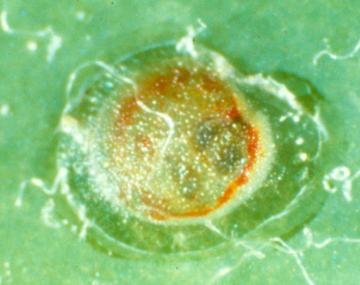
CM eggs are laid singly, generally on the upper surface of leaves, or on the fruit. The eggs are flat, oval discs measuring 1.0 by 1.25 mm (0.04 by 0.05 in.). When first laid, an egg is translucent. It later develops a reddish embryonic ring; this is called the "red ring stage" (figure 2). Shortly before hatching, the dark head capsule of the developing larva can be seen; this is called the "black head stage". Egg hatch occurs in 6-20 days depending on prevailing temperatures. First generation egg hatch begins at petal fall and continues for 2-3 weeks.

Larvae

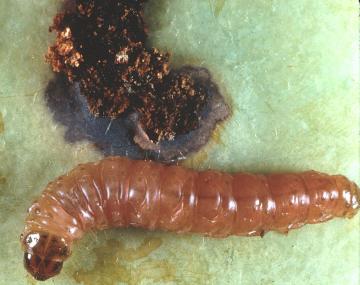
CM larvae go through 5 instars in 3-5 weeks. At egg hatch, larvae are about 2 mm (0.08 in.) long and white with a black head and thoracic and anal shields. Larvae are 13-19 mm (0.5-0. 75 in.) long when fully grown. The body is pinkish white, while the head and thoracic and anal shields are brown (figure 3).

Newly hatched larvae seek fruit, which they enter to feed and develop. Entry may be through the calyx or the opposite side of the fruit. Larvae discard their first bites of epidermis, then either feed beneath the surface or tunnel directly to the center of the fruit. CM larvae deliberately feed on the seeds of the fruit. As larval development nears completion, they eat out an exit tunnel, which they plug with frass (figure 4).

Larvae leave the fruit and construct a thick silken cocoon under loose bark or in some other protected spot. The cocoon serves as a hibernaculum for the overwintering larva.

Pupae

CM pupae are about 13 mm (0.5 in.) long and brown. The pupal period ranges from 7-30 days, depending on temperatures.

Damage of codling moth

CM larvae are fruit feeders and cause little or no injury to other plant parts. A larva may take a bite or two of a fruit causing an injury known as a "sting". Or, it may continue feeding, producing a deep entry into the fruit (figure 5). A "sting" causes a surface blemish , but unlike a deep entry, it does not result in interior breakdown of the fruit. Fruit with "stings" from the first generation usually remain on the tree, while those with deep entries usually fall during the "June drop." Subsequent generations may or may not cause premature drop, depending on the variety. Second generation larvae are active in fruit throughout August. This later, deep entry damage is a more significant problem because affected fruit must be culled. Failure to cull may downgrade a load.

An adult codling moth viewed from above. The moth is an iridescent grayish light brown color that has lighter coloration alternating with the darker brown. There is a chocolate-brown patch containing copper to gold markings at the tip of each forewing. The wings are at rest so the hind wings are not visible. The antennae are the same greyish brown color and point backwards towards the body of the moth.

Figure 1a. Codling moth adult (top)

An adult codling moth viewed from above. The moth is an iridescent greyish light brown color that has lighter coloration alternating with the darker brown. There is a chocolate-brown patch containing copper to gold markings at the tip of each forewing. The wings are at rest so the hind wings are not visible. The antennae are the same greyish brown color and point backwards towards the body of the moth.

Figure 1b. Codling moth adult (side)

An egg as seen on the surface of a leaf.  The egg appears round and flat with a translucent yellow coloration. There is an orangish red ring that surrounds the edge of the egg. A clear membrane  appears to cover the egg.

Figure 2. An egg in the “red ring stage”

The codling moth pictured is seen near a darkened  entrance hole of a fruit. The larva looks like a smooth pinkish-orange caterpillar with a dark brown head.

Figure 3. Codling moth larva

A green apple with Codling Moth damage is seen still attached to the tree. Pictured is the exit tunnel created by a larva that has neared the end of its development. The tunnel  is seen on the side of the apple towards the calyx. The damage appears to be plugged with frass which looks like a  brown mass.

Figure 4. An exit tunnel plugged with frass

An apple is cut in half and pictured vertically from the peduncle to the calyx. The middle of the apple is dark and appears rotted with a visible CM larva inside. The apple’s flesh is a typical whitish yellow but the areas that have been fed on by a Codling Moth larva are dark yellow and brown. The feeding areas extend from the apple’s skin to the apple’s core.

Figure 5. A deep entry into the fruit causing interior breakdown of the fruit

Monitoring codling moth

Monitoring for CM is performed using delta traps hung in the orchards to capture adults. Traps are very important for setting biofix, determining the seasonality of adult flights (there are usually two flights, sometimes three, of this insect per year). Adult flight is used to predict egg hatch and subsequent larval emergence. They can also estimate the relative adult population density in the immediate area. 

Typical traps are triangular in shape with a sticky inner surface (e.g, delta or Pherocon IIB traps). The CM trap requires a pheromone, which comes in a rubber capsule that you can simply place in the trap on the sticky surface and replace as directed. 

To monitor CM, set traps just after petal fall, around early May (Hudson Valley), mid-May (western Western NY) or late May (Champlain Valley). Trap placement is 60 ft. into Place traps at the edge of the orchard, in the top third of the canopy where moths typically fly, adjacent to hedgerows or alternate hosts, and where possible prevailing winds typically enter the orchard.  and separate Separate traps from other CM traps by about 160 ft. and from other species' traps by about 60 ft. Check traps at least once per week for CM males. In semi-dwarf or larger trees, traps should be placed in the top of the canopy; this is not necessary for high density systems. 

First trap catch is the biofix date for the NEWA CM model. Use this date to increase precision of the degree day model spray windows. First trap catch for the second generation can also be entered into the NEWA CM model for increased precision. Degree days, calculated from base 50 F, are accumulated from the date of first sustained moth catch (the biofix). The first spray is applied at 250 DD50 after the biofix. This timing corresponds to an estimated 3% egg hatch. A second spray may be applied 10-14 days later. If pressure is not overly severe, one spray, applied at 360 DD50 after the biofix, is sufficient. A spray for the second generation should be applied 1260 DD50 after the biofix date. If CM pressure is severe, that application should be followed by another one in 10-14 days. We don't yet have any hard and fast moth capture thresholds for determining whether to spray or not spray in insecticide-only treated orchards. However, we have recognized the utility in relying on the provisional "ballpark" values of 5 CM per trap. For those using mating disruption, zero males caught in traps in disrupted orchards shows your mating disruption program is working.

Codling moth management

Predators and parasites feed on CM, but these natural enemies cannot keep this pest from reaching damaging levels in commercial orchards. 

Mating disruption

For growers planning to use mating disruption as part of their annual codling moth (CM) management program, there are a number of several products on the market that affect both codling moth and the oriental fruit moth (OFM) simultaneously, in addition to a number of products that affect just a single species. If your target is both CM and OFM, there are a number of products that affect both pests –some product options include CheckMate CM/OFM Puffer, Isomate CM/OFM TT, Cidetrak CM-OFM Combo, and Isomate CM/OFM Mist Plus. 

Among products that target a single species, there is Cidetrak CMDA Combo Meso. Please follow the label for each product for dispenser density and placement within the tree (for CM, place the dispensers in the top 20-30 percent of the tree canopy). 

For those growers who have used a mating disruption product for CM in previous years, it is likely that you will need some supplemental insecticides, especially for the first generation (see below for a listing of product choices). In addition, it is very important that you place pheromone traps in trees to monitor the success of your mating disruption program. We have conducted a number of studies with a newer lure from Trécé Inc. to monitor CM in mating disruption blocks, called a CM-DA Combo. It contains both the sex pheromone – which is released by the females to attract the males – and a kairomone (i.e., a plant-derived chemical volatile [i.e., pear ester]) that attracts both male and female moths. We recommend at least one trap per 5 acres with no less than one trap per 10 acres to determine the success of your mating disruption program. There are also powerful 10X lures available for monitoring CM male adults in mating disruption blocks. These lures allow you to monitor the activity of the moths in the “background” while the mating disruption is still working. Catching moths in traps with a 1X lure would indicate mating disruption is not working.

Conventional management

If your plan is to use just conventional insecticides for CM control, your choice of products is quite varied, depending on the stage of CM you wish to target. Products that possess ovicidal activity (i.e., affecting the eggs) should be applied as follows: Intrepid or Rimon – apply within 150–175 DD after biofix and follow up 14 days later (note, Rimon may only be used once per season in NYS). Insecticides that target the hatching larvae (i.e., 230–250 DD after biofix) are as follows: diamides (e.g., Altacor, Exirel, Verdepryn, Besiege, Voliam Flexi), organophosphates (Imidan), neonicotinoids (e.g., Assail), indoxacarb (e.g. Avaunt), spinetoram (e.g. Delegate), and Chromobacterium subtsugae (e.g.Grandevo).  Please refer to the Tree Fruit Pest Management Guidelines for rates on these products. It is important to implement good resistance management practices for all of the above products; that is, use only one of the abovethe same active ingredient for each of multiple sprayss within the same generation of CM; do not use the same active ingredients across two consecutive generations).

Biologicals

Another option that growers can consider for CM control is a codling moth granulosis virus (CpGV) (e.g., Cyd-X, Virosoft or Madex HP, the latter two containing a CpGV that is active on both CM and OFM). These products can be used very successfully in combination with mating disruption to reduce the severity of this pest. CpGV products must be ingested by the hatching larvae. The larvae will continue to feed for a couple of days before the virus kills them. CpGV products are fairly short residual (i.e., 5–7 days); thus, they need to be reapplied more often than conventional insecticides. Growers will likely need 4–5 applications per generation depending on the length of the egg hatch period, the severity of the populations, and weather conditions.

Guide to codling moth stages

  • Adults first flight
    Timing: Bloom through 30 days past petal fall 
    Where to look: Pheromone traps
  • Adults second flight
    Timing: 30 days past petal fall through harvest
    Where to look: Pheromone traps
  • Eggs
    Timing: Bloom through harvest 
    Where to look: Upper leaf surface and fruit
  • Larvae
    Timing: Petal fall through harvest
    Where to look: In the fruit
  • Overwintering larvae
    Timing: August through tight cluster
    Where to look: In cocoons under bark on trunk or lower scaffolds
  • Pupae
    Timing: Half-inch green through one week past petal fall
    Where to look: In cocoons under bark on trunk or lower scaffolds

Authors

  • Monique Rivera
    Department of Entomology, Cornell University
  • Michael Basedow
    Eastern New York Commercial Horticulture Program, Cornell Cooperative Extension
  • Janet van Zoeren
    Lake Ontario Fruit Program, Cornell Cooperative Extension
  • Anna Wallis
    Cornell IPM, Cornell University

Last updated: 2025

Modified from an article written by Arthur M. Agnello and David P. Kain: Agnello, A. M., Kain, D. P. (1996). Codling Moth. New York State Agricultural Experiment Station.

  • Figure 1. Codling moth adult. Photo: NYSAES, Cornell University or Hannah Tolz, CIPM
  • Figure 2. An egg in the “red ring stage” Photo: NYSAES, Cornell University
  • Figure 3. Codling moth larva. Photo: NYSAES, Cornell University
  • Figure 4. An exit tunnel plugged with frass. Photo: Elizabeth Tee, Cornell Cooperative Extension
  • Figure 5. A deep entry into the fruit causing interior breakdown of the fruit.  Photo: Elizabeth Tee, Cornell Cooperative Extension
  • Figure 6. Size comparison between the Codling Moth life stages. Illustration: Hannah Tolz, CIPM
portrait of Anna Wallis
Anna Wallis

Fruit IPM Coordinator

Cornell Integrated Pest Management

Anna Wallis
  • aew232 [at] cornell.edu
Janet van Zoeren
Janet van Zoeren

Integrated Pest Management Specialist

Cornell Cooperative Extension

Janet van Zoeren
Michael Basedow
Michael Basedow

Extension Associate Tree Fruit Specialist

Cornell Cooperative Extension

Michael Basedow
Fruit thinning
Applied pest management
Headshot of a woman outside in a blue shirt
Monique Rivera

Assistant Professor

Department of Entomology

Cornell AgriTech

Monique Rivera
  • monique.rivera [at] cornell.edu