Grapevine downy mildew (Plasmopara viticola)

Fruit Fact Sheet

Grapevine downy mildew is one of the most destructive and widespread diseases of grapevine. Downy mildew impairs photosynthesis, reduces yields, and can result in complete defoliation when not managed properly.

Grapevine downy mildew is caused by the oomycete pathogen Plasmopara viticolaPlasmopara viticola is native to North America but can infect wild and cultivated grape varieties across the globe. The pathogen thrives in cool, wet climates and requires high relative humidity and a temperature range of ~55-86°F (~13-30°C) for spores to germinate and infect the grapevine. Vineyards in regions where these conditions are common during the growing season are more susceptible to downy mildew outbreaks.

European grape varieties (Vitis vinifera) are generally more susceptible to downy mildew than North American varieties (ex: Concord and Niagara) and hybrids (ex: V. viniferaV. labrusca crosses). However, no cultivars are completely resistant. Downy mildew reduces yields and weakens grapevines by:

  • Impairing photosynthesis
  • Defoliating vines
  • Causing the stems, rachis, inflorescences and clusters to wither and die

Signs and symptoms of grapevine downy mildew

Downy mildew infections can occur on all young tissues: leaves, shoots, rachises, flowers, and berries. Plasmopara viticola enters these tissues through the stomata, which are small pores that permit water and gas exchange for vine photosynthesis. Symptoms start to appear 7-12 days post-infection.

Although young leaves are most susceptible, infections can also occur on mature leaves. Berries become resistant 3 weeks post-bloom.

A green grape leaf with a shiny yellow area on the leaf surface.

Foliar downy mildew lesions begin as shiny yellow “oilspots” on the leaf surface.

A photo of the underside of a grapevine leaf. Parts of the leaf are brown and there are some white spots.

Yellow downy mildew lesions eventually turn brown when the tissue dies. Severe foliar infections cause leaves to wither and fall off the vine.

A photo of the underside of a green grape leaf. There are two white spots on the leaf underside.

Spores develop when nighttime temperatures are 55-86°F (13-30°C) and relative humidity is high. Under these conditions, fuzzy white (“downy”) sporulation occurs on the leaf underside.

A green grapevine shoot covered in a white substance.

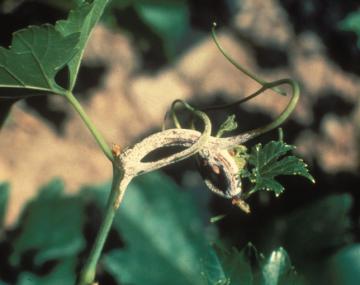
Infected shoots and rachis wither and turn brown/black. Tissue shrivels and dries out as infection progresses. In warm, wet conditions sporulation can occur on shoots and rachis.

A grapevine rachis with some small green inflorescences and some brown inflorescences.

Infected inflorescences wither, turn brown, and detach easily from the rachis. White, downy sporangia can grow from the infected inflorescences.

A grapevine cluster with green berries and a white substance covering the rachis and some of the berries.

Berries are susceptible until 3 weeks post-bloom. Infected berries turn a dull green or red-brown color and may be covered in sporangia in warm, humid weather. Infected berries shrivel and detach easily from the rachis.

 Disease cycle of grapevine downy mildew

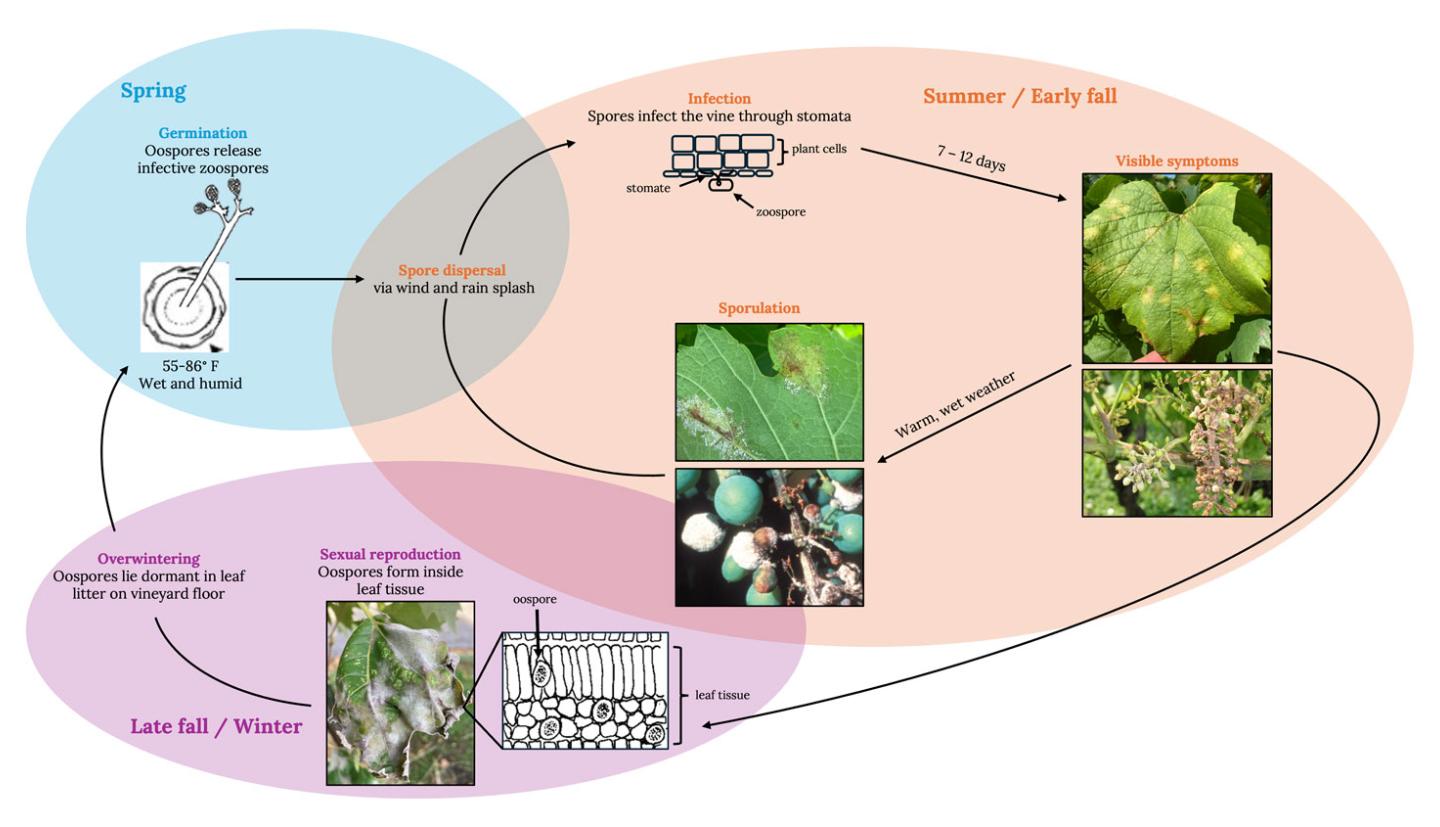
Schematic diagram of the P. viticola disease cycle.

The disease cycle begins with release of zoospores in spring or summer under warm, wet conditions. Spores infect by entering through the stomata.. Next, symptoms appear on infected tissues. Symptoms include yellow lesions on leaf surfaces, brown inflorescences, and brown berries. Spores emerge through stomata on leaf undersides and other tissues. Oospores form when sexual reproduction occurs inside leaves. Oospores overwinter in leaf litter and release zoospores in the spring and summer.

Management of grapevine downy mildew

Cultural control

Measures that promote air flow within the canopy and decrease leaf wetness will help prevent downy mildew. Recommended control measures include:

  • Shoot thinning to reduce canopy density
  • Shoot positioning in the trellis to increase air circulation
  • Leaf pulling in the cluster zone
  • Removing suckers to limit pathways for spore transport from the vineyard floor to the canopy
  • Removing leaf litter on the vineyard floor post-harvest to decrease overwintering inoculum
  • When planting a new vineyard, avoid low, shaded, wet areas with poor air flow where water accumulates during rainy weather
  • Planting less-susceptible varieties (i.e.  hybrids or native North American varieties) to reduce disease incidence and severity

Chemical control

The most critical control period for downy mildew is 2 weeks pre-bloom to 3 weeks post-bloom. This is the interval when chemical control can be most effective. However, leaves remain susceptible throughout the season and pesticide applications may be required after the critical control window to prevent defoliation. Generally, the following practices are recommended for chemical downy mildew management:

  • Early season (bud break - bloom): Broad-spectrum protectant fungicides can be effective at preventing primary infections pre-bloom. Broad-spectrum protectants should be applied when weather conditions are conducive to infection (nighttime temperatures above 60°F and rainy). 
    Note: New federal regulations may impact the availability of broad-spectrum products for downy mildew. Be sure to read the fungicide label and consult with a grape IPM specialist or viticulture extension agent.
  • Immediate pre-bloom – bloom: If downy mildew infections are already present and/or weather conditions are conducive, this is the time to apply products with specific activity against downy mildew. These kinds of products have a high risk of resistance development and should not be applied more than once per season.
  • Post-bloom – veraison: Chemical control should be used during this window to prevent severe foliar infections that can weaken the vines, slow fruit development, and increase susceptibility to winter injury. Monitor weather and apply protectants in advance of warm, wet periods. Rotate all products (never apply a fungicide with the same FRAC code twice in a row) to avoid resistance development.

Biopesticides

Biopesticides can be very effective at protecting against new infections, but are not capable of eradicating existing downy mildew outbreaks. To ensure effective downy mildew control, Cornell Grape Pathology recommends using biopesticides in rotation with other “conventional” chemical products.

For more information and detailed management guidelines see the Cornell Grape Disease Control Guide (available in English and Spanish).

Any time you use a pesticide, you must read and follow the label directions and comply with all applicable laws and regulations related to pesticide use. Also be sure that any pesticide used is approved for use in your country and state/province.

Authors

  • Kathleen Kanaley
    PhD candidate, Plant Pathology department, Cornell University CALS at Agritech
  • Dr. Kyle Bekelja
    Grape IPM Coordinator, New York State Integrated Pest Management Program, Cornell University
  • Raúl E. Lemus Garza
    Bilingual Project Specialist, New York State Integrated Pest Management Program, Cornell University

Last updated: March 2025

Funding support for K. Kanaley was provided by a spring 2025 Extension and Outreach Assistantship.

  • Foliar downy mildew lesions. Image courtesy of Kathleen Kanaley, Cornell University.
  • Yellow “oilspot” lesion on a grape leaf. Image courtesy of Kathleen Kanaley, Cornell University.
  • Brown downy mildew lesions and sporulation on the underside of a grape leaf. Image courtesy of Kathleen Kanaley, Cornell University.
  • Downy mildew sporulation on the underside of a grape leaf. Image courtesy of Kathleen Kanaley, Cornell University.
  • Downy mildew sporulation on a grapevine shoot. Image courtesy of University of Georgia Plant Pathology. (Adapted: crop and remove ID overlay)
  • Downy mildew infection of grapevine inflorescences. Image courtesy of Rick Dunst, Double A Vineyards. (Adapted: crop and remove ID overlay)
  • Downy mildew sporulation on a grape cluster. Image courtesy of University of Georgia Plant Pathology. (Adapted: crop and remove ID overlay)
  • Schematic diagram of the P. viticola disease cycle. Images courtesy of Kathleen Kanaley, Cornell University; University of Georgia Plant Pathology; Rick Dunst, Double A Vineyards; and G. Ash, American Phytopathological Society. (Adapted: crop and remove ID overlay)
Kathleen Kanaley

Graduate Student (Gold Lab)

School of Integrative Plant Science

Plant Pathology and Plant-Microbe Biology Section

Kathleen Kanaley
  • kk697 [at] cornell.edu
portrait of Kyle Bekelja
Kyle Bekelja

Grape IPM Coordinator

Cornell Integrated Pest Management

Kyle Bekelja
Raúl Lemus Garza
Raúl E. Lemus Garza

Bilingual Project Specialist (Spanish/English)

Cornell Integrated Pest Management

Raúl E. Lemus Garza
  • rel267 [at] cornell.edu
Agronomy
Food Systems
Kaitlin Gold
Katie Gold

Assistant Professor and Susan Eckert Lynch Faculty Fellow

School of Integrative Plant Science

Plant Pathology and Plant-Microbe Biology Section

Cornell AgriTech

Katie Gold
Plant disease detection and epidemiology
Grape pathology
Remote sensing and imaging spectroscopy
David Combs

Research Support Spec I

Cornell AgriTech

Department of Entomology

David Combs