Making Data-Informed Decisions
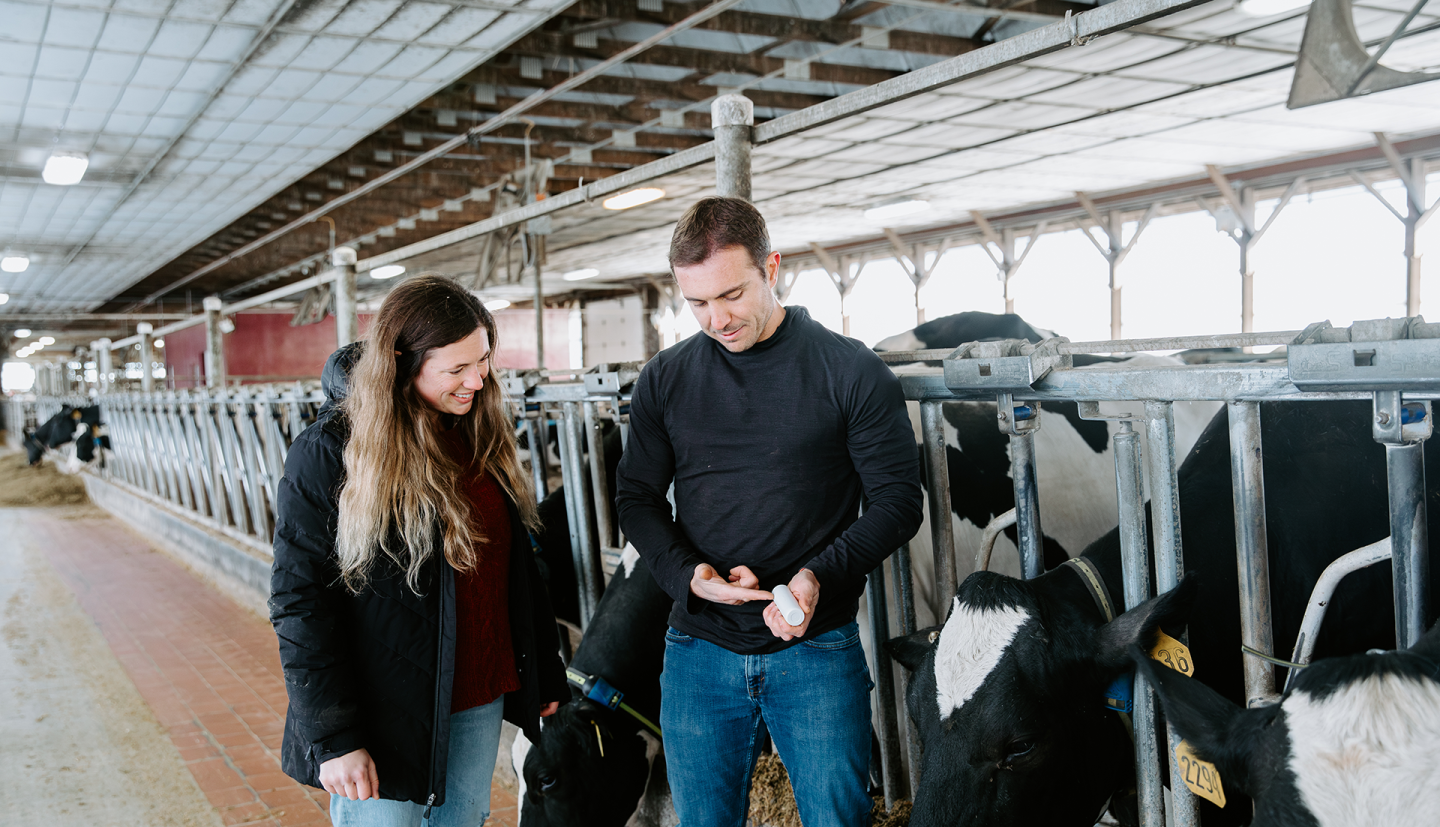
Big data is common on modern dairy farms, and farmers require unique data analysis tools to inform decision making and achieve long-term sustainability. Cornell has three programs that use data for this purpose:
- Ruminant Farm Systems (RuFaS) model: Supports sustainable productivity and environmental health.
- Cornell Agricultural Systems Testbed and Demonstration Site (CAST): Fosters the development and implementation of data-driven technologies that allow farmers to automate management tasks.
- Cornell Nutrient Management Spear Program: Reduces greenhouse gases and improves water quality at the crop production level.
Ruminant Farm Systems
The RuFaS model is a next-generation, whole-farm model that simulates dairy farm production and environmental impact. The model uses modern, modular coding and development practices to build a flexible, adaptable, interoperable research and decision-support tool for sustainable ruminant production.
The goal of the model is to be a next-generation decision support tool that is modular, adaptable, open-source, and available to a wide range of users, including dairy industry professionals, natural resource managers and researchers. Efforts are focused, in part, on modeling greenhouse gas emissions at the whole-farm level under different management scenarios.
Cornell Agricultural Systems Testbed (CAST) and Demonstration Site
The CAST program aims to accelerate climate-smart agricultural transformation with data-driven technologies and management practices through innovation, collaboration and education.
Specifically, CAST seeks to integrate sensor data at all levels of crop and animal production into an integrated decision-support tool for farmers. The goal is to create an ecosystem of fully integrated technologies which exchange data to improve farming practices.
Cornell Nutrient Management Spear Program
The Cornell Nutrient Management Spear Program has multiple goals:
- Assessing current knowledge of nutrition management
- Identifying research and educational needs
- Conducting applied field and laboratory-based research
- Facilitating technology and knowledge transfer
- Aiding in the on-farm implementation of beneficial strategies for field crop nutrient management, including timely application of organic and inorganic nutrient sources to improve profitability and competitiveness of New York farms while protecting the environment
The program also seeks to improve understanding of soil and environmental parameters that affect the accuracy of existing nutrient recommendations and the risk for environmental pollution. Such understanding will enable refinement of the recommendations while enhanced technology can increase the use of farm records to make farm-specific recommendations with the ultimate goal of improving profitability while protecting the environment.
Team

- kfr3 [at] cornell.edu

- (607) 255-3061
- qmk2 [at] cornell.edu

- (607) 254-4910
- mev1 [at] cornell.edu

- (607) 255-0136
- jog25 [at] cornell.edu