periodiCALS, Vol. 6, Issue 2, 2016
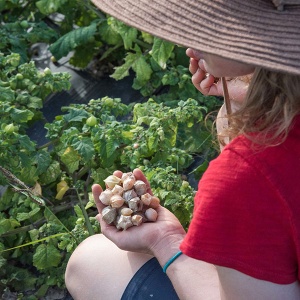
It started as a simple idea: Cornell students learning about farming should have someplace to actually farm. Thus was born Dilmun Hill.
In the 20 years since students tilled those first three acres, the farm has grown and improved, provided opportunities for research and experimentation, and enabled lifelong friendships. Today, Dilmun Hill’s 12 acres of land are part of the Cornell University Agricultural Experiment Station, producing organic vegetables for a CSA and on-campus restaurants, and even giant pumpkins for a pumpkin regatta on Beebe Lake.
Marguerite Wells ’99 was the farm’s first summer production manager, in 1996. She now works to develop wind farms.
“My favorite memory at Dilmun Hill? I remember treeing a woodchuck that I chased out of the barn. Or, after a quiet summer working on the farm, hearing a horn blare on a late August day and realizing the students must be back. Eating a few precious, tiny kiwi fruits, warm from the sun,” she said.
Benjamin Scott-Killian ’08 was a co-manager in 2007. He and his wife now live in Washington State, where they raise cattle, pigs and poultry, and are working to establish a grade-A creamery.
“Dilmun Hill was the first place where I was able to connect my passion for ecology and environmental stewardship with growing food. It was so empowering for me, a kid from suburban Long Island, to be able to transmute my activism and love for science into the kinetic, social and spiritual activity of farming,” Killian said. “Now, as a farmer on my own land, I’m so grateful for that experiential education I had at Dilmun Hill.”
Dilmun’s current crop of students affirms the value of experiential learning. A season as vegetable production co-manager has taught Kirby Peters ’17 about irrigation, pest control and—most importantly—working cooperatively.
“With vegetable production, everything is so time sensitive. It’s a lot of work, compromising and constantly making decisions with a group of five people, but we’ve gotten really good at communication,” he said.
Development sociology major and wholesale production manager Noelle LaDue ’19 was drawn to Dilmun by her interest in rural land management and inequality.
“I want to study displacement of small farmers and how that contributes to inequality, so I wanted to get firsthand experience in farming,” she said. “I’ve done a lot of really fast learning at Dilmun.”