Cornell researchers have developed a storage method that sharply reduces internal browning in SnapDragon® apples, potentially allowing New York growers to market high-quality fruit for months longer with less storage loss.
The method stores apples at 42°F under low-oxygen conditions, addressing one of the most persistent postharvest challenges facing growers and packers. Compared with conventional 38°F storage, the treatment reduced internal browning from roughly one in four apples to fewer than one in 100, even after nine months in storage.
Internal browning develops during extended storage and is often invisible until an apple is cut open, leading to fruit losses and reduced consumer confidence. The new strategy gives growers a practical way to avoid those losses.
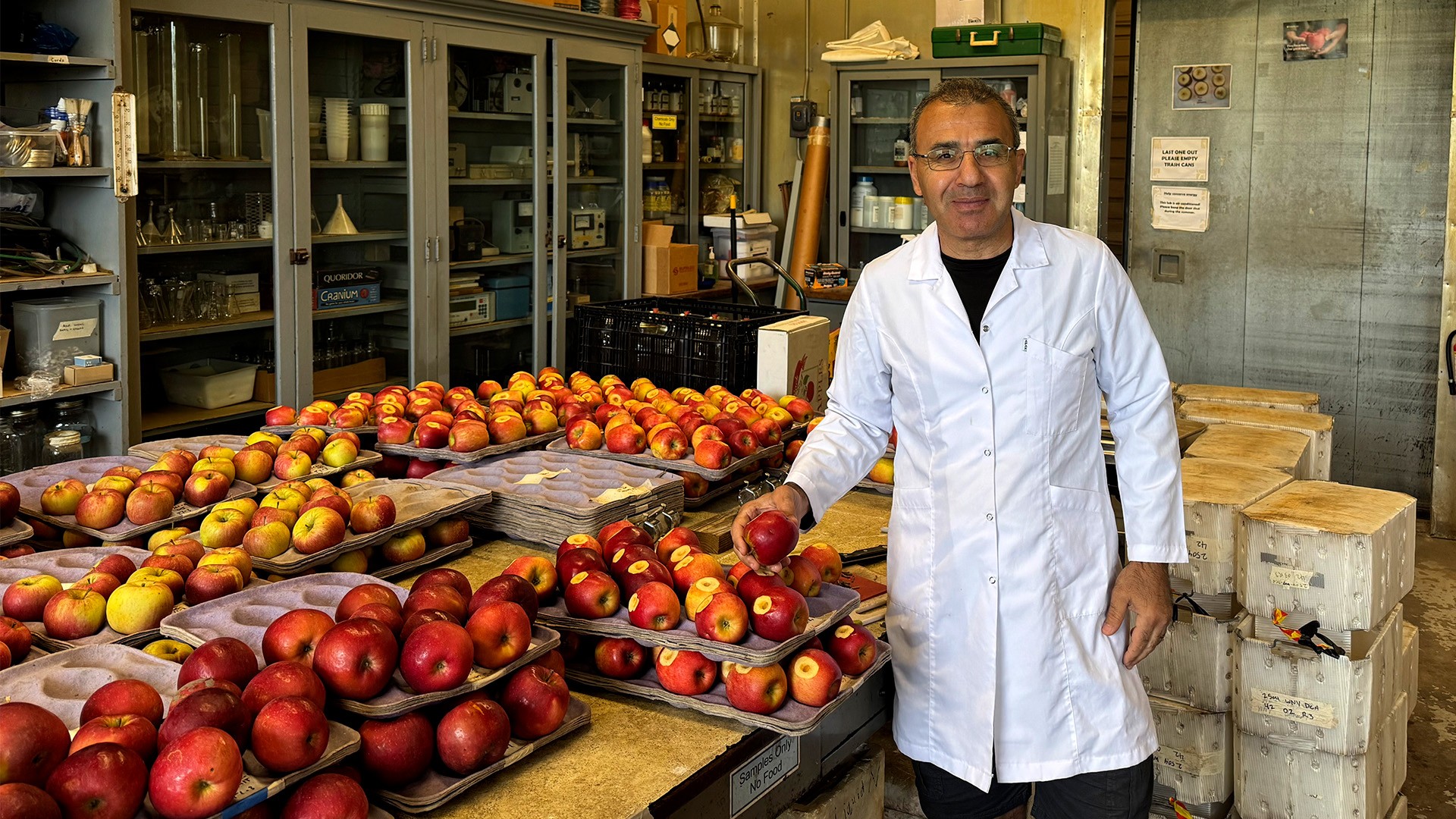
“By fine-tuning storage temperature and oxygen levels through dynamic controlled atmosphere (DCA) storage technology, we can substantially reduce internal browning while preserving the crisp texture, flavor, and overall eating experience that consumers expect from SnapDragon®,” said Yosef Al Shoffe, the senior research associate in Cornell’s School of Integrative Plant Science who leads the university’s fruit and vegetable postharvest physiology and technology program.
SnapDragon® is one of 70 apple varieties developed at Cornell since the 1890s. Cornell apple breeder Susan Brown selected it from a cross between Honeycrisp and NY752 at Cornell AgriTech in Geneva, N.Y. Released in 2013, the variety is prized for its crunch and sweet-spicy flavor.
Browning reduced 97%
In the study at Cornell’s postharvest laboratory, Al Shoffe used apples picked from commercial orchards in the Hudson Valley and western New York. He found that he could reduce internal browning 97% by storing the fruit at 42°F, keeping oxygen at very low levels (0.5%) and increasing carbon dioxide levels to 1%, when compared with fruit stored at the usual 38°F temperature.
“Using DCA storage technology to maintain very low oxygen levels helps stabilize fruit metabolism, reducing cellular damage that leads to browning,” said Al Shoffe.
“This approach relies on existing controlled-atmosphere storage infrastructure, making it practical and immediately applicable for commercial operations,” he added.
The treatment also outperformed a common storage practice that uses the ethylene inhibitor 1-MCP, which increased browning in SnapDragon® apples. Beyond the laboratory, Al Shoffe’s team conducted a statewide trial where commercial storage operations tested and confirmed the low-oxygen, 42°F protocol.
“This kind of applied research is exactly why Cornell’s apple program is so valuable to growers,” said Jim Bittner, president of Bittner-Singer Orchards and executive director of the New York State Horticultural Society. “It bridges the gap between controlled experiments and real-world storage rooms.”
Al Shoffe plans to continue exploring how the protocol performs across different orchard sites, fruit maturity at harvest, and storage durations, as well as how it integrates with other postharvest technologies.
But his findings thus far are about more than storage performance, said Chris Watkins, a recently retired Cornell faculty and postharvest management expert. "For SnapDragon®, it's about protecting a variety that represents years of investment by growers and researchers alike. With the right storage conditions, we can help ensure that investment pays off."
What stakeholders say
This is the type of research our growers need—science that translates directly into better pack outs and longer storage life.
- Scott Henning, Lake Ontario Fruit Inc., Albion, N.Y.
This valuable research provides us with recommendations critical to storing the variety later in the season with improved results.
- Emily Verbridge, K.M. Davies Co., Inc., Williamson, N.Y.
Maintaining internal quality—not just external appearance—is essential to protecting the SnapDragon® brand.
- Ryan Hess, Hess Brothers Fruit Company, Landcaster, Pennsylvania
With consistent quality maintained beyond eight months, SnapDragon® apples could remain viable for sale well into late spring and early summer, strengthening New York’s competitive position in the premium apple market.
- Jessica Wells, Executive Director, Crunch Time Apple Growers
This opens the door to more stable supply and improved returns. When retailers know they can rely on quality for longer periods, it changes the conversation around contracts and promotions.
- J.D. Fowler, Fowler Farms, Wolcott, N.Y.
Consumers remember flavor and texture, and they reward us with repeat purchases. If we can consistently deliver that crunch and clean flesh even after long storage, that's a competitive advantage that can extend the SnapDragon® sales season while reducing the chances of disappointing consumers.
- Joel Crist, Crist Brothers Orchards, Walden, N.Y.
Story based on materials provided by Yosef Al Shoffe, edited by Craig Cramer, communications specialist, School of Integrative Plant Science.