The safety and well-being of our community is our highest priority. We know the recent news and allegations are deeply concerning, and we are committed to a safe environment for all. Learn how Cornell is addressing sexual violence.

Alert Close
Back

Discover CALS

See how our current work and research is bringing new thinking and new solutions to some of today's biggest challenges.

Survey of U.S. dairy producers with digesters finds 95 percent did not expand herds because of the technology

Share
  • Cornell Cooperative Extension
  • Animal Science
  • PRO-DAIRY

U.S. dairy production has continued its decades-long consolidation into fewer, larger operations[1],[2]. Recent news coverage has suggested that the growth in anaerobic digester adoption over the past decade may have encouraged this expansion[3],[4]. Whether digesters influence herd-size decisions, however, has not been well documented. 

To test that claim and understand what drives adoption, Cornell researchers surveyed U.S. dairy producers who operate digesters about the factors behind their adoption decisions and future farm investments. Of 352 surveys delivered, 63 were returned (an 18 percent response rate), representing 15.8 percent of dairy digesters in the U.S. EPA AgSTAR database[5].

Key findings:

  • 95 percent of farms did not increase herd size because of their digester.
  • Cost share programs remain a top driver of adoption and future investment.
  • Long-term markets for renewable energy and carbon credits matter most for new digesters.
  • 44 percent of producers plan to reinvest in or build new digester infrastructure.

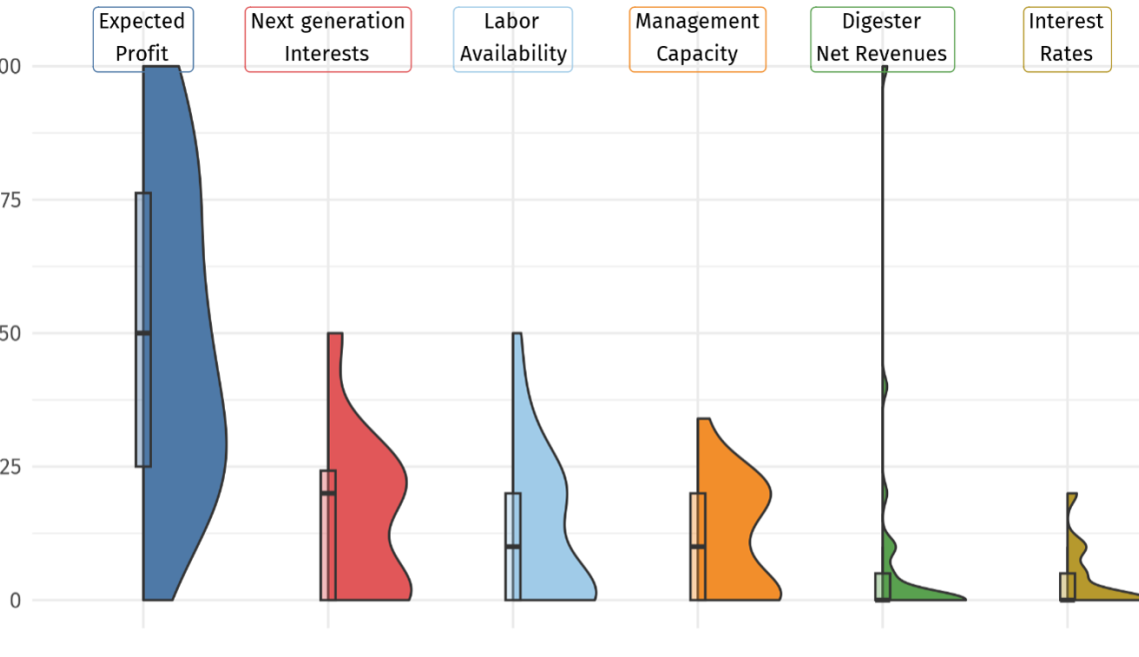
Producers ranked expected dairy business profit as the most important factor in decisions to expand their herds, followed by the interests of the next generation and labor availability. Digester net revenues played little to no role, and 95 percent of farms did not increase herd size because of their digester. Figure 1 from the peer-reviewed publication shows how producers weighted six factors in these decisions[5].

All digester types, including those that accept other feedstocks with dairy manure (19 percent co-digested other feedstocks with manure), and biogas utilization pathways were represented in the responses received. Just over half (52 percent) of the systems are managed or operated by a third party, and most of those were installed in 2017 or later. Annual milk production per cow among respondents averaged 28,196 pounds, exceeding the U.S. average by nearly 15 percent, which aligns with higher productivity among larger dairy farms[6].

A statistically significant positive correlation between larger herd size and renewable natural gas (RNG) production for off-farm sale suggests that larger operations are more likely to adopt biogas to RNG pathways, rather than biogas to electricity pathways. Most dairy manure digesters generate more biogas energy than is used on the farm, resulting in some off-farm use whether electricity or RNG is produced.

A majority of producers reported that cost share was highly important and that it covered an average of 57 percent of digester project costs (standard deviation 36 percent). Total median cost reported for projects was between $1,000 and $1,999 per cow. It should be noted that the average age of digesters reported was 10 years. 

Markets for digester products were also rated highly in importance, especially for new systems, including low carbon fuel standards, the Federal Renewable Fuel Standard (RIN credits) and carbon credits. Odor control, revenue diversification and regulatory uncertainty ranked just below the financial metrics and pipeline proximity was seen as less important. Labor availability was ranked as much more important for new digester adoption than for current operations. Nearly half of respondents plan to reinvest in or construct new anaerobic digester infrastructure. 

Investment in digesters could grow with effective capital cost share programs for both new and existing systems, and with markets that offer long-term price certainty for digester products and services. This matters most for small and medium-sized farms, where the technology is available but financial feasibility is harder. 

This work is part of a larger effort by the Cornell Dyson School of Applied Economics in collaboration with Cornell CALS PRO-DAIRY specialists, funded by the Environmental Defense Fund, to understand the motivations behind anaerobic digester adoption and how the biogas is utilized based on a survey with U.S. digester operators on dairy farms[5]. 

Share your experience

We want to hear more first-hand experiences from dairy producers who have digesters operating on their farm. Share successes, challenges and solutions with fellow dairy producers in a small group conversation. Receive $50 for your time. 

If you have digester experience on your dairy farm and are interested in sharing your thoughts, complete a short survey: tinyurl.com/CornellBiogasSurvey

References

[1] Bohnert, K. (2026, July 10). The great consolidation: How the U.S. dairy industry is doing much more with much less. Dairy Herd Management. dairyherd.com/news/great-consolidation-how-u-s-dairy-industry-doing-much-more-much-less.

[2] Gillespie, J., & Njuki, E. (2026, February 23). Fewer farms, more milk: The changing structure and costs of U.S. dairy farming. Amber Waves. ers.usda.gov/amber-waves/2026/february/fewer-farms-more-milk-the-changing-structure-and-costs-of-us-dairy-farming.

[3] Scotten, M. (2026, June 24). Cow manure could be the next data center fuel. Sentient Media. sentientmedia.org/cow-manure-could-be-data-center-fuel/.

[4] Bienkowski, B. (2026, January 14). Groups petition USDA to block factory farm manure digesters from clean energy funds. The New Lede. thenewlede.org/2026/01/cafo-biogas-manure-digester-usda/.

[5] Wehner, J., W. Zhang, C.A. Wolf, L. Ray, D. McLaughlin (2026). Drivers of current and future anaerobic digester investment on U.S. dairy farms. JDS Comm. 7(6): 765-770. doi.org/ 10.3168/ jdsc.2026-1066.

[6] USDA-NASS (2026). Milk production – March 2026. nass.usda.gov.