Back

Discover CALS

See how our current work and research is bringing new thinking and new solutions to some of today's biggest challenges.

Share
  • Dairy
  • Animal Science
  • PRO-DAIRY

If you love an ice cream sundae in the summer or a latte while the snow flies, then you know how important it is for dairies to produce milk all year around. But to do that, they have to ensure that their cows become pregnant in a timely manner.

“Dairy cattle reproductive efficiency is critical to ensure consistent milk production and maximize farm profitability,” said Thea Nikolaou, PhD’28 Biomedical Engineering, a member of the lab of David Erickson, professor of mechanical engineering. “This means farmers need to carefully manage the pregnancy status of their cattle.” 

But determining a cow’s reproductive status can be difficult for farms with less access to traditional methods. Rectal palpations or ultrasounds can reveal pregnancy, but both require training to carry out and, in the case of ultrasound, expensive equipment. Using laboratory-based tests of milk or blood samples can also be effective, but they can be tedious and could mean longer wait time for the results.

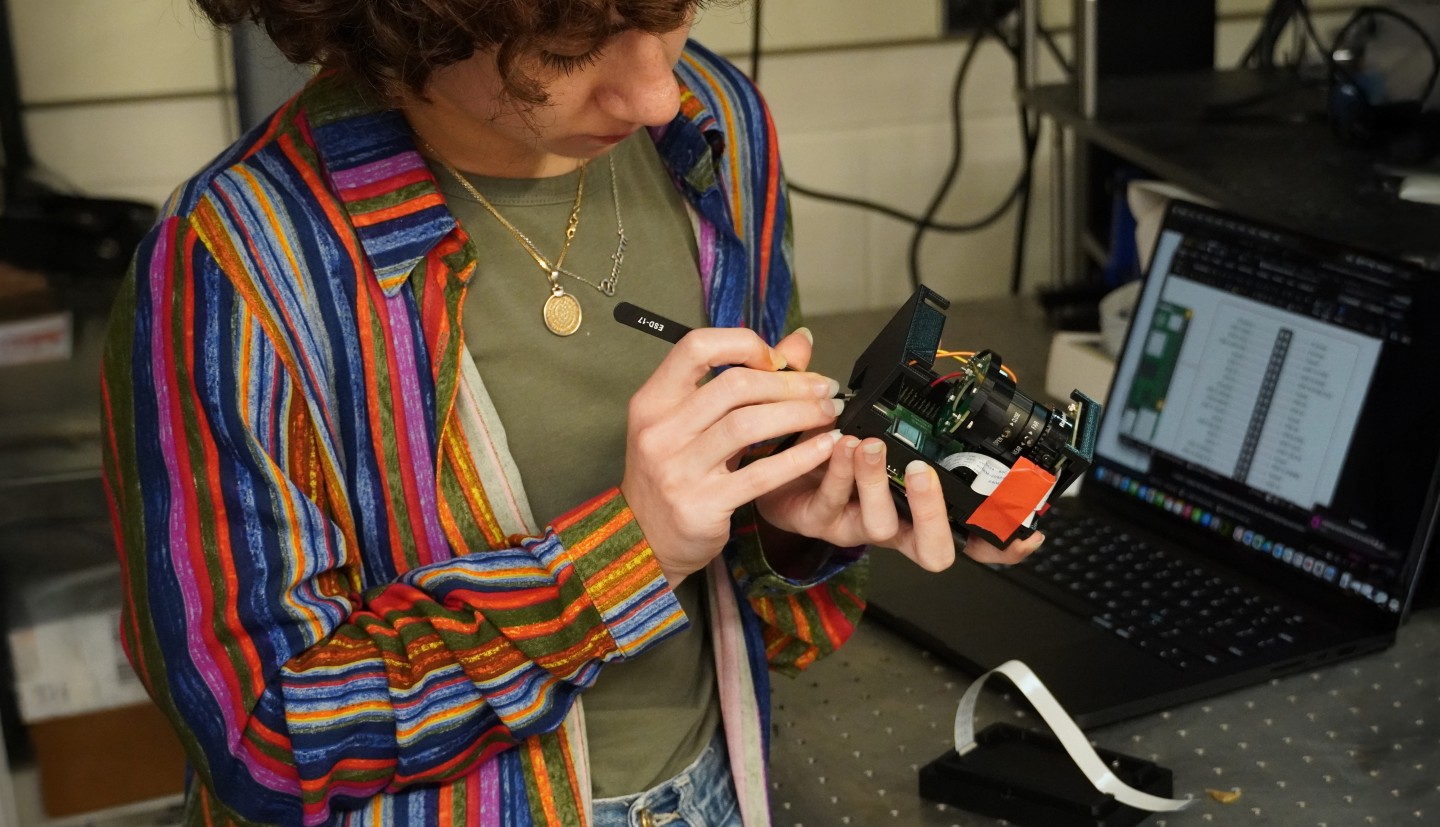
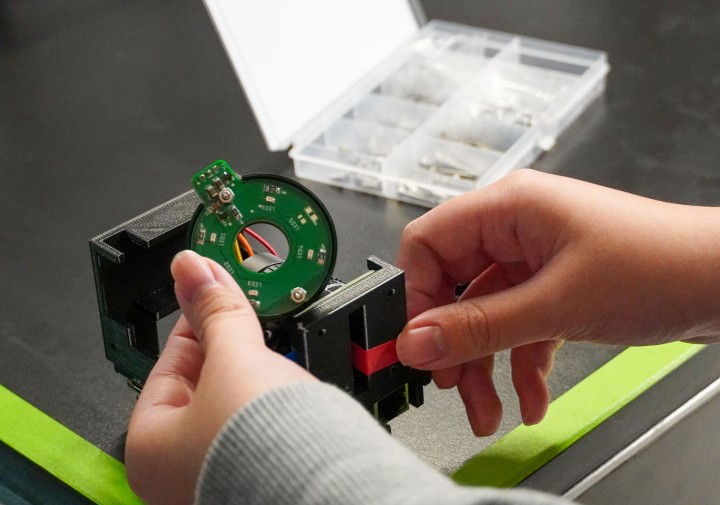
But Nikolaou is working on a technological breakthrough that could put dairy farmers with limited pregnancy-testing access more firmly in the driver’s seat, lowering the difficulty of managing dairy cattle reproduction. Collaborating with the Cornell Agricultural Systems Testbed and Demonstration Site (CAST) for the Farm of the Future, she and the Erickson lab are helping to develop the ReproPhone, an imaging device that lets farmers know a cow’s reproductive status on demand.
CAST pioneers the latest agricultural innovations and data-driven solutions at the intersection of technology and farming. It is made up of three Cornell farms: the Cornell Dairy Research and Education Center (CDREC), the Cornell Teaching Dairy Barn and Musgrave Research Farm. Together, they serve as models of the U.S agricultural economy, and CAST’s interdisciplinary team of researchers is using them to create an ecosystem of networked technologies and techniques for the 21st-century farm.

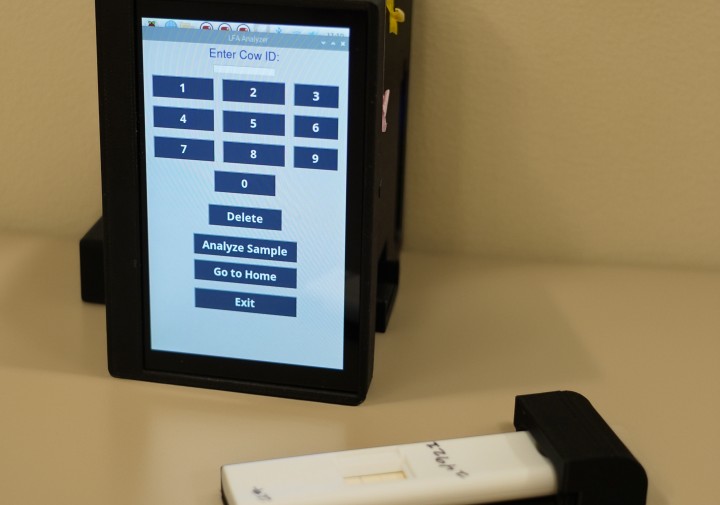
The ReproPhone is one of those cutting-edge technologies. The device consists of a portable mini-computer and a cassette that holds a lateral-flow test strip. It works either with a test strip for a single pregnancy marker (singleplex) or with a combination of two markers, one for pregnancy and one that indicates a cow’s ovarian status (multiplex).

In the singleplex version, the test strip is similar to a COVID test, except it requires a drop of cow’s blood rather than nasal fluid. The assay is made up of antibodies and other reagents that can rapidly detect and estimate concentrations of the protein Pregnancy Specific Protein B (PSPB). 

“There’s no human subjectivity involved. A farmer can do this test on-farm, on their own, without expensive equipment.” – Julio Giordano

“Instead of a human having to decide if the test shows one line or two in the test strip, as in an over-the-counter COVID test, the ReproPhone measures florescence to decide if PSPB is present and at what level. If it is above a certain level, then the cow is pregnant,” explained Julio Giordano, professor of dairy cattle biology and reproduction, and director of CAST. “There’s no human subjectivity involved. A farmer could do this test on-farm, on their own, without expensive equipment.”

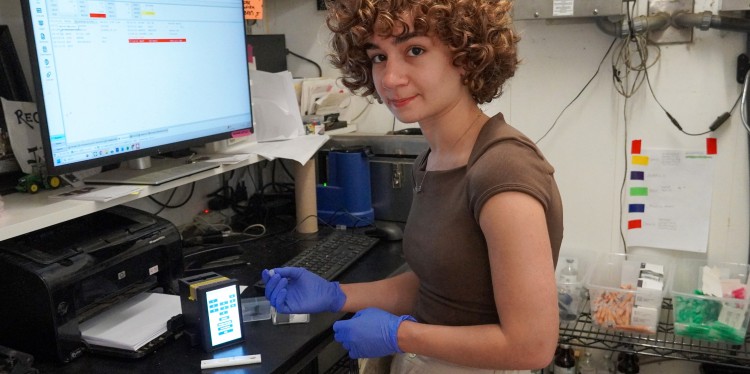
The researchers are also designing the ReproPhone to reduce the amount of hands-on labor involved in pregnancy testing and to streamline data collection, integration and analysis. “We hope to develop a tool that farmers can use to collect a blood sample, scan the cow’s ear tag, match it to the right tube of blood and then to the right test, and finally transfer the data to the herd management software,” Giordano said. “This could make reproductive testing less prone to errors, simpler and more accurate.”

Nikolaou and her colleagues are also further developing the multiplex assay, which can measure two markers of cow reproductive status at the same time: PSPB and progesterone. The addition of progesterone to the test reveals the status of a cow’s ovaries and can aid with determining her pregnancy status. If she is not pregnant, knowing her ovarian status allows the herd manager to plan a specific treatment aimed at inducing ovulation, so she can be bred as quickly as possible, thus keeping the dairy’s milk production on track.

To develop the ReproPhone, the researchers have been working with an industry partner, BioTRACKING LLC, which makes the antibodies used in the singleplex lateral flow assay and has vast experience in detection of pregnancy markers. Once the ReproPhone is fully developed for the duplex assay, BioTRACKING’s technology could be combined with Cornell’s to deploy the tool to farms.

CAST will soon be testing the singleplex assay at CDREC, which features a dairy of approximately 700 adult cows and an additional 420 head of youngstock. “Through CDREC, CAST provides the platform for validating the ReproPhone under farm conditions,” Nikolaou said. “Using the device and the rapid tests at the farm will also inform the feasibility of integrating the system into current farm workflows.”

Offering a place to test new technology is one of the main features of CAST, said Erickson, who is also CAST associate director and co-principal investigator. “There have been so many advances in artificial intelligence and in robotics and autonomous systems of all kinds, and CAST is the perfect place to pull all of that together within agriculture,” he said. “It offers a place where we can make something happen in the real world, not just in the lab.”

Jackie Swift is the communications specialist for the Cornell CALS Department of Animal Science and the communications manager for CAST.


Keep Exploring

a man holds a vial of liquid and talks with another man in a white lab coat in a barn

News

Cows depend on microbes to live. Thousands of different species inhabit the rumen, the largest section of a cow’s four-section stomach. They ferment the grass that cow eats and extract nutrients, providing metabolites essential for the cow to...
  • PRO-DAIRY
  • Animal Science
  • Microbial biology
A group of people stand together in front of the facility at the Miner Institute.

Field Note

Abby White, Agricultural Sciences, Cornell CALS ‘29 and Candyce Lee, Agricultural Engineering, University of Arkansas Pine Bluff ‘27, joined the Nutrient Management Spear Program (NMSP) as interns this summer. Candyce was hosted jointly through...
  • Animal Science
  • Agriculture
  • Dairy