Food scientists at Cornell AgriTech have developed a liquid-fermentation process that grows protein-rich oyster mushroom mycelium in days rather than weeks and – in a first for the field – have shown that the fungus will thrive on a fatty acid commonly found in waste cooking oil instead of sugar. The research points toward a faster, less land-hungry way to produce protein for a global population whose food demand is projected to roughly double this century.
“We have a skyrocketing population growth in the 21st century,” said Ke Wang, assistant professor in the Department of Food Science at Cornell AgriTech and senior author of the study, which was published in Sustainable Food Technology. “That will be challenging to meet given the current landscape of our agriculture and food production systems.”
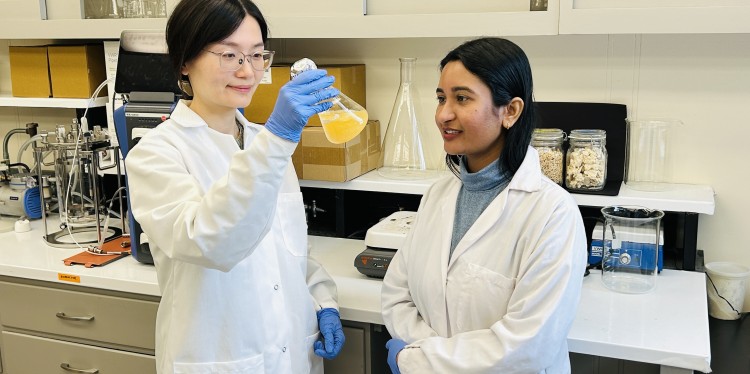
Wang’s lab is part of a growing field focused on mycoprotein: protein derived from the whole biomass of fungal mycelium. Mycelium is the thread-like vegetative network of a mushroom, normally hidden underground; the cap most people picture is just the fruiting body. “Usually we don’t eat mycelium,” Wang said, “but we can grow it in a liquid culture, and under continuous agitation it forms a specific morphology: spherical, porous pellets.” Those pellets can be harvested, dried and processed into food ingredients.
The Cornell team screened several mushroom species – shiitake, maitake, lion’s mane and oyster mushroom – before settling on Pleurotus ostreatus, the black oyster. “It grows the fastest,” Wang noted. “Other mushrooms can take months to produce a visible pelletized mycelium. P. ostreatus is ready to harvest within one to two weeks.” It also pellets reliably in submerged fermentation.
“Many mushroom species don’t form pellets or only do so under narrow conditions,” said Krishna Kalyani Sahoo, a postdoctoral fellow at Cornell and the paper’s first author. “Achieving pellets in submerged fermentation is important for downstream processing, especially if we want to develop structured whole-food products from the mycelium.”
The bigger surprise came from what the mushrooms were fed. Most fungal cultivation runs on glucose, but the long-term goal of Wang’s lab is to use food industry waste as feedstock. The team tested the dominant sugars in fruit waste (glucose and fructose), dairy waste (lactose) and lignocellulosic agricultural waste (xylose). They also tested oleic acid, an 18-carbon fatty acid that makes up roughly 55%–83% of olive oil and is abundant in used cooking oil and oilseed processing residues.
“That has never been tried before – using a long-chain fatty acid as the sole carbon source for fungal cultivation,” Wang said. “What we observed was something very unexpected. Oleic acid is not a conventional carbon source, but the productivity was as good as glucose and higher than lactose, xylose or fructose. The protein content wasn’t quite as high as with glucose, but it was higher than with the other sugars. That was a novel and interesting finding.”
Under optimized conditions, the team pushed protein content to 39.7% of dry mass. “For other species that figure can reach 50% or even 60%,” Wang said. “From a mushroom standpoint, ours is already on the higher end, and we found that protein content can be further increased by fine-tuning fermentation conditions.” The mycelium also delivers a full spectrum of essential amino acids alongside roughly 40% to 50% dietary fiber, beta-glucan, and trace minerals and vitamins.
So how does it taste? Members of the lab have eaten the freeze-dried pellets. “It’s pretty mushroomy,” Wang said. “But some of my students said it’s also fruity, floral, with an aroma. The texture is very airy and light, partly because it’s freeze-dried.”
The next test is whether the process holds up at scale. “We will start a pilot-scale study this fall,” Wang said. “People will rightly ask: If we move from a small bench reactor to a 100-liter pilot reactor, will the results change?” Answering that question is the gap between a promising lab result and a protein that could eventually land on a plate.
Christina Szalinski is a freelance writer for the College of Agriculture and Life Sciences.