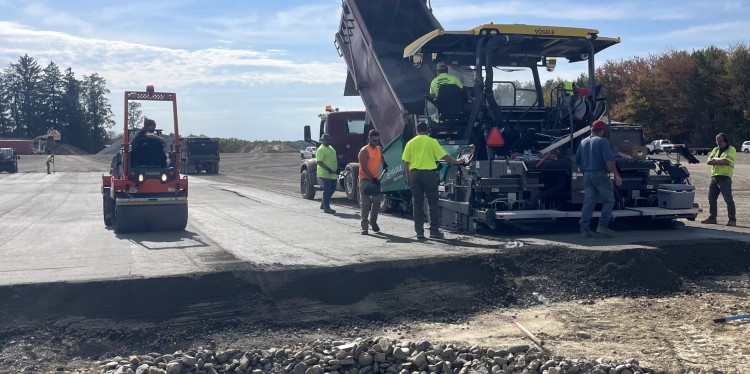
A newly released case study by Cornell CALS PRO-DAIRY Dairy Environmental Systems and project collaborators is showcasing the successful use of Roller Compacted Concrete (RCC) for a large-scale dairy silage pad installation at Tiashoke Farms in Washington County, New York, believed to be the first agricultural application of RCC in the state.
The project involved construction of a 182,000-square-foot, eight-inch-thick silage feed pad installed during September and October 2025 as part of Tiashoke Farms’ expansion from approximately 1,200 to 1,700 dairy cows. The case study evaluates RCC as an alternative to conventional concrete and hot mix asphalt for agricultural infrastructure, focusing on installation efficiency, durability, cost and long-term performance.
“Overall, the Tiashoke crew is very pleased with the silage pad,” said Dayton Maxwell of Tiashoke Farms. “We’re uncertain of how this new type of concrete will hold up over the long-term.”
Roller Compacted Concrete is a no-slump concrete mixture placed with asphalt-style paving equipment and compacted using vibratory rollers. Traditionally used in roads, feedlots, dams, and industrial applications, RCC is gaining attention for agricultural uses because of its durability, strength, rapid installation and reduced maintenance needs.
According to the report, the RCC silage pad was completed in just 10 days, despite minor weather delays, and silage was placed on the pad only five days after construction was completed. Researchers noted that RCC provided installation speeds comparable to hot mix asphalt while offering greater durability and lower overall cost than conventional concrete.
The project’s total cost was approximately $1.27 million, significantly lower than the estimated $1.94 million cost for conventional concrete construction of the same scale. RCC also demonstrated strong performance characteristics, including compressive strengths ranging from 4,000 to 6,000 psi, high resistance to cracking and corrosion from silage leachate, and an expected lifespan exceeding 30 years.
Site preparation played a major role in the project’s success. The area was graded and leveled with 12 inches of gravel prior to paving, and the completed pad was designed with drainage features to manage silage leachate through a low-flow collector and vegetated treatment area.
The case study also outlines important lessons learned during the installation process, including the need for careful coordination of aggregate sourcing, cement delivery scheduling and moisture management to ensure proper RCC performance.
Project collaborators included Tiashoke Farms, Cornell CALS PRO-DAIRY, Blair Excavation & Concrete Corporation, Wayne Companies/Florida RCC, A. Weiss Engineering and the Cornell University Local Roads Program.
Funding support for the project was provided through the New York State Department of Environmental Conservation Dairy Advancement Program.
Researchers say additional monitoring and evaluation will help determine the long-term performance of RCC under heavy agricultural use and could support broader adoption of the material for dairy infrastructure projects across the Northeast.