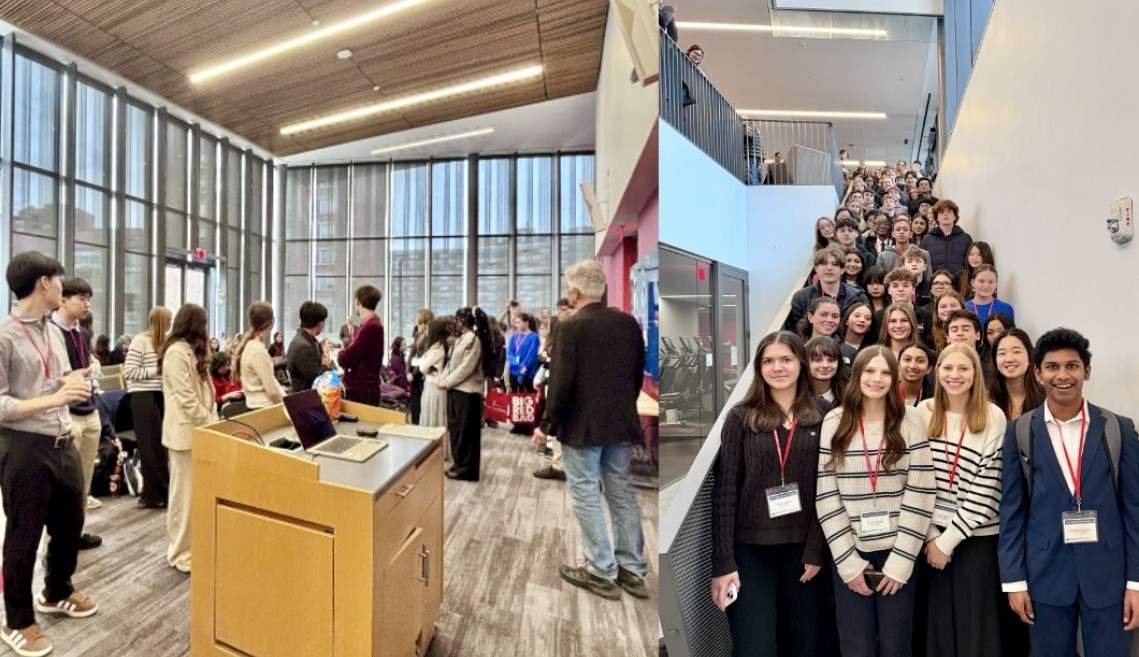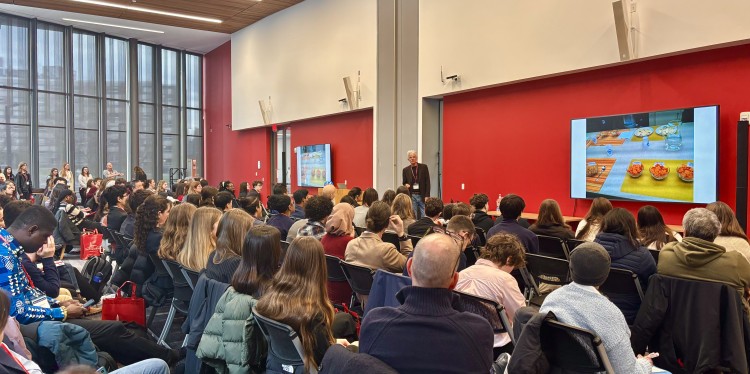
On a drizzling and cloudy March 20 morning at Cornell University, most of campus looked scant. But on the first floor of Toni Morrison Hall, nearly 100 high school students dressed in suits and blazers flipped through notes and downed cups of coffee, awaiting a keynote speech on the devious ploys of big food.
They were at the New York Youth Institute, a full-day annual event affiliated with the World Food Prize Foundation and hosted by Cornel CALS. The event was led by Polly Endreny Holmberg, State Coordinator of the NY Youth Institute and Associate Director of the Humphrey Fellows Program at Cornell. Each year, students from grades 9 through 12 present their food security research to agrifood systems experts across the University for feedback, engage in hands-on activities and participate in a day of intensive programming around the future of food. Among the activities this year were tours across CALS in animal agriculture, aquaponics, biotechnology, robotics and a nonprofit grocery.
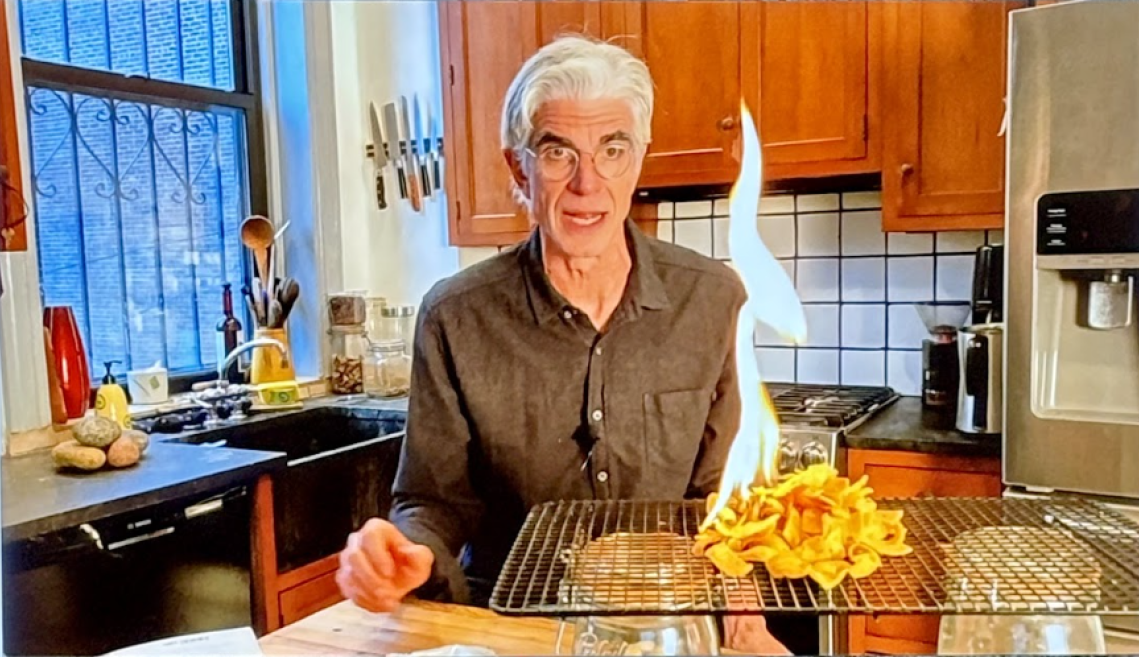
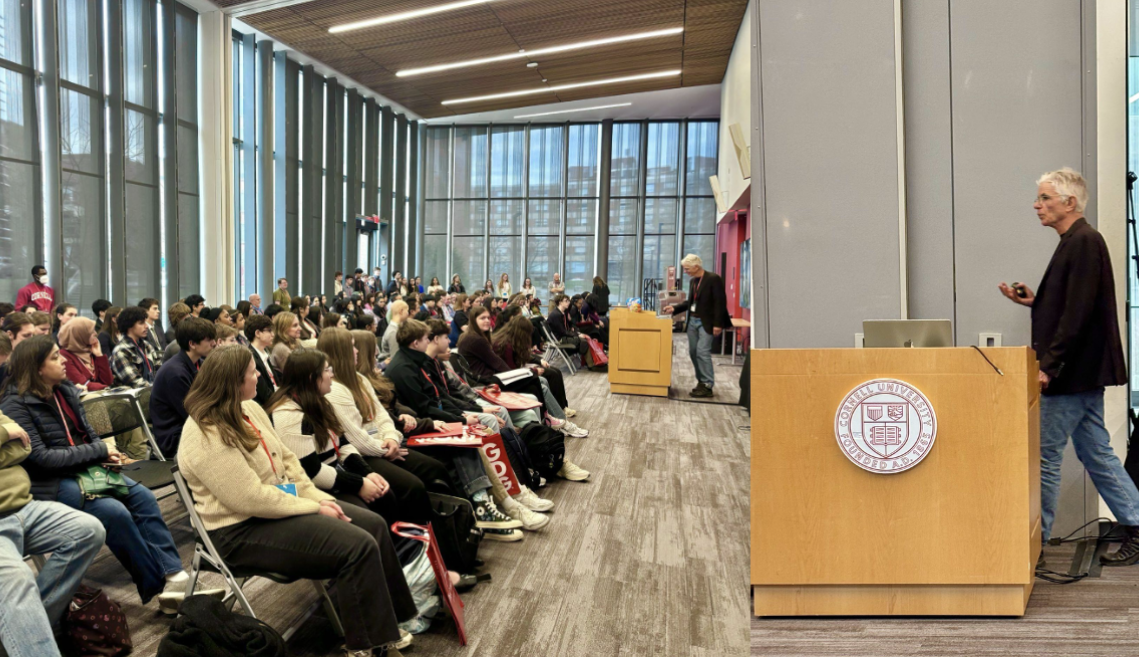
Following welcoming remarks by New York State Commissioner of Agriculture Richard Ball, Pulitzer Prize-winning author Michael Moss took the stage for the keynote. Moss is an investigative reporter and author of the #1 New York Times bestseller Salt Sugar Fat: How the Food Giants Hooked Us. His recent writings reveal some of the tactics large food manufacturers use to manipulate our diets, including through the preservatives inside a protein bar and the unnatural dust that gives flavored chips their distinct taste.
A common thread across his work? His persistence in uncovering if we have the agency to decide what we eat.
I had first learned about Moss while taking the Anabel’s Grocery course (AEM 3385: Social Entrepreneurship Practicum) in my sophomore year. His writing has been instrumental in shaping our own approach to countering mainstream food norms by providing fresh, affordable and nutritious food from local vendors. A cold email I sent to Moss in July 2025 ultimately led him to become the keynote speaker for the New York Youth Institute, and for him to finally see our student-run grocery store in person.
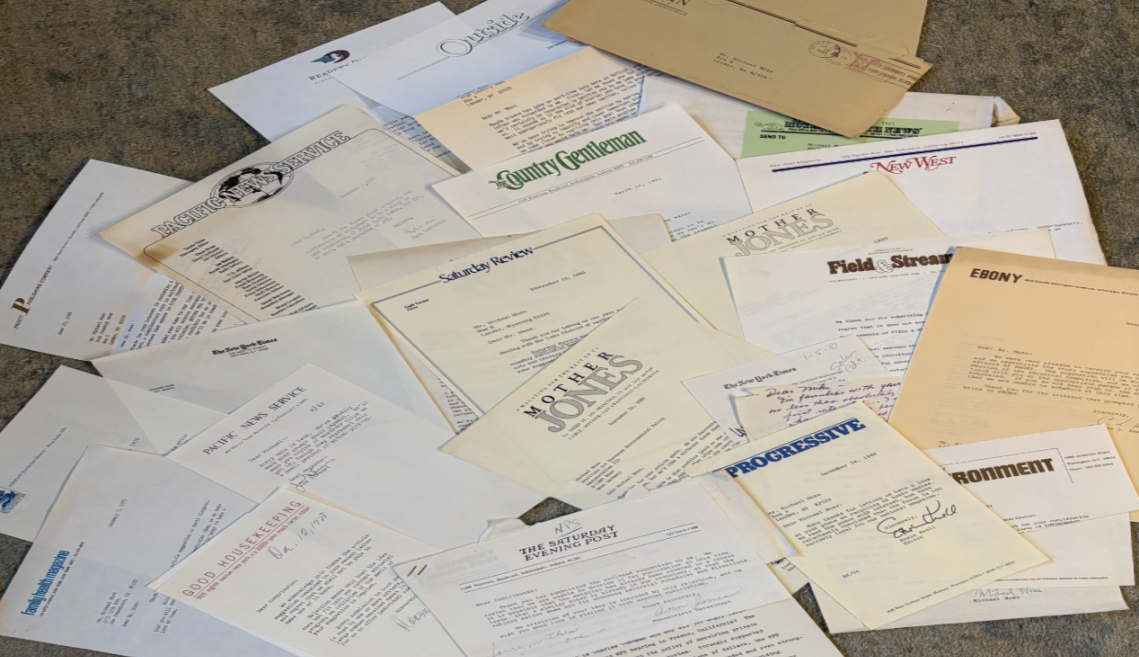
Launching his speech with an anecdote about his introduction to journalism, Moss shared that his career had a humble beginning: a pile of rejection letters.
“Despair is your friend,” Moss said. “Don’t take it personally.”
But Moss remained persistent, eventually receiving an offer to work with the New York Times. After spending several years reporting on the Iraq War on the ground, he slowly transitioned to investigating a challenge closer to home: big food. Handing a student in the audience a bag of potato chips and asking her how she felt upon trying one, Moss offered a tangible reminder that food giants are all around us. Like most consumers, the student was drawn to the snack’s perfected combination of oil and salt. To Moss's point, it was, simply put, irresistible.
Alexander Baum, a freshman at Hewlett High School, shared that he appreciated Moss’s authentic presentation style and ability to engage with the audience.
“My favorite part was when he discussed the importance of salt,” Baum said. “I had no idea that it was so integral to so many common tastes. People know they should have less salt for health reasons, but food manufacturers know that if they reduce salt the taste of their products will be distorted.”
Highlighting his Pulitzer Prize-winning article about a woman who was paralyzed after eating hamburger meat infected with E. coli, Moss emphasized that the onus of making healthful, responsible eating choices is increasingly falling on busy consumers. Household frozen favorites, like hot pockets, pizzas and even hamburgers, are now a go-to for working families on the go. And their ingredients – salt, sugar and fat – keep customers coming back for more.
In the process, whole foods have largely lost their appeal in the public eye. According to Moss, efforts to market them have fallen short.
So, Moss shared a story of how he challenged one advertising company known for marketing Coca-Cola and Quiznos to take a chance on a popularly unpopular food. To the ad agency Victors & Spoils, he asked: how would you get people to buy broccoli?
The agency embraced the challenge. The “Broquet” emerged as a way to “show a bro you care” with broccoli instead of flowers. Advertisers described broccoli as “43% less pretentious than kale,” which was trailing broccoli in vegetable rankings but had still achieved fame on cookbook covers and hipster movements. Broccoli was proposed as the “Alpha Vegetable.” One suggested advertisement described it as “great with a side of steak.”
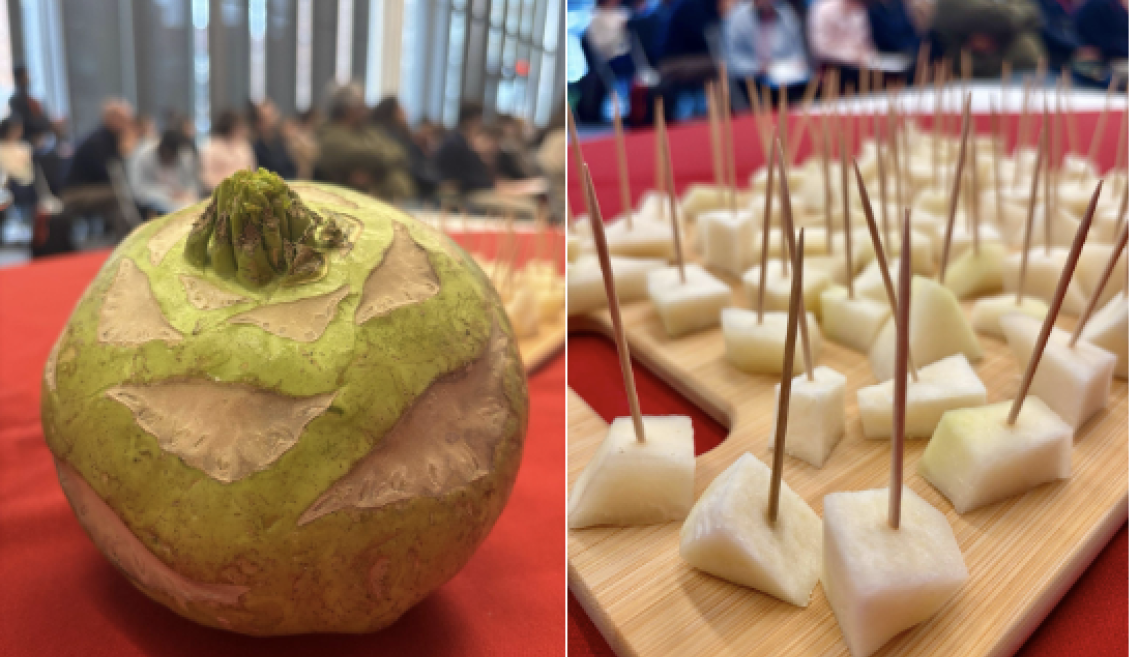
Moss then pivoted to the students, presenting them with a vegetable unfamiliar to most: kohlrabi. Described as a mix of turnip and apple, this cruciferous vegetable has potential to become a salad staple but is seldom found on people’s grocery lists. What would it take for the average consumer to buy it?
Samples of kohlrabi sourced from Ithaca’s Stick & Stone Farm and Anabel’s quickly amplified the session’s energy and engagement. Students bit into cubed kohlrabi to understand its mouthfeel, sweetness and crunch. For most, their curiosity outweighed their distaste for the vegetable’s lingering cabbage odor.
Following a period of brainstorming, share-out sessions revealed new opportunities to market kohlrabi. Among them: highlighting kohlrabi’s carrot-like crunch, promoting recipes that blend kohlrabi’s sweetness with savory elements and including it in the salad bar in university dining halls. One student prompted applause by asking, “Could we call it ‘Kool-rabi’?”
“Some crafty teamwork turned a mere keynote into a tasty incubator for ideas,” Moss said.
Sanaya Mistry, a junior from Mount Saint Dominic Academy, shared that her understanding of the marketing of processed food has evolved since hearing Moss’s speech.
“Moss's keynote made me realize that America's unhealthy eating habits are not simply about personal weakness, but about how the system is designed to make junk food win,” she said. “The creative campaign he facilitated for us to promote kohlrabi as a delicious snack option made me hopeful that change is possible.”
As students prepared to enter their roundtable panels and share their own pitches for food and agricultural innovation, Moss reminded them to remain inquisitive and critical. He suggested that they embrace the possibility of pursuing a nonlinear path, while maintaining a watchful eye on the corporations that steer their decisions.
“You’re going to be knocking on a lot of doors that will not open for you,” he said. “All you need is one yes.”
Thank you to Rebecca Picard, Senior Director of Global Youth Programs & Partnerships for the World Food Prize Foundation; Anna Cummings, Assistant Director of Admissions for Cornell CALS; and the many students, faculty, staff and Humphrey Fellows who contributed their time and effort to running the March 2026 New York Youth Institute.