What kinds of leadership or professional skills have you gained through the fellowship that you think will matter in the ag industry?
The backbone of the FFAR Fellows Program is to coach students on professional development skills to be leaders in current and future roles. I have learned the importance of professional development and leadership to be an effective team member. I have gained lots of hands-on experience with professional development in the areas of effective communication, cross-functional team development as well as honing my organizational and productivity skills. I anticipate developing skills in project management and enhancing my science communication to broad audiences. Another integral facet of the program is understanding self through self-awareness assessment tools like “Dominance, Influence, Steadiness and Conscientiousness” and “Emotional Quotient Inventory.” By understanding our strengths and weaknesses we can better navigate self-development. We also take the CliftonStrengths assessment to understand our natural talents and strengths to harness those skills in future roles. Overall, I have developed stronger communication, interpersonal and organizational skills.
Can you walk us through your research and what impact you hope it will have for growers or the broader food system?
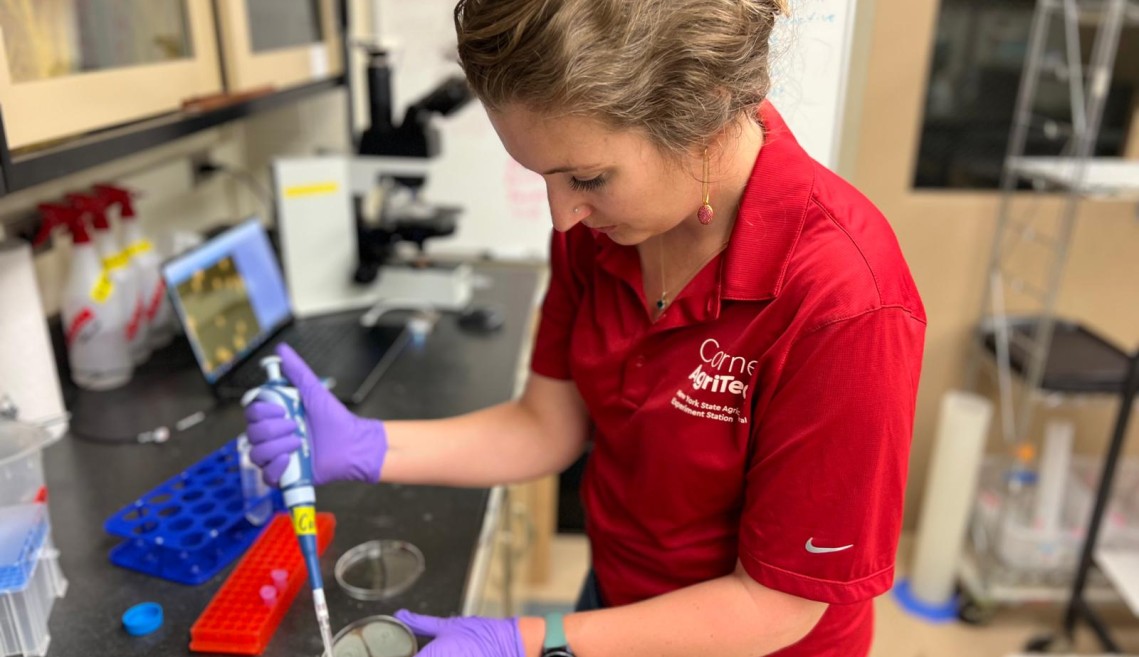
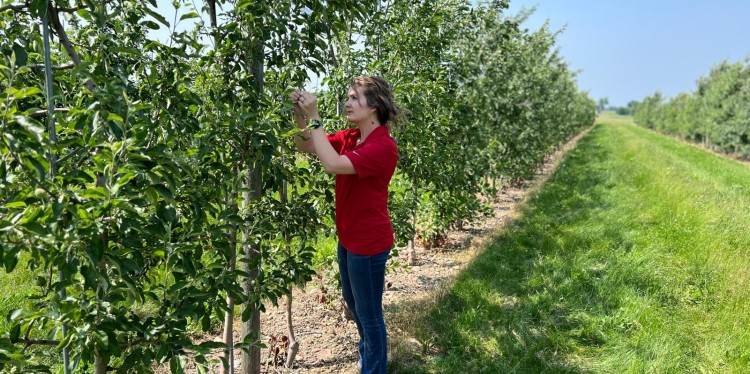
I am a Ph.D. candidate in the Plant Pathology and Plant-Microbe Biology (PPPMB) section in SIPS, where I study postharvest diseases of apples. My dissertation focuses on blue mold, caused by Penicillium expansum, which is an important postharvest disease of apple. The fungus produces the mycotoxin patulin which is highly regulated due to its neurotoxic effects on humans, especially children. There are only four fungicides in the US labeled to control blue mold and there are reports of fungicide resistance in the region. My research aims to improve blue mold management by monitoring for fungicide resistant isolates, integrating sustainable control strategies such as biopesticides and UV-C light, and developing improved pathogen detection tools for apple packinghouses. Together, this work supports FFAR’s focus on nutrition, food quality and food safety by promoting healthier food systems and more efficient, environmentally sustainable apple production.
How has being part of CALS and Cornell AgriTech shaped your experience, especially when it comes to learning by doing?
My time at Cornell AgriTech started in 2016 when I accepted a position as a technician in Professor Brian Nault’s applied vegetable entomology lab. This experience was pivotal since it was the first position that paired my education, B.S. in biochemistry, with my farming experience. As a technician, I learned how to conduct small-plot insecticide efficacy trials. I saw the full circle of planting, data collection, data analysis and dissemination of field research results to growers. I developed a passion for applied agricultural research and delivering results via extension-based activities. From that position I sprang into an industry role for almost three years and then returned to Cornell AgriTech, this time in the PPPMB section to pursue a Ph.D. I am constantly inspired by the scientists at AgriTech who have streamlined the research process from lab bench to field by conducting applied research and connecting with growers and key stakeholders. By doing so, there is greater adoption of sustainable agriculture solutions that address farmers’ needs. I have been fortunate to work in labs, Professor Brian Nault’s and now Professor Kerik Cox’s, where research is guided by grower needs. This direct approach allows us to develop projects and, within a growing cycle, report findings and offer guidelines to growers that address research gaps.