Back

Discover CALS

See how our current work and research is bringing new thinking and new solutions to some of today's biggest challenges.

Vegetable specialist with the Cornell Vegetable Program
Share
  • Cornell Cooperative Extension
  • Field Crops
  • Vegetables

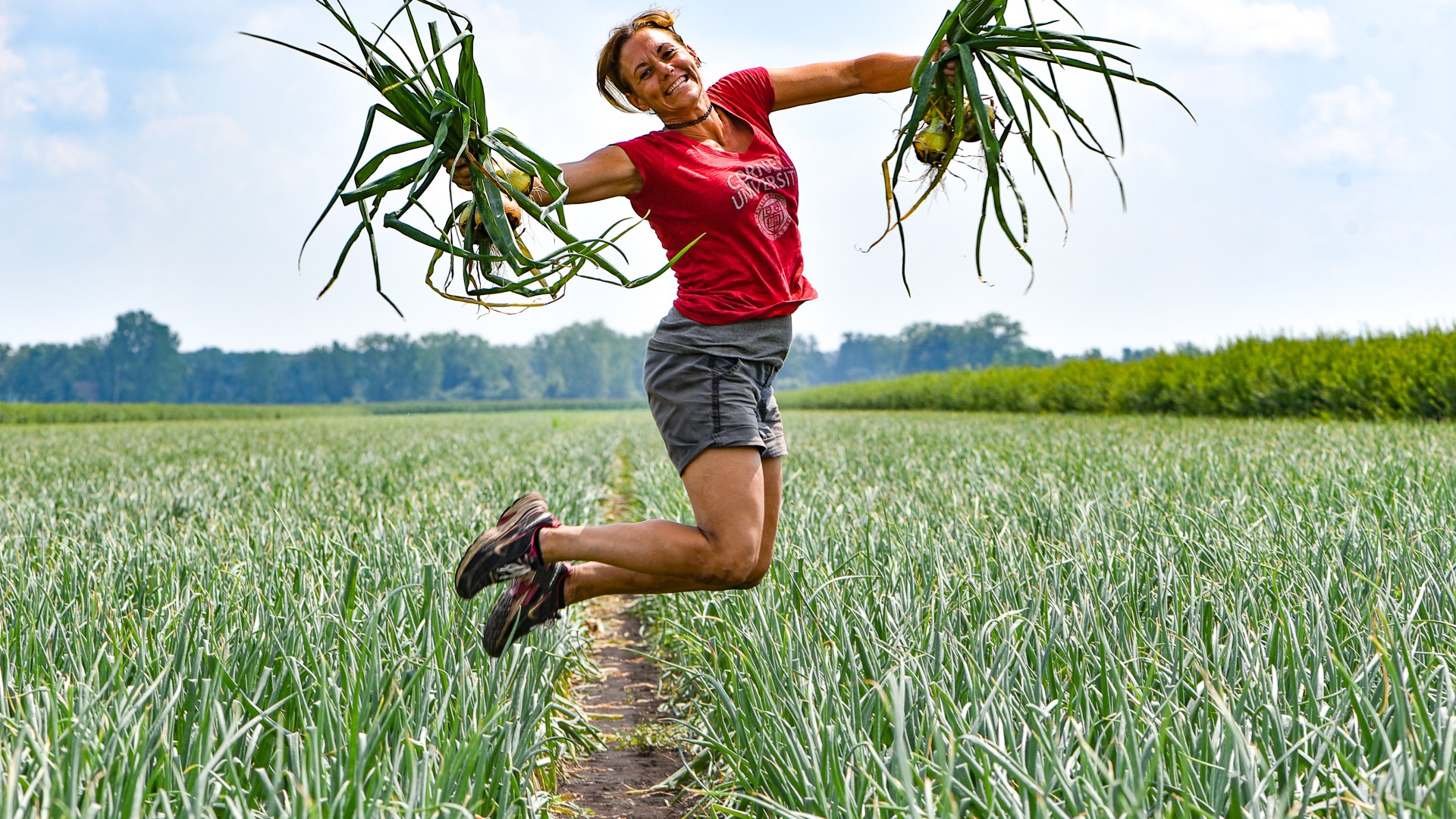
Christy Hoepting, vegetable specialist with the Cornell Cooperative Extension’s (CCE) Cornell Vegetable Program, discovered her calling in the rich, black soil of Ontario Canada's muck fields, where she saw firsthand how applied research could solve real grower problems. As a CCE educator for over two decades, Hoepting has become the go-to expert for New York's muck onion industry, helping guide decision making while building trust and transparency among growers. Hoepting’s work translates field trials into practical solutions that keep the western New York onion farms relevant and competitive.

Describe your path to extension

My path to Extension actually started in a lab as an environmental toxicology undergrad at Guelph. I did a summer in a windowless lab, which convinced me bench science wasn’t for me. From that point, I vowed to work outside and have ever since.

An internship at the Muck Crops Research Station in Bradford, Ontario sealed it. Working on onion smut and maggot issues while living on a farm in that area showed me the power of applied research and led me to pursue a master’s in applied entomology and plant pathology.

Presenting my thesis caught the eye of Cornell’s onion specialists and a CCE educator. They invited me to share results with New York growers and urged me to apply for a job with Extension. I nearly passed on it, thinking I wanted to stay in Canada, but my advisor pushed me to interview.

The interview was hands-on with farm tours, a grower-focused talk, and lots of Q&A. I leaned into providing clear, field-driven solutions and got the offer. As a single mom with an 18‑month‑old, it was a leap, but it put me where I wanted to be: outside with growers, translating research into results.

How would you define Extension and your role?

Extension is the bridge between Cornell research and the grower community. In my case, that means muck onion growers. I translate faculty research into practical, grower-ready guidance, ensure it addresses producers’ needs, and relay those needs back to researchers. I serve as the growers’ voice and conduct applied, on-farm research, helping lead the shift toward more practice-focused extension.

Who are your mentors?

I had strong role models — notably women — including Debbie Breth of CCE’s Lake Ontario Fruit Program and Carol McNeil, vegetable specialist with the Cornell Vegetable Program.. Carol, a generation ahead of me, wasn’t doing field research in her role — that approach had just begun when I started 25 years ago. I embraced it, and applied, on-farm research became my brand of extension.

I joined the brand-new CCE Lake Plains Vegetable Program in 2001. Our three-educator team, which included Alan Urb and Arlie McFall who had both arrived just a year ahead of me, was still figuring out what extension in this context looked like. With plenty of voices in my ear, I spent my first two years shadowing Arlie’s program; as a fellow Canadian, he was a steady, practical mentor.

A few key people shaped my path. Lee Stivers, running a private research farm in Batavia, championed applied, on-farm research. I shared an office with Debbie Breth on the Lake Ontario Fruit team. She was already doing the kind of rigorous, on-farm trials I strive to deliver today. And while more a partner in crime than a mentor, I have to mention Brian Nault, our entomologist . Our careers have have always run in parallel, and the collaboration is special. I bring an idea, and together we make it happen.

Those influences set my compass toward collaborative, applied, on-farm research.

What is muck?

Muck soils are former glacial lakebeds that filled with vegetation. Over time that plant material decomposed into peat. Once they drained, these areas became “muck” soils which is black, rich, and high in organic matter (typically 20% or more).

In western New York, the Elba Muck is about 5,000 acres, with many smaller muck pockets elsewhere, some as small as 20 acres. Onions thrive in muck soils thanks to their fertility, moisture-holding capacity, and uniform seedbeds.

The growers are largely third- to sixth-generation, operating in a mature industry. While a few new farms enter, the sector has consolidated, and those still producing onions today are highly skilled and efficient.

How do you approach building trust with the grower community?

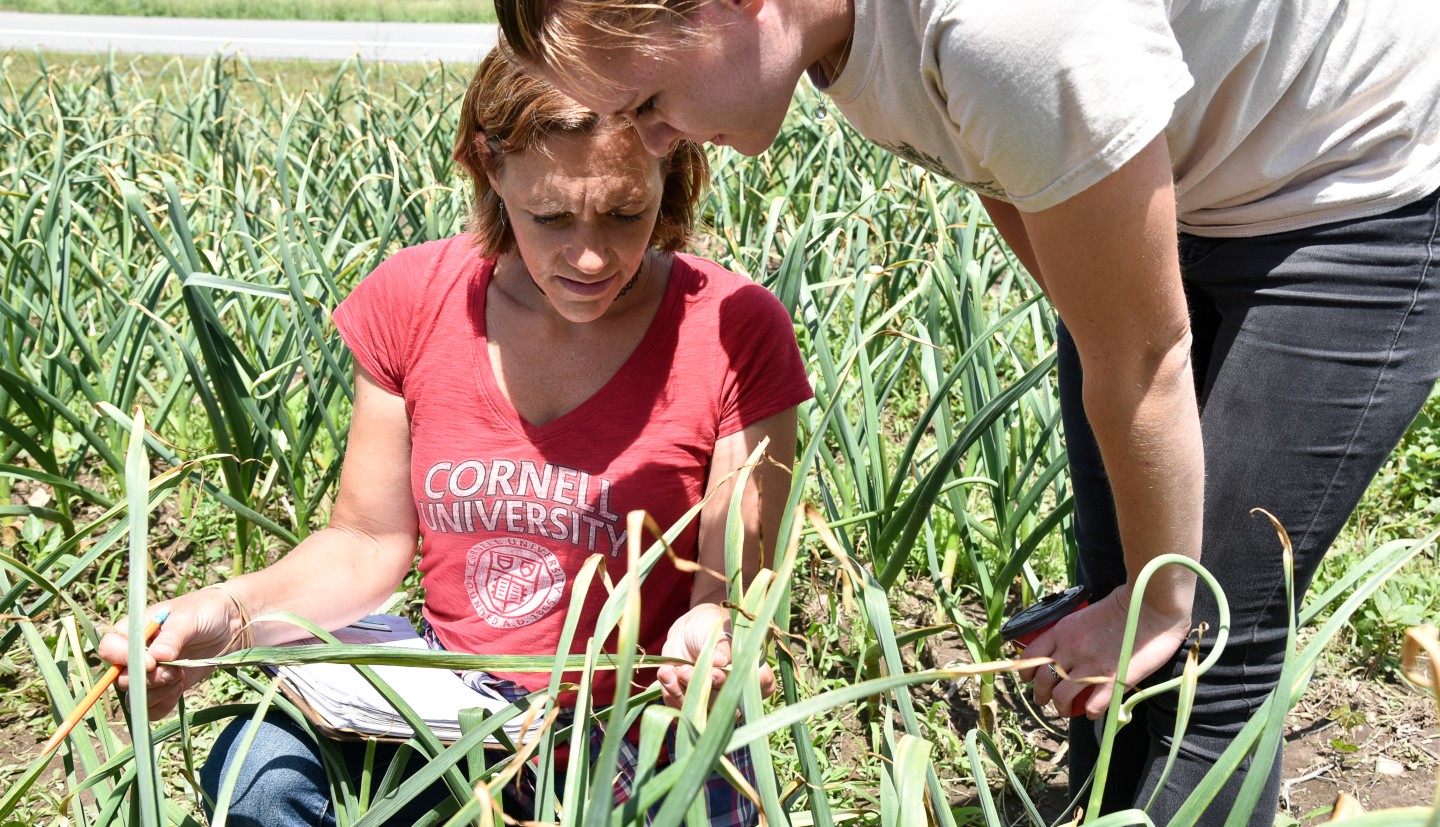
You have to work slowly and steadily, showing up and delivering results. When I arrived, pesticide reps drove most decisions and I had to earn my place. My first major breakthrough came in my sixth year when I identified a new onion virus in New York. Around year 10 I bought a backpack sprayer, started on‑farm spray trials, and launched a scouting program, turning grower problems into trials and solutions.

I’m constantly in the fields. I send weekly scouting reports, and I meet growers every Tuesday at Muck Donut Hour to walk through each field and plan sprays. After 25 years, and now working with a second generation, that consistency has built immense trust.

The scouting program also fostered transparency. Growers share data and spray records, learn from each other, and make their own decisions. Today, more than 90% make their own spray timing decisions instead of relying on reps to guide them. It took time and a culture shift (the newer generation is more open), but a steady presence plus actionable, field‑based research builds trust.

Keep Exploring

A woman smiles, posing for a photo.

Field Note

Hailing from Belize, Gabriela Garcia joined Cornell CALS’ Nutrient Management Spear Program (NMSP) as an intern in January 2026 from Zamorano University , located in Honduras. This semester, she will be working alongside Carlos Irias on the...
  • Animal Science
  • Agriculture
  • Field Crops
A background of a corn field with two figures illustrating the P-index 2.0 in the foreground.

News

Grid sampling– a process where fields are divided into small grids and a soil sample is taken from each section for individual analysis– can generally be very informative. It is capable of capturing variability throughout a field that may have...
  • Animal Science
  • Agriculture
  • Field Crops