Back

Discover CALS

See how our current work and research is bringing new thinking and new solutions to some of today's biggest challenges.

Share
  • Animal Science
  • Agriculture
  • Field Crops

Grid sampling– a process where fields are divided into small grids and a soil sample is taken from each section for individual analysis– can generally be very informative. It is capable of capturing variability throughout a field that may have otherwise gone unseen. For this reason, it is becoming increasingly popular on farms that have variable rate application technology

Earlier work by the Cornell CALS’ Nutrient Management Spear Program precision ag team showed how detailed soil information can help farmers make better fertilizer application decisions (e.g. regarding lime, phosphorus, potassium), in turn enabling them to avoid unnecessary costs and get the most out of every acre. However, there’s still more to be discovered when it comes to grid sampling.

The New York Phosphorus (P) Index 2.0 uses soil test P values to determine P management implications, in other words, the amount of P that farm decision-makers are allowed to apply on their fields. Generally, the recommended P application level mitigates the risk of P loss to areas outside of the field while ensuring that the soil still supplies enough P to the crops to support their growth.
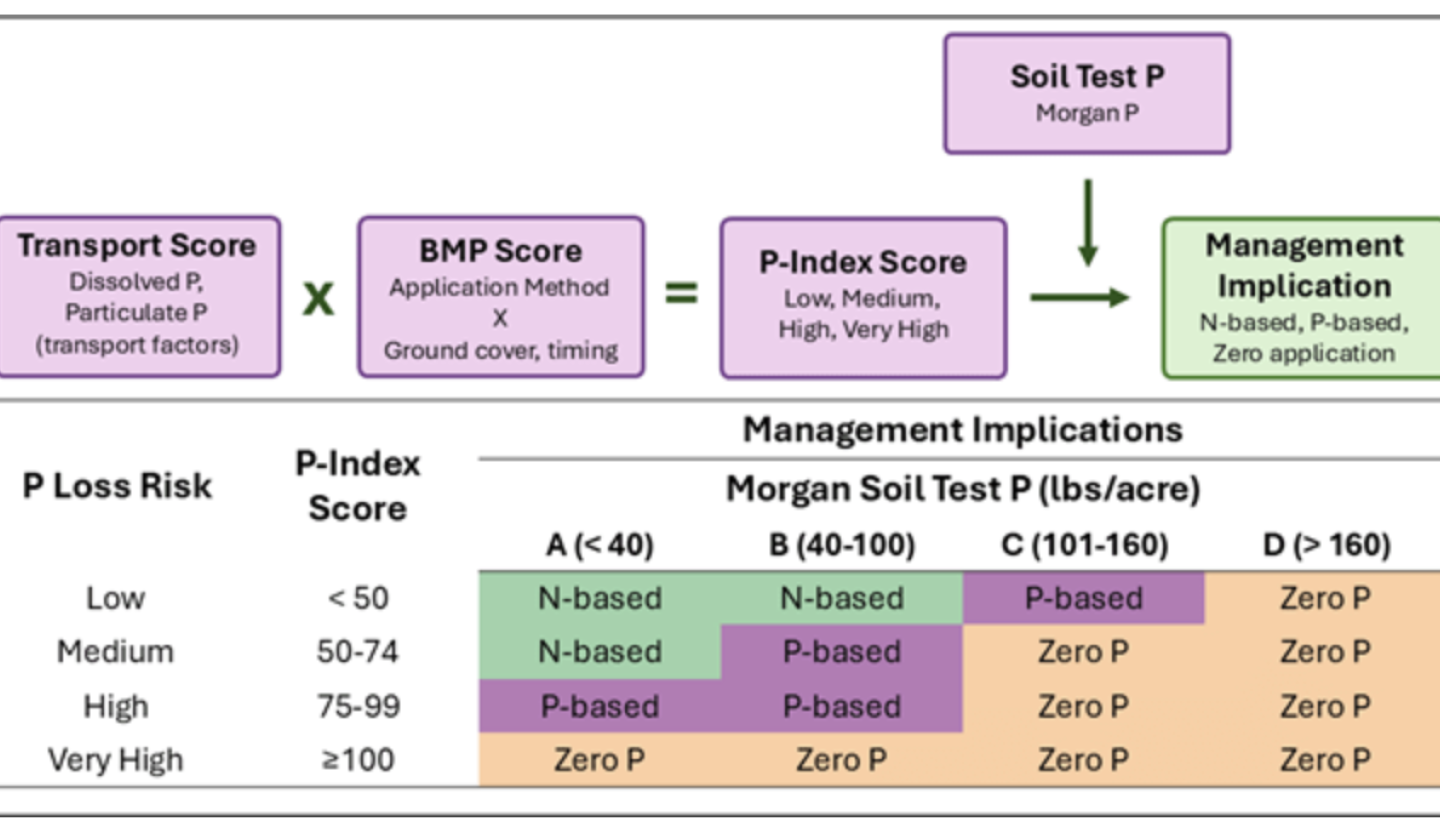

The NY P-Index 2.0 management implications can range from no P application (where P levels are high) to N-based application (where P levels are low and allowed to be built up in the soil) (see above, full management implication details here). 

Generally, the P-index is assessed at the field level, meaning there is typically one score per field. So, to address questions on how to use the P-Index in a grid sampling context, the precision agriculture team at NMSP worked with farmers to analyze soil data from 20 corn fields across six New York farms. The findings of this research were recently published in the Soil Science Society of America Journal. 

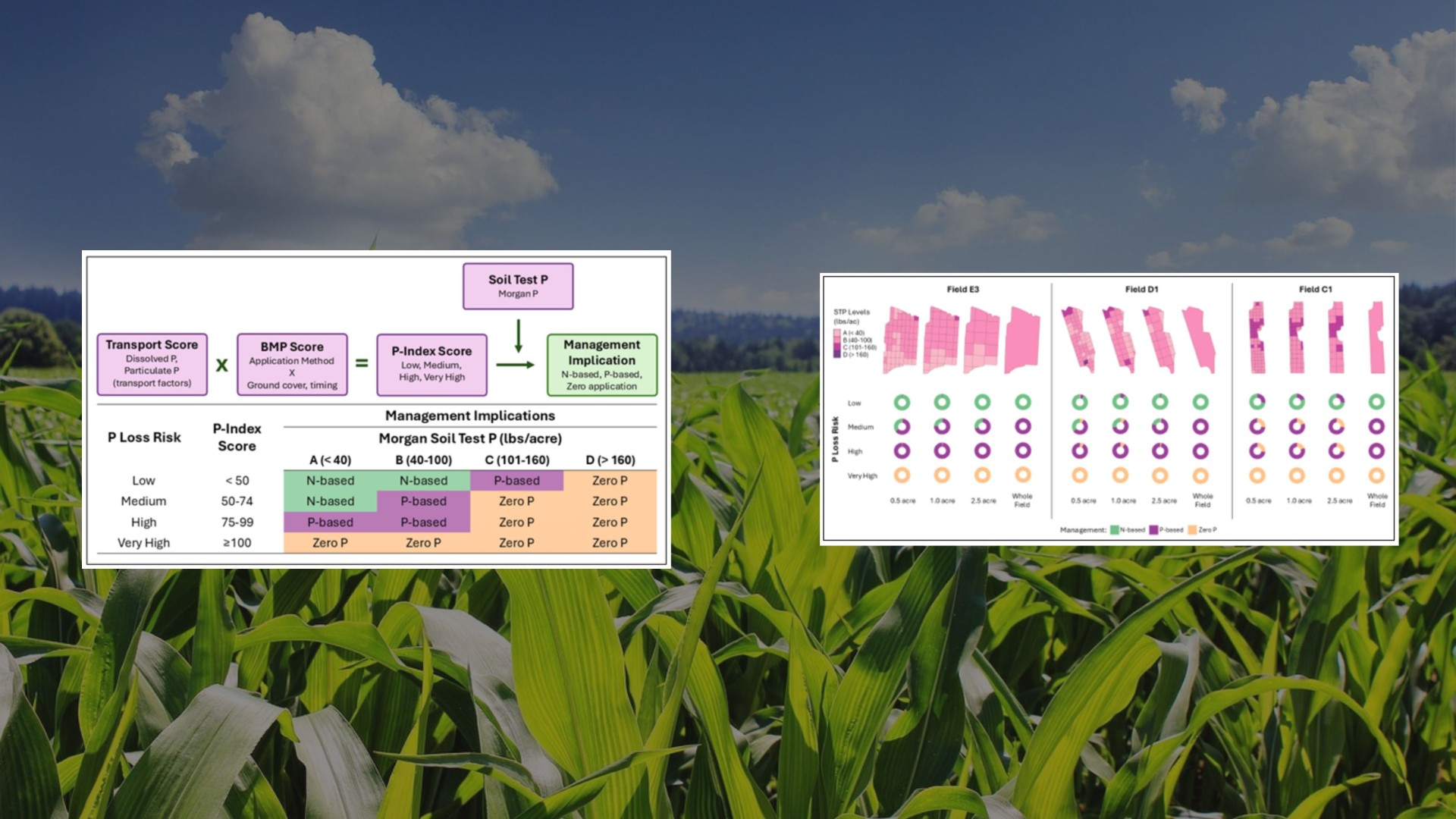
The team evaluated soil test P results for 0.5, 1.0 and 2.5 acre grids at each of the four different P-loss risk levels (low, medium, high and very high P loss risk). 

So, what did they find?

Manuel Marcaida III, NMSP data analyst and lead author on the publication, stated “Grid sampling for P management was most useful in fields with soil test P levels between 40 and 100 lbs P per acre. For fields with uniformly low or excessively high soil test P levels, taking a field composite sample provided adequate information for nutrient management planning.” For those fields where grid sampling was beneficial, a 2.5-acre grid size captured meaningful variability without the added cost of finer grid sampling. 

These findings imply that farmers and crop advisors can streamline their soil sampling without losing the information necessary to determine the P loss risks in their fields — and they can also use this knowledge to guide their future P-index assessments and manage their fertilizer use in a way that accounts for the P-loss zones. 

“Soil grid maps show you the lay of the land — literally — so you can decide whether a single P-Index score is appropriate for the whole field, or if you’d rather break the field into P management zones to maximize nutrient efficiency and minimize environmental impact.”

Marcaida noted that it is best to think of grid sampling for use with the P-Index as a diagnostic tool. “Soil grid maps show you the lay of the land — literally — so you can decide whether a single P-Index score is appropriate for the whole field, or if you’d rather break the field into P management zones to maximize nutrient efficiency and minimize environmental impact.” 

Read more about grid sampling in another recent Cornell CALS article.

Read the full, recently published paper or the extension article.

Madeline Hanscom ‘22 is a communications assistant for the Nutrient Management Spear Program (NMSP).

Keep Exploring

Cropland map

News

The new, high-resolution maps calculate global emissions from croplands by region, crop and source – enabling hyper-local mitigation.

  • Ashley School of Global Development and the Environment
  • Global Development Section
  • Agriculture
A woman smiles, posing for a photo.

Field Note

Hailing from Belize, Gabriela Garcia joined Cornell CALS’ Nutrient Management Spear Program (NMSP) as an intern in January 2026 from Zamorano University , located in Honduras. This semester, she will be working alongside Carlos Irias on the...
  • Animal Science
  • Agriculture
  • Field Crops