Back

Discover CALS

See how our current work and research is bringing new thinking and new solutions to some of today's biggest challenges.

Share
  • Cornell University Agricultural Experiment Station
  • Agriculture

For Kieri Keys ’28, it was love at first sight. Before beginning her freshman year at Cornell, Keys attended the Outdoor Odyssey pre-orientation program, which included a visit to the Dilmun Hill Student Farm

“I was immediately obsessed with it,” Keys said. “The first time that I walked through the farm, it just felt like a calling. I thought they were doing such important work and it was a unique opportunity to be so hands-on, learning from one another.”

Keys spent summer 2025 as one of five undergraduate student managers of her beloved Dilmun Hill, where students have been growing vegetables and building community connections for almost 30 years. The students work full-time over the summer and part-time spring and fall to grow fresh produce for the farm’s CSA, and to sell at farm stands on campus and at Anabel’s Grocery, the student-run grocery store in Anabel Taylor Hall. 

This year for the first time, Dilmun Hill had a manager dedicated to specialty and agroforestry projects, with grant support from the Towards Sustainability Foundation. Sophia Caporusso ’26 oversaw the farm’s shiitake mushroom cultivation, the restoration and expansion of the farm’s paw paw tree grove, and the planting of honeyberry bushes. Though, as with all of the tasks at Dilmun Hill, farm managers and student volunteers all pitch in.

The mushrooms are cultivated on hardwood logs inoculated with shiitake mushroom spawn. Students inoculated 100 logs in May 2024, and they produced their first fruits this summer. Another 30 logs were inoculated this spring, Caporusso said. 

Paw paws are native to the Eastern US and produce large, mango-like fruits with green exteriors and dark yellow flesh. A small grove of paw paws was planted at Dilmun Hill in the late ’90s, but it had been neglected for many years, said Ryan Maher, organic coordinator for the Cornell University Agricultural Experiment Station (Cornell AES), which manages Dilmun Hill and most of the farms and greenhouses on Ithaca’s campus. This summer, CALS alum Bob Meadows ’72 taught farm managers how to graft paw paws to increase fruit production. And Yosef Al Shoffe, senior research associate in the School of Integrative Plant Science’s Horticulture Section led a pruning workshop. 

Honeyberries, also called haskaps, resemble long blueberries, though honeyberries tend to be more resilient and less threatened by pests than blueberries. Dilmun farm managers and volunteers planted 42 honeyberry bushes this spring. They should fruit in a year or two. 

“Dilmun is a really special opportunity for students, especially students coming in with no agricultural experience,” Caporusso said. “I think that’s a big reason the team is so interdisciplinary. We sometimes have people from ag sciences but also from environment and sustainability, people from entomology, we had a philosophy major on our team this year. It’s a really unique group to be in. We're all motivated by different things and the one thing that connects us is that we’re going through it together.”

Molly Christel ’26 is majoring in plant sciences and hopes to have a career breeding biofortified staple crops like maize and rice to combat global hunger. Working at Dilmun Hill has helped her better understand food production from the grower perspective, which she believes will make her a better researcher supporting growers. 

“I was interested in the leadership element of Dilmun Hill,” Christel said “We managers make every single decision from what we’re planting, to where and when, marketing, sales prices. Every accomplishment that we have is our own, but every setback is also ours and we have to own up to it.”

For Maher, Dilmun Hill’s real strength comes from its ability to bring people together, within Cornell and across the broader community, to create more engaged and experiential learning opportunities. For example, local 4-H groups come to Dilmun for tours and demonstrations and farm managers collaborate with the Food Donation Network to share produce.

Dilmun Hill, like all of the Cornell AES-managed farms and greenhouses, also serves as a resource for hands-on learning in courses covering topics like agricultural machinery, soil science and food systems. Cornell faculty and researchers who would like to bring their class to Dilmun Hill can send a request to dilmunhill [at] cornell.edu (dilmunhill[at]cornell[dot]edu)

“I feel like the community-engagement piece of our mission is really important,” Maher said. “The farm serves as a place for students to actively engage with a broader community of practitioners – interested students, faculty, educators, farmers and others. I want people to see the farm as an opportunity to get involved, and the agroforestry work serves as an example of this. It’s a real resource for everybody.”

Dilmun Hill will host a farm tour and field day on Sept. 26 from 4-7:30 p.m. to showcase their new agroforestry projects. A Harvest Fest celebration is also planned for later this fall, date forthcoming. To follow events, learn more about volunteering, apply to be a 2026 farm manager, bring a class or community group to Dilmun Hill, and other opportunities, visit the Cornell AES website


Krisy Gashler is a freelance writer for the Cornell University Agricultural Experiment Station.

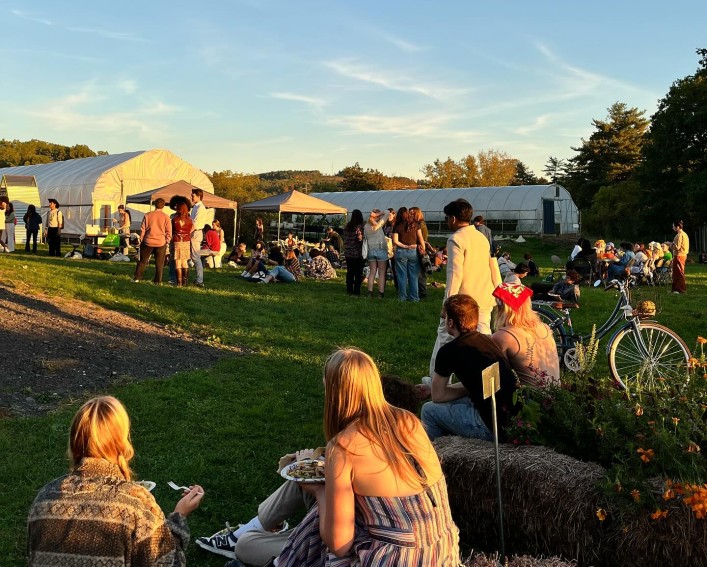
From Sweet to Savory: Dilmun Hill Farm Tour

Friday, September 26, 2025 | 4 - 7:30 pm

Join us at Dilmun Hill Student Farm for a field tour of our emerging agroforestry crops!

Groups of people at a farm

Keep Exploring

Close up of wheat in a field

News

Growing climate-smart crops is half the battle. Consumers need to understand sustainability claims and, more importantly, be willing to pay a premium for them.

  • Charles H. Dyson School of Applied Economics and Management
  • School of Integrative Plant Science
  • Soil and Crop Sciences Section
experimental flasks of flocculent pellets

News

Mycelium, the vegetative, root-like network of fungi, has the power to transform food waste into new, life-sustaining food.

  • Food Science
  • Agriculture
  • Climate Change