Awards
Professor Bruce Lewenstein was honored by the Global Network for the Public Communication of Science & Technology (PCST) with the inaugural award for Advancement of Science Communication as a Professional Field. The award recognizes Bruce’s long career of supporting the development of the field worldwide, including through communication networks (he established the PCST Network’s first listserv and website), research on emerging issues in the field (such as media coverage of biotechnology and nanotechnology), attention to new forms of science communication (such as citizen science), and development of theory-based approaches to teaching science communication. The award was announced at the PCST Network’s biannual conference, held this year in Aberdeen, Scotland.
Graduate student Julia Sebastien received a 2025–2026 Institute for European Studies Graduate Fellowship, a program sponsored by Cornell’s Einaudi Center for International Studies.
Research Associate Kari Waters won the SAGE Award for the best journal article published in volume 25 of European Union Politics. The article is entitled “The EU Commission: Supplying Enforcement and Demanding Compliance.”
Events
Please join us for our Second-Year Projects Presentations on Monday, September 15, 3:00 pm, in 102 Mann Library Building. Four graduate students, Kevin Martinez, Rosie Nguyen, Andrew Restieri, and Julia Sebastien, will present on their research. The colloquium is followed by a reception, located in The Hub of the Department of Communication.
Assistant Professor Wunpini Mohammed will participate in a panel as part of the “Decolonizing Media Narratives on Africa” colloquium. The event presents a keynote presentation and panel that problematizes harmful tropes about Africa. Significant among topics to be explored in the keynote is the way that narratives around war and genocide are framed in news media. The panel will bring attention to the potential of African pop culture to not only challenge stereotypes about the continent but also present the rich tapestry of African cultures. The event takes place on Wednesday, September 17, 3:00–4:30 pm at the Africana Studies and Research Center, Multipurpose Room, and online (requiring registration).
Publications
Research Associate Dominic Balog-Way & Professor Katherine McComas, August 2025, “Unpacking the Risk of Misinformation: A Communication-Based Critique,” Risk Analysis.
Misinformation has attracted enormous attention since around the 2016 U.S. election and Brexit referendum, with many claiming that society is drowning in a sea of fake news and false or misleading statements. This article unpacks and then constructively critiques the dominant way that ‘the risk of misinformation’ has been interpreted by examining the tendency to (i) define the term in isolation from communication, (ii) neglect messengers’ intentions, (iii) perceive audiences as susceptible misinformation recipients, and (iv) reduce communication to a one-way process of misinforming. The authors conclude by arguing that a communication-based approach, grounded in the agency of messengers and audiences, offers a more nuanced and holistic foundation for interpreting and addressing the complex challenges associated with false and misleading messages.
Graduate student Ria Gualano, book review of Children, Deafness, and Deaf Cultures in Popular Media (John Stephens and Vivian Yenika-Agbaw, Eds.), July 2025, International Journal of Communication.
Ria provided a review of the edited collection of essays that situates global perspectives on d/Deaf representations in children’s and young adult media across various contexts.
Assistant Professor Wunpini Mohammed & Siguru Wahutu, June 2025, introduction to the forum, “Interrogating Colonial Narratives about Genocide and War in Africa: Perspectives from Sudan and the Democratic Republic of Congo,” Communication, Culture and Critique.
Western media portrayals of Africa have often reduced this diverse, expansive continent to tropes about hunger, poverty, disease, and war. The essays in this forum section challenge these colonial and imperial narratives about Africa. In this introduction, the authors present the framing of Sudan and the Democratic Republic of Congo in Western media coverage as useful for understanding how Africa has historically been framed in news media reports.
Graduate student Beatrys Rodrigues & André Peruzzo, August 2025, “Real Harassment, Virtual Robots? Exploring Misogyny Against Machines,” International Journal of Communication.
This study analyzes comments on a Brazilian bank’s anti-harassment advertising campaign featuring a feminized virtual assistant “talking back” to offensive users, which sparked widespread backlash on social media. Findings suggest that the artificial intelligence assistant’s deviation from docility disrupts entrenched gender expectations, provoking ironic and hostile commentary tied to broader moral panics about shifting gender norms. The authors conclude that these audience reactions highlight the persistent challenges of introducing feminist interventions in human-machine communication and emphasize the need for more comprehensive strategies to combat technology-mediated misogyny.
Graduate student Ashley Shea…Professor Natalie Bazarova…Associate Professor Drew Margolin, August 2025, “Beyond ad Hominem Attacks: A Typology of the Discursive Tactics Used When Objecting to News Commentary on Social Media,” PLOS One.
In this paper, the authors explore the prevalence of ad hominem attacks and characteristics of other discursive tactics used by people when objecting to online news commentary. Their findings confirm that while ad hominem attacks are the most common discursive tactic used to object to news commentary, people also deploy a diversity of other discursive objection tactics.
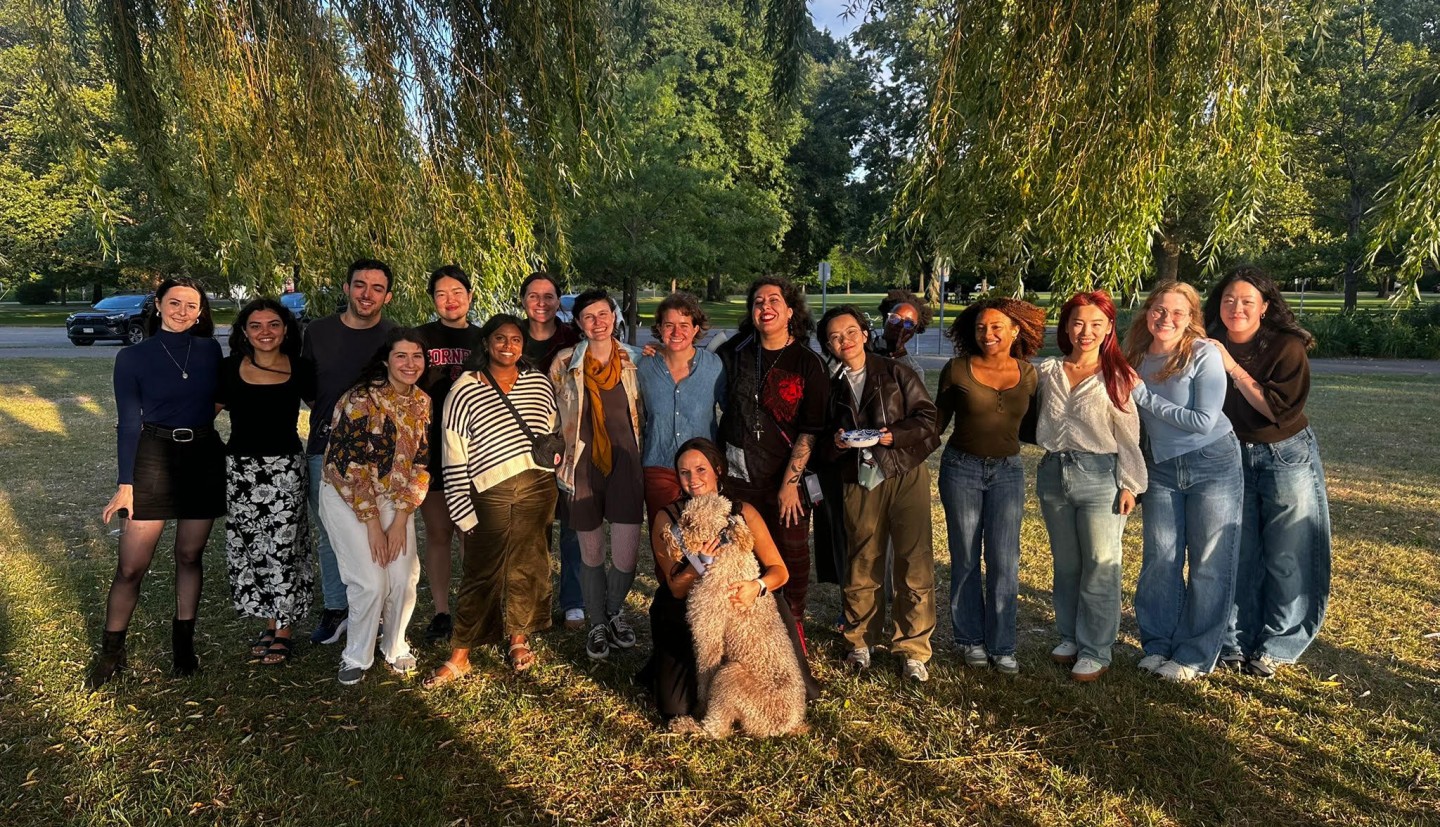
Picture Time!