Back

Discover CALS

See how our current work and research is bringing new thinking and new solutions to some of today's biggest challenges.

Share
  • Animal Science
  • Field Crops
What inspired you to pursue agronomy?

I am Brazilian, and I was raised on a third-generation farm in São Miguel do Iguaçu, Paraná, a small town near the tri-border area with Paraguay and Argentina. 

As a child, I developed a deep interest in agriculture. I grew up raising beef cattle, surrounded by no-till farming systems cultivating corn, soybeans and wheat. This early exposure inspired me to pursue a lifelong career in agronomy.

Could you highlight a few professional and academic experiences that contributed to your passion for sustainable agriculture?

I was fortunate to be admitted to the University of São Paulo, Luiz de Queiroz College of Agriculture (ESALQ). In my third year, I became the coordinator of Projecting Agriculture Committed to Sustainability (PACES), a student extension group focused on field experimentation and organizing conferences.

I also took part in educational technical trips. One of these was an international journey where we visited large farms, companies and universities across Paraguay, Argentina, Uruguay and southern Brazil. Among the farms we visited were Amaggi and SLC Agrícola, the two largest private soybean producers in the world. This experience really broadened my understanding of large-scale agricultural systems and deepened my perspective on Latin-American agriculture.

Why did you decide to pursue a graduate degree and join the Nutrient Management Spear Program?

A key turning point happened during my exchange program at University of California, Davis. While I was there, I had the opportunity to interact with graduate students from many different countries, which helped me realize how impactful and rewarding a research career can be. That inspired me to look for a graduate program that would align with my interests in plant nutrition and offer hands-on, practical experience because that’s something I’ve valued since my childhood in Brazil.

Fortunately, I discovered Dr. Quirine Ketterings and the Nutrient Management Spear Program (NMSP), which combines both of these elements. 

I was excited to learn about the lab's work, particularly projects like the Value of Manure, and the lab’s contributions to the Phosphorus Index and development of nutrient guidelines for field crops. The more I learned, the more excited I became about joining a team that is deeply involved in applied, impactful research. The lab’s mission and dynamic approach resonated with my goals, and I knew it was the right place for me to grow as a researcher.

You’ll be working on the soil test conversion program during your graduate program with NMSP. Can you explain what that means, and why it’s important?

In New York, fertility guidelines are based on the Cornell Morgan soil tests. However, many in-state commercial soil testing labs use the Mehlich-III test as their baseline. Conversion equations were developed when the Concentrated Animal Feeding Operation (CAFO) rules first came in — almost 25 years ago.

Since then, new labs and evolving soil test standards have emerged, and there’s now a need to revisit and update these conversion equations. That’s the project that I’m taking the lead on —  the 2025 Soil Test Conversion Program.

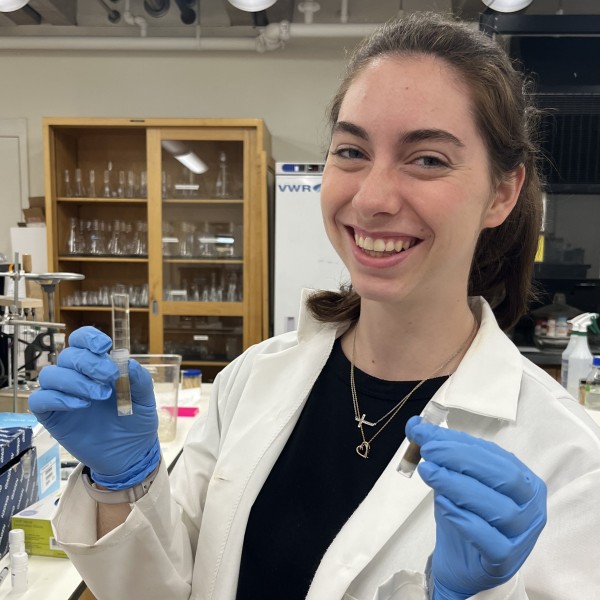
My role this year will involve collecting soil samples from farms across New York State, representing different soil types and series. Then, I’ll process these samples and submit them to labs that want to participate in the program. I’ll work with the data once the lab analyses come back. 

As of now, I’m already processing the first 100 samples that came in while also working with consulting firms, Cornell Cooperative Extension and the Soil and Water Conservation District staff to complete the sample collection.

What are you looking forward to the most, personally and professionally?

The opportunity to connect research with practical application and to engage directly with New York’s farmers and consultants to learn from their experiences and build a collaborative network. More than that, I hope to grow both personally and professionally throughout my master’s, learning from mistakes and successes, with the support of the NMSP team.

What is your long-term career goal?

I want to become a researcher who effectively connects theory with practice, and who is prepared to address the changes and challenges that agriculture and farmers will face in the coming years — both in the United States and in Brazil. I’m confident that NMSP will help me achieve this through the hands-on extension opportunities it offers.

Keep Exploring

A group smiles around a poster.

News

For a two and a half decades, NMSP has worked to support farmers with sound science, and made strides when it comes to on-farm research and extension. Led by Quirine Ketterings, NMSP focuses on the big picture when it comes to agriculture and...
  • Agriculture
  • Field Crops
  • Dairy
Mark Sorrells, professor of plant breeding and genetics stands in a barley field

News

LakeEffect, the first winter malting barley released by the Cornell Small Grains Breeding Program, produces high yields, is disease resistant and has a good malting profile, researchers in the School of Integrative Plant Science said.

  • School of Integrative Plant Science
  • Plant Breeding and Genetics Section
  • Plant Pathology and Plant-Microbe Biology Section