

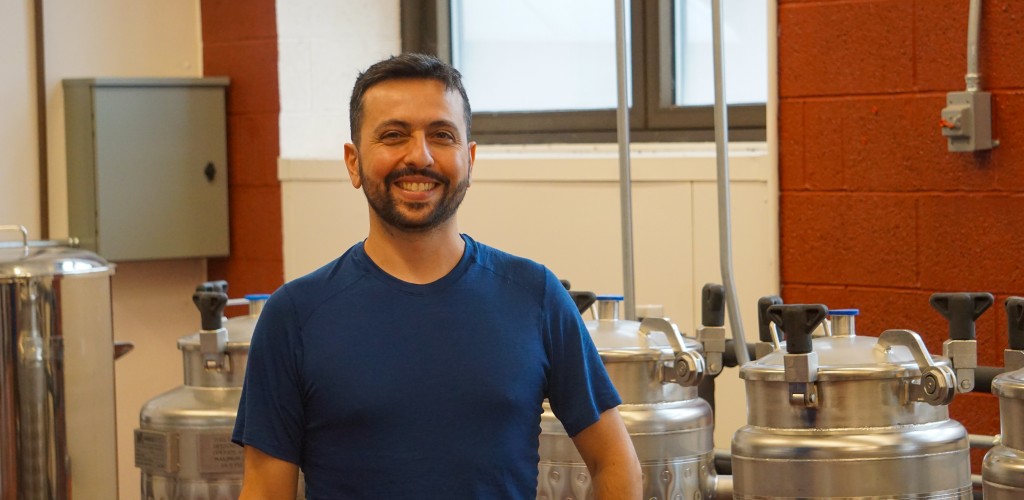
The craft beverage industry in New York state is booming, and Cornell AgriTech has hired a new extension associate to coordinate diverse brewing and distilling extension programs that support craft beverage professionals statewide through education, resources and essential services.
Frank Addeo joined the Cornell Craft Beverage Institute (CCBI) in June. Formerly he was a director of the Craft Brewing and Distilling Program at South Puget Sound Community College and provided quality assurance and quality control support to area breweries, wineries and distilleries.
In New York, the number of breweries has surged from 95 in 2012 to 535 in 2023. Breweries can be found in every county in the state, and more than 400 acres of hops are being cultivated. With the addition of Addeo, CCBI will be able to grow programs that benefit brewers, distillers and farmers.
“Until now, we primarily worked with wineries and cideries, but fruit fermentation is completely different from grain fermentation,” said Anna Katharine Mansfield, associate professor of enology and head of CCBI. “The new position will offer outreach and support to brewers similar to what is provided to wineries. This was a gap we needed to fill, and Frank will be able to expand our programs, run analyses and answer questions from brewers.”
Chris Gerling, senior extension associate at CCBI, noted that much of the growth in New York state brewing has been with very small breweries.
“These small breweries don’t have the same kind of support the larger ones have. They don’t have their own laboratory, they don’t have their own quality people, infrastructure, support,” he said. “We felt that quality control resources for these people in the industry was essential.”
With Addeo on board, CCBI also will be adding programs and support for the distilled spirits industry.
“The spirits industry is in a different place from brewing,” Addeo said. “This is due in part to the timing of development for each craft, but one commonality is the active establishment of logistical networks, which is typical for any growth of a new industry. There are overlaps: Some distilleries produce grain and malt-derived spirits and will seek the same suppliers as breweries.”
For both industries, CCBI will participate in industry events and offer short-form courses and workshops that range from ingredient quality assessment to social media marketing.
Originally from Brooklyn, Addeo earned his bachelor’s degree in fine arts from Marist College, a master’s degree in sociocultural anthropology from Columbia University and a second master’s in biology from Central Washington University. While completing his certificate in craft brewing, he worked as a research brewer for a hops broker in Yakima, Washington, which, he said, gave him insight into the perspectives of hop growers as industry producers. Addeo said his interest in brewing came from his fascination with how food and culture interplay in societies.
“I spent years working in Europe and Mexico, where food was an essential part of gathering and affirming collectivity,” Addeo said. That led to his study of food preservation methods and traditions for vegetables, kombucha and kefir. He began making beer at home before deciding to pursue a career in the field.
Cornell alumnus Derek Edinger ’94, M.Eng. ’95, who with his wife, Stacey, owns Brewery Ardennes in Geneva, New York, said he is excited about the hire and is looking forward to working with CCBI. “Making great quality beer is, of course, of utmost importance, and we’re all very conscientious about what we’re doing and how we’re doing it,” he said.
Echoing Gerling’s sentiment that smaller breweries haven’t had the resources for testing and research that larger breweries have, Edinger said access to the laboratory will be a help on the process side of beer making.
“They can help us test the quality of the beer,” he said. “We want to make sure the beer has all the properties we think it does, things like the percentage alcohol, the amount of hoppiness.”


