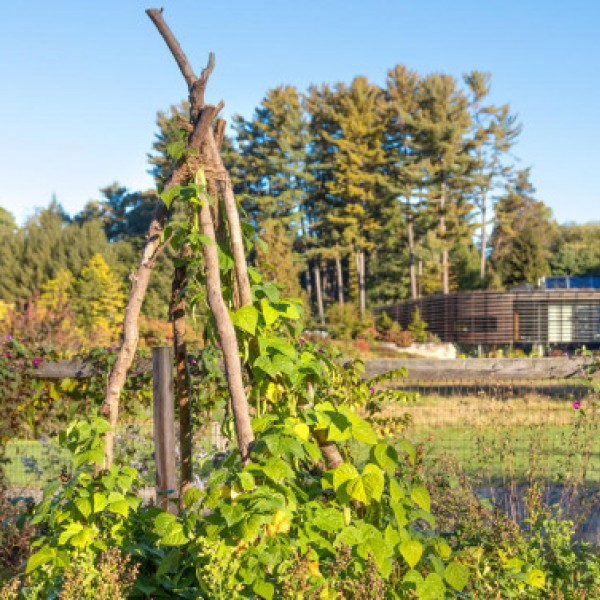
“I think the opportunity to actually do research in the field, get your hands dirty and work with plants really set the program apart for me,” said Theodore Lee, an undergraduate at Cornell’s College of Agriculture and Life Sciences. “At AgriTech, there are hundreds of acres of fields, with endless research happening at any given time. It’s the perfect place for students to fully engage with agricultural science.”
In recent years, projects in the program have become more innovative as digital agriculture initiatives at Cornell AgriTech have expanded.
“This year in particular we had a number of students getting experience in digital agriculture and computational approaches,” said Kyle Wickings, associate professor of entomology and director of the program. “Whether using drones to look at plant system quality or sensors to assess plant health or soil health, undergraduate students got to look at research through an innovative lens, and that’s important if we want to keep students excited about ag and food careers.”
Projects in business development in entrepreneurship are also new to the program. Over the past couple of years business students have worked with the New York State Center of Excellence to develop business plans for food products.
While working with the center, Paige Warren, a student from SUNY Morrisville, had the opportunity to collaborate with the Cornell Maple Program to create a sports drink made with maple syrup. Experts from both programs helped Warren develop the product and create a business plan. At the end of the internship, Warren presented her plan and provided samples to Cornell AgriTech faculty and staff.
“The most valuable part of the program for me was learning to grow and develop a business from the ground up,” said Warren. “I not only learned from Cornell experts but from an entrepreneur’s standpoint, because I was able to connect with local maple producers as part of the program.”
More than 300 students have participated in the program since its founding, and it has played a key role in attracting and preparing undergraduates to continue on as graduate students on the Geneva campus, as well as supporting the agriculture talent pipeline in New York state and beyond.
“I was a Summer Research Scholar in 2018 and have been at AgriTech ever since,” said Victoria Hoyle, a Ph.D. student on the Geneva campus. “The welcomeness, mentorship and support of faculty, graduate students and fellow summer scholars was ultimately why I became so drawn to AgriTech and decided to come back. Many of my lab mates were summer scholars as well. I will forever be grateful for the opportunity and connections that [the program] allowed me to make.”