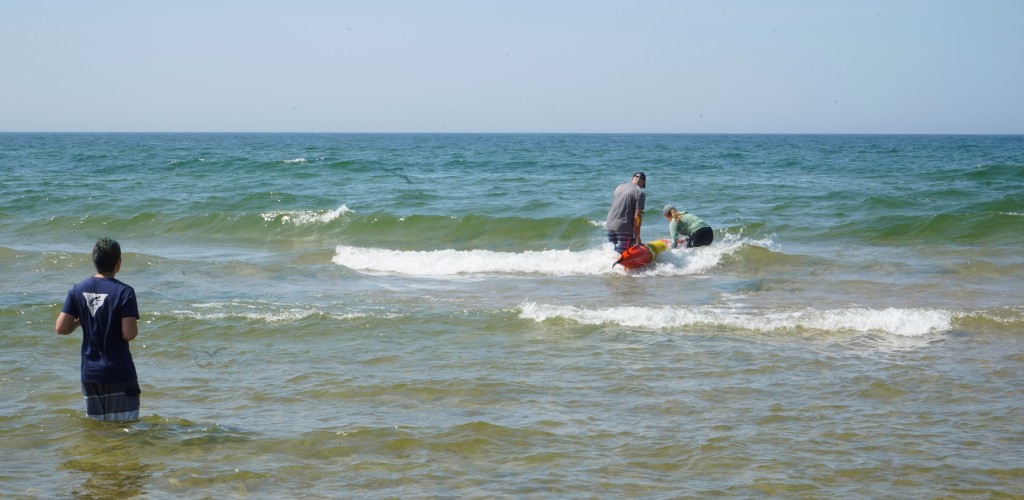
As part of a multiyear grant funded by the USGS exploring questions around bias in acoustic surveys, four drones were deployed in Lakes Erie, Huron and Michigan. Two of the drones are sail and solar powered surface vessels (Saildrones), which will explore fish avoidance in traditional acoustic surveys, and attempt to provide correction factors if it occurs. Two other drones, long range autonomous underwater vehicles (LRAUVs), will survey waters in Lakes Michigan and Erie.
One LRAUV has both up- and down-looking echosounders and will explore the surface and bottom acoustic dead zones. These regions cannot be surveyed by traditional down-looking acoustic units mounted to vessels and their effects on fish density estimates from acoustic surveys is not fully understood.
The second LRAUV will follow behind the first and sample eDNA at different depths to determine if drones can be used to apportion acoustic returns to different species in Great Lakes surveys. Such work could make it possible to use fully automated surveys and make the Great Lakes a leader in automated drone usage.